Category Archives: 05-Creating & constructing good solutions

Using creative problem-solving techniques, asking “So what?” to get out of the weeds and to the point, stress-testing recommendations for logic, evidence & practicality

Keep yourself from walking the plank: How to Make Great Decisions for your Organization

Group Decision Making
Making great decisions for your organization

Bain & Company published an article, “How Organizations Make Great Decisions” by Michael Mankins and Jenny Davis-Peccoud. Mankins and Davis-Peccoud claim that organizations whose decisions fail are due to dysfunctional processes.

Through their experience, they found that firms which established a “structured approach to decisions, one that ensures agreement on criteria, facts, alternatives, commitment and closure” are successful in making great decisions. These companies not only have high-quality decisions and execution but their enablers allow the decision process to move smoothly and quickly.

Every company’s structured decision approach is going to differ based on company culture and governance but they should include five critical elements: criteria, facts, alternatives, commitment and closure.
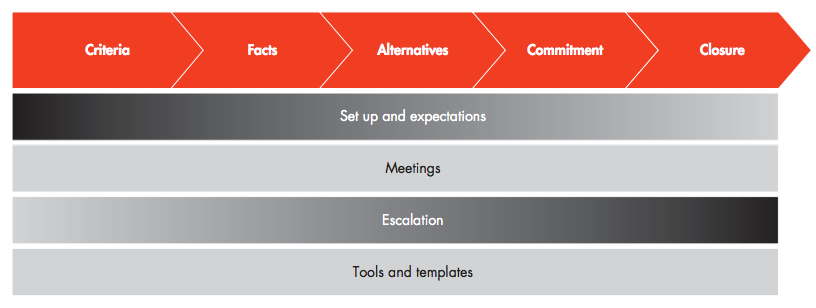
Critical Elements
The five critical elements of structured decision making and the enablers that support them
  1. Criteria: Know the goal of your decision and clarify the criteria for making the decision. For example, if the firm wants to give an end-of-month discount offer for customers, the goal will be to increase end-of-month sales by 15%. The criteria tells us whether the decision to offer a discount was effective.
  2. Facts: Find the precise facts you need to understand the scenario, create alternatives and come to your decision. If the facts directly relate to the decision making criteria, you can use the data, there is not a need to find all data available.
  3. Alternatives: Evaluating alternatives improves the quality of decision making. Ask the recommender, “What alternatives did you consider and reject and why?”
  4. Commitment: The group must commit to the decision. Hopefully everyone agrees on it as well, but once the decision is made, all parties must support the decision for it to succeed.
  5. Closure: Making the decision and committing to it is only the first step. Without communication of the decision, taking responsibility for execution, setting timelines for Implementation, and creating a feedback loop to monitor the performance of the Implementation, the decision will not happen.

The last element spoke to me the most. Often decisions at my company are made that are not properly implemented. The decisions are executed poorly and never reach their intended effect. Or the decision fades away and is never implemented.

In my opinion, the last element could be the most time consuming part of the decision making process. It is imperative for management to work through the challenges facing the implementation, monitoring the feedback loop for the decision’s progress. If the decision is not achieving its desired result, management must act quickly to adjust the implementation.

Mankins and  Davis-Peccoud identified four ways that companies can enable great decisions:

  1. Take the time to plan, prepare and implement the decision
  2. Do not try to accomplish everything in one meeting
    • Discuss operating reviews and strategy conversations separately
    • Discuss facts, alternatives, and make the decision in separate meetings
  3. Only escalate if necessary and have guidelines to know when decision making escalation is necessary
  4. Use company created tools and templates for many, if not all, strategic decisions

My main take-away from the four enablers is to not use one meeting to accomplish all steps of the decision making process. For a large decision that affects many people, it is better to focus on each step of the decision making process separately. At first this sounds like too many meetings to come to a decision. However, if Mankins and Davis-Peccoud are correct, setting a meeting for each stage of the decision making process will keep the process moving and allow management to consider the facts, alternatives, make the right decision, and set the implementation plan.

My department is currently considering changing how we approach software implementations. We want to be seen more as marketing consultants than software trainers. I am going to take this decision making approach to my team and ask that we use this process as we go through changing our implementation strategy.

Dig Deeper to Solve the Underlying Problems

For the sake of switching things up, I thought that I would share with you a show that really knows how to “dig deep” (pun completely intended) into the things that we often take for granted. If you have the time and are interested in finding ways to approach problems in a very different and unique way, I highly suggest you watch “Going Deep with David Rees” on National Geographic (the show just started airing a couple of weeks ago).

Why does this matter and how does it apply to this course? Sure, the topics may seem silly, ranging from learning how to tie a shoe to creating the perfect ice cube for your scotch, but the show does a great job at taking a simple concept and really understanding the components that go into it. Let me explain one of the episodes to help give you some better insight. The steps are rather detailed, but that’s really the point.

How some of us think about digging a hole:

    1. Grab a shovel.
    2. Dig.

How David Rees thinks about digging a hole:

    1. He first addresses the problem and what he’s looking to accomplish (he wants to build a “party hole”).
    2. David went to an experimental mine at the Colorado School of Mines to understand how these subject matter experts dig holes in the mine. From there, he determines that digging a hole into a rock is too dangerous for him and as a result the scope of his project changes.
    3. He goes to a soil biologist to figure out the best combination of sand, silt, and clay to dig the perfect hole (medium loom).
    4. David then goes to visit “Dr. Shovel” at Penn State University where he tests out a number of shovels to determine which ones are most efficient for him to use. From there, he learns that you actually need a couple of types of shovels for different stages of a dig.
    5. David learns that the hole he designed was actually flawed and potentially dangerous if he doesn’t “shore up the sides.” This discovery makes him adapt and change his original plans.
    6. So where does he go to learn how to shore up the sides? He goes to a golf course to learn how to keep his hole intact.
    7. From there, David goes to a cemetery to meet with a professional digger to learn better techniques on how to dig a hole. They first mark down the location and dimensions of the hole they are going to dig.
    8. He then goes to Harvard University to understand how the field mouse burrows a hole. There, he learns that these field mice dig much faster when they dig together instead of alone. As a result, David learns that he will be much more efficient if he has his friends help dig the hole with him.

Whether you’re a project manager, part of the product development team, or your manager asks you to give a presentation on the dynamics of your competition within the industry, you can use some of the analysis and problem solving skills that are utilized throughout this show. That, and you may get a good laugh out of the show as well. And you thought digging a hole was easy?

Spoiler alert. He ends up digging his party hole.

Tiny Data: Not An Excuse

When I got my first job as a Process Improvement Engineer for an industry leading company in their flagship facility, my first question to their production manager was: “Where’s the historical data on the process we need to improve?”. His answer was: “Well I know how many pounds of potatoes we usually put in, and I know about how many bags of potato chips come out the other end.”

How could such a sophisticated, industry leading company have so little knowledge about their own processes? Four years later, reflecting back on all the companies I have worked for and had exposure to, few have had the ‘big data’ that is such a popular topic of today’s data analysis discussions.

How do those us us who have only, ‘Tiny Data’ or incomplete data use it to make better decisions and improve out businesses? The first article posted below cites an Army Colonel’s experience:

“Look,” said the colonel, “if I’m on a battlefield trying to defend a hill and I get a piece of intelligence, even if I’m not 100 percent sure that it’s accurate, I will make decisions based on that intelligence.” He strongly believed that it’s better to have some information than none—and that you’d be a fool to disregard it just because it falls short of being definitive.

There are many ways to utilize small amounts of data, incomplete data, and varying quality data. You must find ways to fill in the gaps, determine the variance of the quality, and find ways to draw meaningful conclusions and areas to investigate more fully with small amounts of data.

Branch out and be creative, because a little bit of information is better than no information and is no excuse for simply accepting the status quo.

When Big Data Isn’t An Option

Small Data Analysis

How to Analyze Data With Low Quality or Small Samples 

Managing Virtual Teams

We often have to work with people in different cities in my business, and sometimes even different time zones! It can be a huge challenge to coordinate work with people you usually don’t see on a day to day basis.  It seems like more and more companies are moving to teleworking, so I thought it would be good to go over some key tips on managing a virtual team:

1) Organize regular meetings with individuals as well as the team as a whole.

This doesn’t have to be in-person; a phone call or Skype can be just as effective. The main thing is you want to make sure everyone is on the same page. The team needs to feel cohesive and like they are all “in the loop” on what’s happening. We do daily “show calls” with all of our team members in Abu Dhabi, London and here in Atlanta. While this may not be feasible for every team, even a set weekly/monthly phone call can be good to foster communication and a sense of inclusiveness.  A phone meeting is also a good way to address any team problems out in the open.

2) Rotate locations: Try to make sure members spend some time physically with the team in their home base, even if all members can’t all be there at once.

This is a critical part of getting a team to work together effectively. Once you put a face with that voice on the phone, you form a  personal connection with that person. It’s also good to see how people function differently while working in the same room. This gives you the opportunity to confront any workflow or personnel issues. This would also be a good time to help the team bond through a social activity, games, etc.

3) Recognize cultural sensitivity.  Be aware of cultural differences on your team so you can head off any potential issues.

I work with people from a variety of backgrounds and walks of life. It is so important to be aware that people often have very different styles of communication and management.  A good way to head off issues is to make the team aware of the expectations for communication and conflict resolution. For example, a manager could instruct team members to mediate conflict themselves, before rushing to upper management to handle the situation.  Team building exercises and cultural awareness classes could also help.

The biggest takeaway I got from this article is the importance of having good communication!  It’s not easy managing a team flung across different cities or countries. But the team will work a lot more smoothly if everyone is kept in the loop, and any problems are dealt with quickly and transparently.

http://www.forbes.com/sites/iese/2013/06/20/managing-virtual-teams-ten-tips/

The ‘Right’ Strategy For Business Intelligence?

Companies often look for templates or real world examples when it is time to bring a business intelligence system online. While they try to mimic a company similar to theirs, each organization is faced with their own respective needs and challenges. One commonality does exist in most roll outs as the strategy standard; involving end users and thinking big but starting small. This article discusses the best implementation strategy that is shared among companies.

Involving the users allows there to be early buy in from many members of the organization and it promotes the benefits immediately.  With many ideas flowing about, the implementation team is well prepared to deliver the best system. Additionally, pilot programs to test this system in are critical. Mass roll outs without the proper testing can lead to various issues and each department usually has its own pace to adopt these technologies.

Timelines allow for organized planning but its really the end user acclimating to the new system and providing feedback which will determine how long this implementation can take.  Does anyone have any other advice that may complement this over arching advice?

Data Visualization – Tableau

For starters, check out this video

I sometimes struggle with conveying my analysis (say, in Excel) into a presentation (say, in PowerPoint). The best way to capture the attention of your audience and to deliver an effective presentation is through data visualization. No matter how sound and detailed your analysis, if it is not communicated well to your audience then all of your hard work in performing that analysis was wasted.

Presenting data in a visual format can often be the quickest and most effective ways to convey results of your analysis and capture the attention of your audience. This can communicate a message that may have taken hours to develop in a matter of seconds if done correctly.

One of my favorite new data visualization resources that I am learning to use is called Tableau. Tableau is a software company that was founded in 2003 and does nothing other than data visualization. The company had sales of $34.2 Million in 2010 which grew to an astonishing $232.44 Million in 2013 and the company went public. It is now traded on the NYSE (ticker: DATA). It is extremely intuitive and the product looks amazing. Here is a great video that gives you an overview of the capabilities of Tableau (also linked above).

There are some really revolutionary and interesting methods to communicate data visually that are becoming more and more accepted in business and is thought by many as a way for companies to distinguish themselves among their peers. Often times my company might be similarly positioned to perform work for a given client, and I have seen that a lot of the work we have “won” has come from an effective pitch that highlights the strengths of our organization in a visually compelling manner that engages the client and shows that we can “give meaning to numbers” which is a skill that is hard to quantify.

I would be curious to get any thoughts on your experience with data visualization software and any recommendations you might have.


Other helpful data visualization links:

http://www.scientificamerican.com/article/the-data-visualization-revolution/

http://blogs.hbr.org/2014/04/the-quick-and-dirty-on-data-visualization/

http://fortune.com/2011/11/15/how-tableau-software-makes-business-data-beautiful/

Crowdsourcing Principles

When someone thinks of the idea of “Crowdsourcing,” their first thought may be Kickstarter or some very successful micro-lending organizations.  Crowdsourcing for financial support has been hugely successful.  For example, LeVar Burton has raised more than $5MM to bring back the PBS “Reading Rainbow” program via apps. (http://bostonherald.com/entertainment/books/2014/07/levar_burton_s_kickstarter_campaign_brings_hit_pbs_show_app_to_).  On the more ridiculous side, over 1,000 people have contributed and promised to buy the Ostrich Pillow, a pillow you put your head inside to sleep in public (http://www.businessinsider.com/the-most-ridiculous-idea-to-ever-get-funded-on-kickstarter-2012-10_)

Crowdsourcing can be used within your company to solve a wide range of problems.  Often a company that has a “flat corporate structure” where opinions and contributions from all employees are valued have a better chance of innovating.  Effective digital platforms and campaigns cater to the Gen Y workforce that most companies want to attract today. Social networks and transparency are something that this generation takes for granted and they want their work-lives to enhance their digital experience.  The key to fully taking advantage of your workforce is to manage the massive amount of data that can be generated.  Having an issue “champion” to manage the process is the best way to begin.

An employee platform will also help companies identify effective opportunities for additional training, advancement and retention that will amount to huge savings, build reputation and attract the best talent in the long run.  Businesses are losing out on innovative employee contributions if they are not creating a way for employees to freely share ideas for improvement. Organizations are even presenting operating challenges to intra- multidisciplinary teams for new perspectives and problem solving.

Deciding what issues should and should not be posed to the entirety of a workforce is important.  However, some of the most complicated issues deserve the most options.  This is new space for older companies but one worth exploring.


Scenario Planning In The Transportation Industry

Atlanta traffic for some of us is a an hour commute or more each day, which can be hampered by construction or accidents. Whether traveling to school or daily job, we can admit that some portions of the city need serious infrastructure investments but we do not see any progress. Public and private sector stakeholders all need to be aligned on objectives and long term planning, yet due to different agenda’s these companies are far apart.

The HBR below discusses the rise of  Freight Flows, an initiative of convening conversations and achieving alignment, and the importance of ‘scenario planning’ in the transportation industry. Scenario planning helps develop point of views for the future and prepare users for a range of possible outcomes rather than placing all your eggs in one basket for one specific prediction. This type of planning helps bring together disparate parties and  effectively ensures that the best capital investments today will best for long term projects.

Delaware Valley Regional Planning Commission (DVRPC) created a web based mapping application to track freight movement throughout the region and the impact it will have on transportation.  DVRPC now intends to use this application as the starting point to educate business and other regional stakeholders on the insights  on other infrastructure projects. Scenario planning is sponsored by the National Cooperative Highway Research program and will help guide the allocation of funds to projects. Stakeholder conversations has become a barrier to continual development of US transportation systems but this strategy could pave the way around that obstacle.

http://blogs.hbr.org/2014/07/to-see-eye-to-eye-on-infrastructure-use-scenario-planning/

Differentiating on Customer Service

We all had some frustrating experiences with customer service representatives in our lives. Fortunately, I did not experience anything as severe as the one recorded example below by with a Comcast representative.

How much of the recorded conversation is the employee’s fault and how much is it the company’s? Obviously the representatives are not trained to react this way, but surely the “let’s-keep-a-customer-at-any-cost” strategy influences the representative’s behavior.

Why, in 2014, some companies are still able to differentiate themselves from the competition by providing great customer service? I would think that in our day and age, good customer service should be the standard, especially with the viral effect social media has on extreme customer experiences (good or bad). Why don’t Comcast’s management provide a better set of guidelines and solutions to their representatives? Why can’t you get the best deal (from any service provider) without dropping the “I’m leaving” bomb?

The switching costs are decreasing in the TV-provider industry. I now have an option to choose from four different providers, up from one (guess who) four years ago. Do you think Comcast is going to revamp their customer service strategy soon? Or can they keep it as long as they still have a monopoly in many markets?

Any part of the recording will do the trick, but to get the full effect please listen to the entire thing.
http://www.huffingtonpost.com/2014/07/14/the-comcast-call-from-hell_n_5586476.html?ncid=fcbklnkushpmg00000063

The Art and Science of Problem Solving in Any Business


Many of you have been encountering any type of problems to solve for your workplace. I have been dealing with different types of problems over last 15 years, mostly should provide engineering solution to clients. As one of team members or project lead to work together with other colleagues to confront complex issues, I should sometimes develop the solid and comprehensive methodology to overcome internal conflicts. In order to do that, I should have adapted particular skills and processes to achieve team objective, valued business and engineering solution to clients.

I am always seeking and researching for tips and techniques for problem solving – from structuring problems to delivering solutions. I found two short articles which I think useful to share with my MP cohort.

The first article is “Art and Science of Problem Solving in Any Business” and second one is “the most 4 effective ways leaders solve problems” Two authors made two valid points for problem solving skills. The first is “People & Management” and second is “Strategy and Opportunities”.  The People & Management is that a great many problems are actually due to policies and processes being reinterpreted by management as they’re being implemented, which in turn causes confusion about how and when things are supposed to be done. The Strategy and Opportunities is that  defining the problem, as well as in dealing with it in such a way that you not only resolve the immediate issue but use the opportunity to improve your business as strategy. They are very simple and straight-forward thoughts. But, I have overlooked them in the process of establishing the project team and scope as well as delivering final solution to management team.

The Art and Science of Problem Solving in Any Business

The 4 most effective ways leaders solve problems