A Google search on Microsoft Excel results in hundreds of websites that offer advice on Excel. There are hundreds of businesses that can teach you how to use Microsoft Excel and hundreds of thousands of YouTube videos explaining Excel tips and tricks.
Although there are software applications available for accounting, finance, data analysis, project management, and forecasting, Excel is a forerunner for these business functions. Most businesses want their managers to have a basic, if not advanced, understanding of Microsoft Excel.
Yet, there are dangers in relying too heavily on Excel, especially if the advanced understanding of Excel is unknown by the company’s management team.
In “Microsoft’s Excel Might Be The Most Dangerous Software On The Planet” Tim Worstall described when JP Morgan’s CIO (in 2012) called upon a quantitative analyst, “a London-based quantitative expert, mathematician and model developer”, to create a new value-at-risk model for a synthetic credit portfolio. The analyst’s “advanced” techniques involved copying and pasting data between several Excel spreadsheets. This manual process left room for error, several errors in fact, which cost JP Morgan several billion dollars.
Despite the availability of automated technologies to double check databases and equations (especially when dealing with billions of dollars), top management of large, public companies still rely on Microsoft Excel.
UK Regulators, the Basel Comittee on Banking Supervision (BCBS) and the Financial Services Authority (FSA), were quick to respond to the incident. In his article, Vic Daniels said the BCBS and FSA “made it clear that when relying on manual processes, desktop applications or key internal data flow systems such as spreadsheets, banks and insurers should have effective controls in place that are consistently applied to manage risks around incorrect, false or even fraudulent data.”
This is an eye-opening lesson for budding managers. A lesson in communication and how to oversee projects worth billions of dollars but also a lesson about understanding the tools a company uses and how they should be used in company projects. To me, the scenario illustrates an important reason for me to learn Excel. With Excel skills, I can create and manage my own projects as well as double check my team members’ projects to prevent errors such as JP Morgan’s. There are other tools that can be used for managing data but I’m going to start with Microsoft Excel.
Bain & Company published an article, “How Organizations Make Great Decisions” by Michael Mankins and Jenny Davis-Peccoud. Mankins and Davis-Peccoud claim that organizations whose decisions fail are due to dysfunctional processes.
Through their experience, they found that firms which established a “structured approach to decisions, one that ensures agreement on criteria, facts, alternatives, commitment and closure” are successful in making great decisions. These companies not only have high-quality decisions and execution but their enablers allow the decision process to move smoothly and quickly.
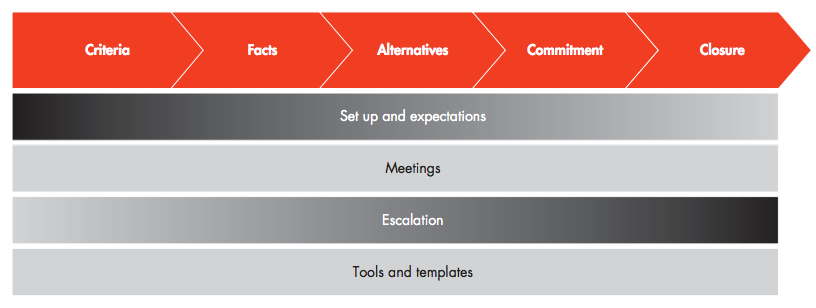
Every company’s structured decision approach is going to differ based on company culture and governance but they should include five critical elements: criteria, facts, alternatives, commitment and closure.
The five critical elements of structured decision making and the enablers that support them
Criteria: Know the goal of your decision and clarify the criteria for making the decision. For example, if the firm wants to give an end-of-month discount offer for customers, the goal will be to increase end-of-month sales by 15%. The criteria tells us whether the decision to offer a discount was effective.
Facts: Find the precise facts you need to understand the scenario, create alternatives and come to your decision. If the facts directly relate to the decision making criteria, you can use the data, there is not a need to find all data available.
Alternatives: Evaluating alternatives improves the quality of decision making. Ask the recommender, “What alternatives did you consider and reject and why?”
Commitment: The group must commit to the decision. Hopefully everyone agrees on it as well, but once the decision is made, all parties must support the decision for it to succeed.
Closure: Making the decision and committing to it is only the first step. Without communication of the decision, taking responsibility for execution, setting timelines for Implementation, and creating a feedback loop to monitor the performance of the Implementation, the decision will not happen.
The last element spoke to me the most. Often decisions at my company are made that are not properly implemented. The decisions are executed poorly and never reach their intended effect. Or the decision fades away and is never implemented.
In my opinion, the last element could be the most time consuming part of the decision making process. It is imperative for management to work through the challenges facing the implementation, monitoring the feedback loop for the decision’s progress. If the decision is not achieving its desired result, management must act quickly to adjust the implementation.
Mankins and Davis-Peccoud identified four ways that companies can enable great decisions:
Take the time to plan, prepare and implement the decision
Do not try to accomplish everything in one meeting
Discuss operating reviews and strategy conversations separately
Discuss facts, alternatives, and make the decision in separate meetings
Only escalate if necessary and have guidelines to know when decision making escalation is necessary
Use company created tools and templates for many, if not all, strategic decisions
My main take-away from the four enablers is to not use one meeting to accomplish all steps of the decision making process. For a large decision that affects many people, it is better to focus on each step of the decision making process separately. At first this sounds like too many meetings to come to a decision. However, if Mankins and Davis-Peccoud are correct, setting a meeting for each stage of the decision making process will keep the process moving and allow management to consider the facts, alternatives, make the right decision, and set the implementation plan.
My department is currently considering changing how we approach software implementations. We want to be seen more as marketing consultants than software trainers. I am going to take this decision making approach to my team and ask that we use this process as we go through changing our implementation strategy.
Often it is easier to go somewhere or achieve something if there is a plan in place to direct us, a map toward the goal. Many frameworks have been developed to assist people in solving problems creatively. These models lead to the same goal, an implementation of a solution.
In the 2009 article “Towards a More Realistic Creative Problem Solving Approach”, Jan Buijs, Frido Smulders, and Han van der Meer summarize creative problem solving frameworks from the 1960s and then introduce their own variation.
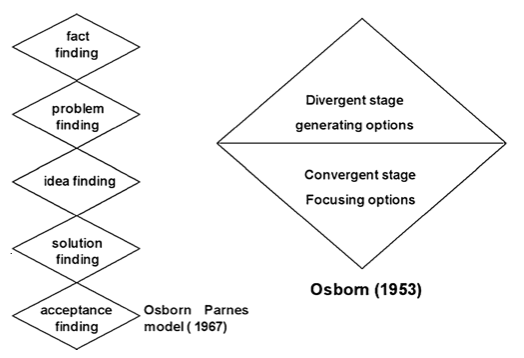
“Creative Problem Solving” (CPS) was first established in 1967 by S.J. Parnes based on the 1953 work by Alex Osborn. Osborn also developed and promoted the concept of ‘brainstorming’ as a tool to solving problems.
The Classical Five-Stage Creative Problem Solving Model. Source: Parnes, 1967
As Buijs writes, further analysis of the Osborn Parnes model brought up questions such as: is CPS truly a linear model? Does the model focus on American culture and isn’t representative of CPS in other cultures? Is the model too content oriented?
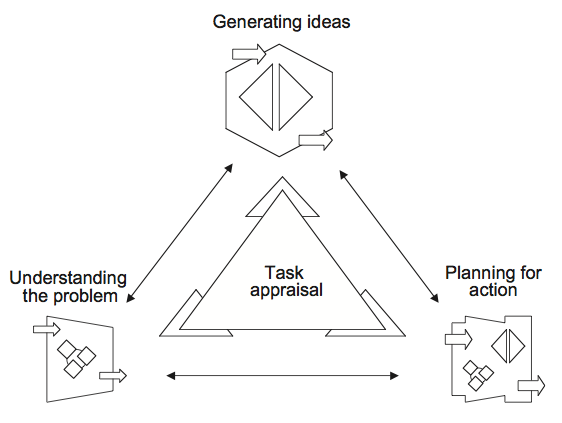
A subsequent model was created in 1993 by Isaksen and Dorval. This model moved away from the linear logic to more circular logic that leaves room for steps to be revisited.
The Ecological Creative Problem Solving Model. Source: Isakesen & Dorval, 1993
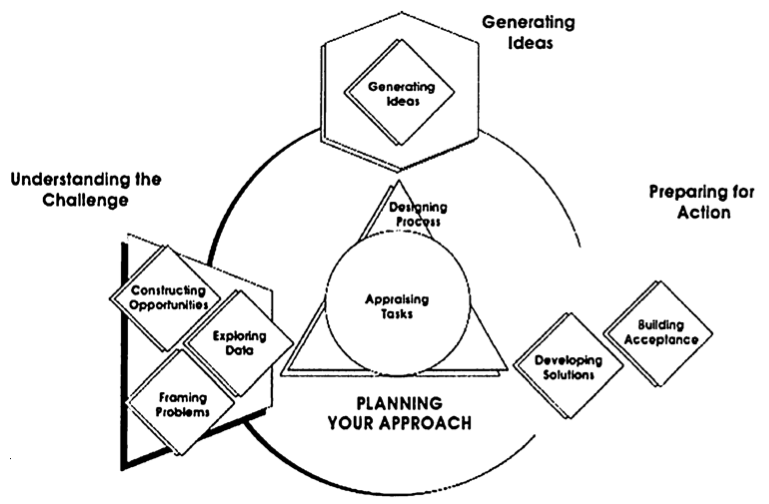
In Isakesen’s 2004 iteration of his CPS model the steps remained interdependent but the steps do not have to occur in a specific order. Isakesen also included subprocesses for each of the original steps.
Version 6.1 of the Creative Problem Solving Model. Source: Isaksen & Treffinger, 2004
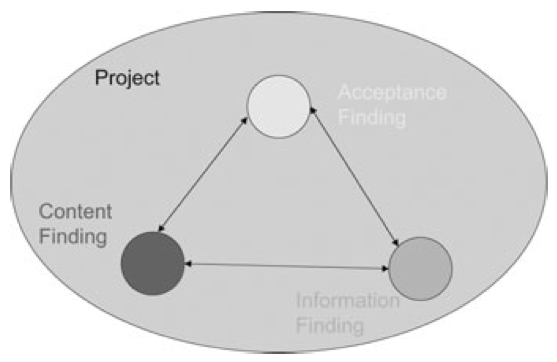
Based on their research, Buijs and team believes the Parnes Osborn CPS model does not offer a complete framework for effective problem solving. In their article, the team introduces a new Creative Problem Solving model. This model is a four-element approach described as “three parallel sub-processes: Content finding, Acceptance finding and Information finding, plus one overarching fourth process: Project management.”
Findings from the Bio-Case: Three Interdependent Processes Concurrently Managed. One Integrated Project – Content Finding, Acceptance Finding and Information Finding. Source: Buijs, 2009
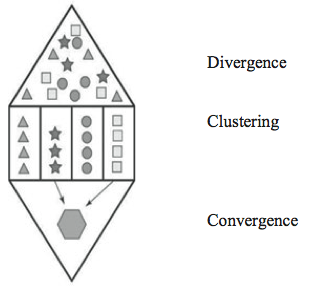
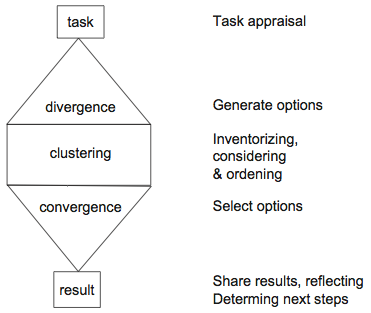
As Buijs explains, “the three parallel processes of Content finding, Acceptance finding and Information finding not only influence each other, they are also mutually dependent.” Together the results of the processes are under the umbrella of the Project Management process which acts “as an overall task appraisal for the total CPS and innovation project, as well as managing all activities in this project.” Each of the three sub-processes “start with their own specific task appraisal, followed by the divergence, clustering and convergence steps and end with a reflection on what has been achieved.” The images below illustrate the flow that occurs in each of the three processes.
The Diverging – Clustering – Converging Module
Buijs claims this model will make CPS more realistic because “in executing one (sub)- process the need for starting one of the other processes is embedded,” they are completely interdependent, not linear.
While it seems odd to create a process for promoting creativity and innovation (something that seems spontaneous and unwilling to conform to processes), this model supports the identification of an innovative solution but also encourages the implementation of the project so the great solutions found during the process are actually implemented.
I believe this is a framework that I can use to start solving my business problems. A project management tool with methods for creative problem solving. In the next week I will use this framework for CPS and see if it meets my everyday needs for finding creative solutions.
———-
Problem Solving In Practice Update: Last week I stated that when an issue was presented to me, I would take the time to understand the issue prior to developing solutions. The beginning of the week was rocky. Twice I thought too quickly and misunderstood questions asked of me. Both times the team members restated themselves and corrected the assumptions I had made by responding without fully listening to their scenarios.
Later in the week, a complicated client request was made of me, a delicate issue regarding one of the people I manage. I was careful to take time to fully understand the situation. I called the client, asked them contextual questions to know the extent of the issue and asked for their preferred solution. After the call, I took time to think of a couple solutions, discussed them with a fellow manager and decided on a solution. I felt more prepared and satisfied with the solution when I shared the response to the client because I had taken the time to fully scope the situation prior to thinking of solutions to their request. Progress!
Sources:
Buijs, J. (2007) Innovation Leaders should be Controlled Schizophrenics. Creativity and Innovation Management, 16, 203–10.
Buijs, J., Frido Smulders, and Han van der Meer (2009) Towards a More Realistic Creative Problem Solving Approach. Creativity and Innovation Management, 18, 286–98.
Isaksen, S.G. and Dorval, K.B. (1993) Expanding Views of CPS: A Synergy Methodology. In Geschka, H., Moger, S. and Rickards, T. (eds.), Creativity and Innovation, The Power of Synergy, Darmstadt, Proceedings of the 4th European Conference on Creativity and Innovation.
Isaksen, S.G. and Treffinger, D.J. (2004) Celebrating 50 years of Reflective Practice: Versions of Creative Problem Solving. Journal of Creative Behavior, 38, 75–101.
Parnes, S.J. (1967) Creative Behavior Guidebook.
Scribner, New York.
One of my two selected topics focuses on solutions.
A Treasure Map of Solutions
In my preliminary research, I ran across an article in Business Insider, “Nine Steps to Effective Business Problem Solving” by Martin Zwilling. As Zwilling writes, managing any company is all about problem solving. Every employee at every level of the company is constantly evaluating issues and scenarios, coming up with solutions, and implementing them to benefit the company and customers. However, just because everyone participates in the decision making process does not mean everyone has a natural proclivity at finding the best solution for the problem.
In my case, I struggle with ‘solving’ an issue before the person presenting the problem has finished speaking. I need to develop a method where I can process the problem, understand the underlying issues, and identify a couple possible solutions before I jump to a single answer.
Based on Brian Tracy’s “The Power of Self-Discipline,” Zwilling defines the decision making process in his words:
Take the time to define the problem clearly.
Pursue alternate paths on “facts of life” and opportunities.
Challenge the definition from all angles.
lteratively question the cause of the problem.
Identify multiple possible solutions.
Prioritize potential solutions.
Make a decision.
Assign responsibility.
Set a measure for the solution.
Looking at Zwilling’s descriptions of each separate step and my weaknesses, the areas I can most improve when finding a solution are: pausing to understand the problem (no jumping to conclusions!), defining the root cause of the problem, prioritizing potential solutions, and measuring the solution.
These are the four pieces of the decision making process I will research and share in subsequent blog posts. Four pieces that I will use to create my own map of finding ‘golden’ solutions to problems.
Along with further research of the topic, I will be putting my research into practice while at work. My first practice is recognizing when I need to make a decision and simply taking a step back to fully absorb the situation and context of the problem without jumping to conclusions. Look for a story on how I handle this test at work in a subsequent post.

 Many frameworks have been developed to assist people in solving problems creatively. These models lead to the same goal, an implementation of a solution.