Tag Archives: Communication

How do you Team?

I personally have found that every project I start I find myself re-integrating with a new team. On one project I may be working with a local group of people I know well and the next day (or even a few minutes later) the team I work with may have oceans between them both geographically and in our experience/knowledge base. I find myself constantly searching for a new role to play on each team. Every time the team changes, new expectations or even demands are imposed upon me.

Being able to succeed in these constant environment changes isn’t easy; it demands that I develop myself to be flexible in the roles I play on each team. I cannot always be the best communicator or the best analyst or the best manager; I may be assigned projects for which I am the least knowledgeable person on the team. Yet, I need to always find a role to play that adds value if I am to be successful.

In Amy C. Edmondson’s blog she describes “The Three Pillars of a Teaming Culture” that fuel successful teams in this rapidly changing environment. She states that we should create a culture of; curiosity towards each team member’s abilities and knowledge, be passionate about the task at hand to motivate cooperation and be empathetic enough to not only hear but rather comprehend other opinions.

These three “pillars” have already helped me re-think the way I approach my constantly changing environment. By listening and engaging more with the people I am working with, we have collectively gained an understanding of where each other’s frustrations and inspiration comes from. We are exponentially increasing the quality of work we do collaboratively and independently, as we are now able to gather thoughts, debate them and decide on a direction more efficiently without hesitation.

Do you think the three pillars can help you get more out of yourself and your team? Are you able to constantly find a way to bring value to a changing environment? Do you feel that working in a team is making you more productive? Do you teach others, learn from others or truly collaborate as a team? How do you team?

More on the 3 pillars:
http://blogs.hbr.org/2013/12/the-three-pillars-of-a-teaming-culture/
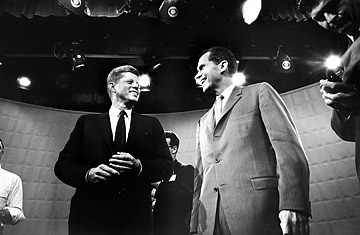
How the Nixon-Kennedy Debate Changed the World

“It is not simply what we say, but how we say it, and how we look while saying it.”

360_presidential_debate_0924

Jack Kennedy, left, and Dick Nixon before their 1st TV debate.

Today, I attended a training course on communicating assertively. It was filled with a lot of great takeaways, and the focus was around adapting your approach towards others for optimum results. The instructor brought up the three “V’s” when communicating with others: verbal, vocal, and visual. It is primarily the vocal (tone) and visual (appearance, facial expressions, body language) that impact communication. Together, these two V’s count for 93% of the impact. Of course, this is context dependent, but the statement led one of my colleagues to mention the famous Kennedy vs. Nixon debate.

In case you are unaware, this was the first presidential debate ever broadcasted on TV. The debate of course was also broadcasted on the radio, and for those listeners who were polled, more said that Nixon was the winner than Kennedy. For those who were lucky enough to watch the debate on TV, more said that Kennedy was the winner. The conclusion—Kennedy’s visual appearance and presence was superior to Nixon’s, and this made him the clear winner, at least to those who watched it on TV.

I was not around for this debate and have not had a chance to watch it yet, but from what I have read, some words used to describe Kennedy after the debate were handsome, dapper, calm, confident, and poised, while Nixon was described as sickly, clammy-faced, awkward, and sweaty. We all know that Kennedy went on to win the presidency, and many believe that this televised debate was what took him from a young, relatively unknown senator to a star in one night.

After hearing this story, I searched for some articles about this debate to investigate. Some argue that the polls used were not statistically significant, and I will leave that up to you to decide. In the end, I do believe that when it comes to communicating and presenting, tone and body language influence the verbal message. It is not simply what we say, but how we say it, and how we look while saying it. We all need to take this into consideration when presenting for impact.

Interesting Time Article on the debate and its impact on the world.

SCHUTZER, PAUL. Democratic and Republican presidential candidates Jack Kennedy, left, and Dick Nixon stand underneath glaring lights prior to beginning their 1st TV debate. Digital image. How the Nixon-Kennedy Debate Changed the World. Time, 23 Sept. 2010. Web. 14 Aug. 2014.

Being Intentional with your Data and Giving your Graphics a Voice!

I have a particular interest in evaluation in the workplace– the evaluation of employees, work output, employers, etc. In the types of programs I’ve been in, I have found in very useful. However, I’m sure that most companies don’t have the time to thoroughly evaluate their work in a systematic and organized way. I have always worked in the research/higher education end of business, and so I don’t personally have experience with how evaluation works in the corporate setting.  How does evaluation look like in your industry or company?

A few years ago, I came across this site and I have been a fan ever since. The group is called Evergreen Data and they focus on intentional reporting and data visualization. I work in public health/higher education, and the public health industry is very data-heavy. Data in public health is used for analysis, program planning, grant opportunities, research, etc. and so I have seen the benefits of its use in my industry. What does your company do with its evaluation data?

This particular site had a checklist on how you should layout your evaluation reports which I’ve found super helpful! The purpose of the checklist is to help identify what parts of an evaluation report can be enhanced through the use of graphics.

Here are some of the items they had in their checklist:

  • Text font and size (sans serif and size 9-11)
  • Text uniformity
  • Line spacing (between 11-13 points)
  • Headers/callouts
  • The number of different types of fonts that you should use (no more than three!)
  • Don’t make too “strong” or “bold” of bullet points
  • Alignment (be consistent!)
  • Make sure that items in page that are grouped together are related
  • Utilize white/empty space!
  • Use of pictures/graphics – individuals learn differently from one another
  • Use color changes for a purpose (are you being intentional by choosing to change the color of a font or header?)

Evergreen also has an additional checklist that’s used for data visualization. It’s specific to making your graphs speak for themselves! This is a great resource as well.

What are some of the tips you have when creating reports (not exclusive to evaluation reports)? What steps do you take to have your data share a “story” or a “point”? Are you intentional in your decisions in terms of report layouts, font, graphics, etc.? Do you find that you have to pay more attention to this? 

How to pitch to VCs, and why accounting does not matter

While most of our class was enjoying accounting, I had a pleasure of taking Charlie Goetz’s Entrepreneurship class.  Charlie is a fascinating person – full of energy and entrepreneurial spirit , he could survive anywhere. He is also extremely successful, building multiple business from the ground up and selling them to wealthy investors for large sums of money (including a business that exclusively sold french fries).  While working  on a project in  his class, I finally realized that it is not just about ideas and execution – Charlie’s pitch and presentation were keys to his success. One might have the best idea and great execution – but if you can’t sell it to real people, especially people with money and connections, all those ideas will be worthless.

One presentation that each entrepreneur hopes to have is a pitch to a venture capitalist – that means your idea made it past the idea stage, and you have an opportunity to make it big. If you can sell your idea to a venture capitalist, you can sell your presentation to anyone, whether it is your boss,  Professor Noonan,  or even Dean Lewis. So how does one prepare for this presentation – “the Money Game” section at WSJ has few tips:

Present Yourself:

Modesty does not pay. Each presentation, whether to a venture capitalist or to your classmates, is a lot like a date. People want to know something about you,   they want to know why they should listen to you.  Going to straight to your presentation is a lot like like going on a date and saying “Let’s get it on”.

–  Tell it to mom:

Keep is simple.  Steve Jobs once said:

“Simple can be harder than complex: You have to work hard to get your thinking clean to make it simple. But it’s worth it in the end because once you get there, you can move mountains.”

When making a presentation, keep it simple and understandable. It is always easier to send more information to ones who need more details,  but once you loose your audience, it is impossible to get them back. One caveat – the assumption needs to be clearly explained, and your pitch needs to be grounded in reality.

Don’t Play with numbers:

Integrity is paramount. Whether pitching to a VC or your Boss, you cannot undermine their trust. A lot of presenters try to focus on the positive, but what one needs to show is they have though of the negatives and have a plan to address it.  It absolutely necessary that your audience can trust you.

Stay on the radar:

In class, the presentation may end on the day of the class. Yet in the real world,  this is just a start – persistence pays off.  Even if you receive a no at the first pitch, you should keep in touch with the investor.

Your can read the rest of the article at WSJ.

PS. Accounting is crucial to business, and multiple accounting scandals of the 2000s certainly proved that.  However, the is always a CPA when you need an accounting advice, but you are the one who needs to make the pitch.


Tips for Leading or Attending Your Next Staff Meeting

Staff meetings. We know the drill. I think we’ve all had experience with good ones, and ones that are just plain awful.

In my experience, staff meetings have served a number of different purposes: updating others on the progress of projects, decision-making, feedback on work, getting insight from team members, problem-solving etc. The success of those meetings depended on the number of people who attended, how prepared individuals were when they went to the meeting, knowing the purpose of the meeting, and knowing the end goal of the meeting—not be confused with “what” the end goal is going to look like. For example, before you go into the meeting, you know that you want to come out with a solution to your most recent sales issues with a customer—you don’t know what that solution may be until the end of the meeting.

The following tips are from an HBR blog post about the most common mistakes that are made when trying to run a staff meeting. I’ve summarized them below:

  1. There’s no clear objective. To avoid this, make sure the objective of the meeting is clear so that “participants […] know what to expect and how to prepare.”
  2. There’s no focused agenda (despite having a clear meeting objective). This means that the agenda items are unclear (and not detailed enough). Speak to attendees beforehand to determine what exactly they want to discuss and how much time to allot to them.
  3. Not everyone in the room has a chance to speak. Ask directs questions, give “the mic” to them to speak, let the interrupters know they’ll have their time to speak = more engagement from everyone.
  4. Endless debates without a conclusion. This goes back to Mistake #2. If folks have an idea of what the agenda is beforehand, then they can come prepared with data to back potential arguments or provide useful feedback.
  5. Not reaching a consensus on an action item. Before you leave the meeting (or soon after), identify what’s supposed to be done, who is supposed to do it, and when it’s supposed to be done by.
  6. No remembering to give “kudos” to individuals. Towards the end of the meeting, make sure that you still recognize certain individuals or teams for their efforts. Help bring everyone’s efforts and hard work full circle—remind them of the overall goal.

Now I wanted to ask you…

  1. What “mistakes” have you made in a meeting?
  2. Based on your experience, what tips do you have on leading a successful meeting?
  3. What do you do just before a meeting? Right after a meeting?

Presentation Tips from Stand-Up Comedians

Stand-up comedians are some of the best public speakers around. They ooze confidence and make it look easy, and if you follow these tips for success, you can succeed in the business world, too.

  1. Know your audience. Would you give an X-rated stand-up routine to a church group? In business, would you give an overly technical presentation to a group of executives who don’t understand (or care) about all the details? I didn’t think so. It is very important to understand the context of your presentation.
    • The culture: What communication style do they prefer? From what starting point or base of knowledge do the people in the room have? In the business world – is it an internal presentation to superiors, to your direct reports, or is it external to members from a certain industry? Knowing the culture will help you relate better to the audience.
    • Their level of knowledge: Is English the native language of your audience? If not, keep the phrasing simple and speak clearly, but don’t insult them either by talking very loud and very slow. Are you giving a training to a room full of beginners? Avoid overly technical phrasing and start from the beginning so the whole audience can understand where you are coming from.
  1. Practice, practice, practice. So much of stand-up comedy is in the timing and the delivery. If you are telling a story in the wrong order or blurt out the ending out of sequence, the joke will fall flat.
  2. Don’t force it – be yourself. Dave Chappelle doesn’t pretend to be anyone other than himself, so why should you try to act like someone you’re not? The audience can gauge authenticity quite well, so it’s best not to pretend to be someone different than you really are.
  3. Be likeable. The audience is rooting for you to succeed. Who wants to go to a comedy show where all of the comics crash and burn? In the same way, you should understand the audience, come across as genuine and confident, and don’t be afraid to stumble. If you slip up, chances are that the audience hasn’t even noticed.
  4. Watch out for hecklers. Know your facts and figures well enough to be heckled. Whoever will be asking you questions at the end or in the middle of your presentation may be analogous to a heckler at a comedy club. Be confident and knowledgeable enough to respond succinctly but firmly to keep the presentation on track. Not all questions in a business presentation are from would-be-hecklers, so it is important to distinguish the two.  Stay on your toes. You never know who might be about to throw a (metaphorical) shoe at you like this guy did to George W. Bush.

Inspiration:

http://www.trainingmag.com/content/supercompetent-speaking-tailoring-your-presentation-your-audience

http://www.mrmediatraining.com/2012/04/25/want-to-learn-public-speaking-try-stand-up-comedy/

https://www.youtube.com/watch?v=I1g35RNrsoU

http://thecomedybook.wordpress.com/tag/presentation-skills-2/


Are you a Leader or a Manager?

I took a class in undergrad about “Servant Leadership” by Robert Greenleaf. I started questioning the difference between a manager and a leader, and have been intrigued by the concept ever since. As I was interviewing for my current position, I was questioned as to what type of leader I would be in the organization.

I pondered, and proceeded to explain the type of manager I would be and the skills that I would bring to the table. I described that I did not feel that someone could place me in the role of “leader”. It was a position that others saw me as based on how they felt about my abilities. They would make the decision to follow, I could not decide that for them.

I stumbled upon this article in the Wall Street Journal regarding this very topic. It discusses the importance of differentiating between a manager and a leader as the concept of the knowledge worker becomes more profound in our society.

“The leader originates, the leader challenges, the leader is an individual, the leader focuses on people.”

Take a look at the article and see how your natural characteristics fall into the spectrum. I believe that leadership is a way of life. It’s a characteristic that exudes from you, both in the professional world and your personal life. Leaders are the people that I select as mentors. The fact that I have placed them in that position in my life re-iterates how I feel about their ability to lead and challenge me.

My father is a mouthy, Italian businessman with salt and pepper hair. He has drowned me in the business world from a very young age. Along the way, I have gathered a few Tony-isms from him about this matter:

“You can promote people and make them managers, but you cannot make them leaders. That trait is who you are. When it comes out, people will know.”

“The person who knows how and why will always have a leg up on the person who only knows how or why.”

He’s a deep fellow.

Decide the type of position you want to hold in the lives of your co-workers, and work towards being looked at in that light. These abilities will alter the way you present, the way you communicate, and the way you analyze situations.

I leave you with one final Tony-ism: “Be cautious not to take too much advice.”

Christine

Managing Virtual Teams

We often have to work with people in different cities in my business, and sometimes even different time zones! It can be a huge challenge to coordinate work with people you usually don’t see on a day to day basis.  It seems like more and more companies are moving to teleworking, so I thought it would be good to go over some key tips on managing a virtual team:

1) Organize regular meetings with individuals as well as the team as a whole.

This doesn’t have to be in-person; a phone call or Skype can be just as effective. The main thing is you want to make sure everyone is on the same page. The team needs to feel cohesive and like they are all “in the loop” on what’s happening. We do daily “show calls” with all of our team members in Abu Dhabi, London and here in Atlanta. While this may not be feasible for every team, even a set weekly/monthly phone call can be good to foster communication and a sense of inclusiveness.  A phone meeting is also a good way to address any team problems out in the open.

2) Rotate locations: Try to make sure members spend some time physically with the team in their home base, even if all members can’t all be there at once.

This is a critical part of getting a team to work together effectively. Once you put a face with that voice on the phone, you form a  personal connection with that person. It’s also good to see how people function differently while working in the same room. This gives you the opportunity to confront any workflow or personnel issues. This would also be a good time to help the team bond through a social activity, games, etc.

3) Recognize cultural sensitivity.  Be aware of cultural differences on your team so you can head off any potential issues.

I work with people from a variety of backgrounds and walks of life. It is so important to be aware that people often have very different styles of communication and management.  A good way to head off issues is to make the team aware of the expectations for communication and conflict resolution. For example, a manager could instruct team members to mediate conflict themselves, before rushing to upper management to handle the situation.  Team building exercises and cultural awareness classes could also help.

The biggest takeaway I got from this article is the importance of having good communication!  It’s not easy managing a team flung across different cities or countries. But the team will work a lot more smoothly if everyone is kept in the loop, and any problems are dealt with quickly and transparently.

http://www.forbes.com/sites/iese/2013/06/20/managing-virtual-teams-ten-tips/

People don’t care how much you know until they know how much you care.

Business success can be defined in many ways – achievement of a firm’s goals and vision, cost reduction, successful strategy implementation, meeting revenue goals, etc. Firm-wide, team based, or individual, not matter your goals or desired outcome, a key success factor is one’s ability to build strong relationships with colleagues, managers, clients and often competitors.

Ed Wallace’s Business Relationships that Last: 5 Steps for Transforming Contacts into High-Performing Relationships proposes that every relationship is built on a foundation of three essential qualities – Credibility, Integrity, and Authenticity.

  • Credibility – the quality that makes other believe in you, your words, and your actions
  • Integrity – being trustworthy in our actions and character
  • Authenticity – being truly genuine and honest with our clients about who we are and what we know

Each aligns with a core tenant and value of the EvMBA program – each difficult to teach or develop in any student (or employee). Each quality requires a level of self-awareness and reflection that can be easily lost in the core or elective MBA curriculum of finance, statistical modeling or product and brand management.

Wallace provides a framework for developing high-impact relationships and introduces a number of activities to spark your thinking about who your key relationships are, what “blockers” are currently holding you back, and actions to take to strengthen your key relationships in a proactive way.

It’s a good and quick read. (Maybe a good one for August, as it’s ~200 pages cover to cover)

Would love to hear your ideas (and actions) on how you build and develop relationships with key stakeholders, colleagues and acquaintances.

Managing [Remote] Teams

Remote work is a passion of mine. Since 2007 I’ve worked remotely in multiple jobs and in multiple capacities. Yikes — that’s 7 years of self-discipline, Skype calls, and lunchtime showers.

While I do not have any direct reports, I’m a Senior Project Manager, which means for every one of my 33 projects, I manage a copy writer, designer, data manager, implementation specialist, and client team — none of whom are in the same state as I am, let alone down the hall.

I’m always looking for ways to improve team work, manage better, and communicate clearly. All of these skills need to be at a different level when there’s no face-to-face, but some of them can translate to an office environment.

Jana Rhyu wrote a blog post on LoopUp that hits several familiar points on managing remotely that I’d like to share with you.

1. Hire the right people
Jana gives some tips on what “the right people” are. You can probably guess “autonomous self-starters” lead the list of good remote employees, but did you know that introverts are some of the best remote employees? Extroverts tend to shrivel without that face-to-face and introverts shine.

Our method of hiring the right people includes a company favorite interview, affectionately called the “Why You Don’t Want to Work Here” call. People think that working from home will be a cakewalk, until they get on this call with a random five people from across the various departments of Fire Engine RED. We tell them things like “your home will be your workplace, so some days you might hate your house,” “your friends will not understand/believe you’re working when they have a day off and try to swing by,” “your spouse will try to ask you to do errands because you don’t have a commute,” “you’ll check your email before you eat breakfast and later realize you’re starving and it’s suddenly 2pm,” and “your boss will still give you work because s/he can’t see your full plate.” It’s a relatively fun call, but a sobering one at the same time.

What would you have on your WYDWTWH call?

2. Get the right tools
Tools for telecommuters are tools for everyone. If you don’t have an IM program in your office, you might consider bringing one in. Shoot a message to a colleague when she’s on the phone and get a response, or ping someone on another floor to see if they got your file.

Google Docs is something I can’t live without. Even in an office it just makes sense to have certain documents shared and thus have the newest version accessible (and editable) on the go.

The list in the article is longer and I definitely use every one and a few more. Ask any MP team member of mine who had a long commute spared for a group project.

3. Communicate regularly
The curse of telecommuting isn’t a lack of communication, but rather an over abundance of communication. Christine Shealy wrote about The Communication Loop and I can tell you that with all your team members able to reach you on your IM, your cell, your home phone, your email, Skype, and by text, that loop gets closed! You can be on a client call but you’ll still be expected to respond to an urgent message about another client.

I’m not sure I’d recommend all the regular meetings in the blog post (what’s the point of a bi-weekly call if you already have a weekly meeting?) but regular meetings to go over progress, outstanding items, and potential problems is a must.

Meeting just to meet, however, is a pet peeve of mine. In very busy seasons with dozens of projects going at once, I understand meeting every other day to keep each ball in the air. Still, it’s great practice to cut unnecessary meetings to once a week so as to not negatively impact productivity.

4. Set the tone
“Be willing to get and give feedback” is the most important on this list, followed closely by “be direct”. I’ll let you read through these points and comment below on what’s most important in a remote or office environment.

Link to the original blog post: http://loopup.com/blog/communicating-effectively/managing-remote-teams-top-4-tips/