Welcome MEMBAs!

This site will be the home of our own course blog, which we’ll update and populate with our own contributions between now and our Capstone experience in May 2017.

In our course Blackboard site, I’ve posted the detailed instructions for registering your account, and for creating, editing and posting an article. I’ll keep the previous students’ contributions posted for a while longer, to help you get a sense of how our own blog will develop over the coming months. (Take some time to browse – there are some great ideas and resources represented here, as well as good examples and models of effective blog posts.)

Not enough time in the day… or week or year

A few weeks ago my manager said “I love your inclination to take on a new projects and your willingness to move your schedule around”. I thought that was great… till she continued on to say “what we need to figure out is how I help you get it all done in time”… ending with “once I get something from you I do know it will be good work”.

Yes! You probably noticed that I had just been sandwiched. While I would have have preferred a more direct feedback method, I do agree with her remarks. I need to get better at managing my projects so I can more consistently deliver on time. To be completely transparent, this is not the first, second or 100th time I have heard that. It’s time to do something about it…which based on past efforts isn’t going to be easy.

Now that I’ve identified the issue at hand, I need to go gather data, analyze it and come up with a solution (sound familiar?). I decided to start by speaking with people I had worked with in the past to get more feedback. I’m sorry to say they all said the same un-helpful thing “Omry, that’s just who you are…”, only strengthening my thoughts on how hard making this change is going to be. I continued by comparing my project management style to others doing similar work. I noticed the expected… they all have project lists, they all have clear due dates/schedules set for each project and they all get their projects in on time. I may not be great at it but I do have lists and schedules, I just apparently have trouble sticking to them. I needed to search more and decided to turn to my trusted searching tool “Google”. I searched and searched through what seemed to be hundreds of pages… till I came to a page called “50 Tricks to Get Things Done Faster, Better, and More Easily”. 50 was a bit much, especially for someone who already can’t find time for everything, but a few tricks caught my attention:


Ubiquitous Capture: Everything needs to be documented! Whether I have an idea for a project or think of something that needs to get done, it needs to be written down. At first this sounded like a lot of work, but because I can do this on my phone and don’t have to care about grammar, it only takes a few seconds and I can jot things down anywhere I go.


80/20 by 50-30-20: This is a combination of two tricks. The first is the realization that 80% of results come from 20% of the work and therefore I should spend my time accordingly. The second is that in my project prioritization I should take my own life/career goals in mind. Spend 50% of time on tasks that will have the largest impact on my career, 30% of time on the tasks that advance my middle term career and 20% on everything else.


Do your worst: I shouldn’t expect perfection in every task on the first run. I can always go back to improving it later. Put pen to paper and start a project to see where it goes. The end result will only reveal itself after I have started the process. In simpler words, Stop Procrastinating.

More tricks for getting things done: http://www.lifehack.org/articles/productivity/50-tricks-to-get-things-done-faster-better-and-more-easily.html

How do you Team?

I personally have found that every project I start I find myself re-integrating with a new team. On one project I may be working with a local group of people I know well and the next day (or even a few minutes later) the team I work with may have oceans between them both geographically and in our experience/knowledge base. I find myself constantly searching for a new role to play on each team. Every time the team changes, new expectations or even demands are imposed upon me.

Being able to succeed in these constant environment changes isn’t easy; it demands that I develop myself to be flexible in the roles I play on each team. I cannot always be the best communicator or the best analyst or the best manager; I may be assigned projects for which I am the least knowledgeable person on the team. Yet, I need to always find a role to play that adds value if I am to be successful.

In Amy C. Edmondson’s blog she describes “The Three Pillars of a Teaming Culture” that fuel successful teams in this rapidly changing environment. She states that we should create a culture of; curiosity towards each team member’s abilities and knowledge, be passionate about the task at hand to motivate cooperation and be empathetic enough to not only hear but rather comprehend other opinions.

These three “pillars” have already helped me re-think the way I approach my constantly changing environment. By listening and engaging more with the people I am working with, we have collectively gained an understanding of where each other’s frustrations and inspiration comes from. We are exponentially increasing the quality of work we do collaboratively and independently, as we are now able to gather thoughts, debate them and decide on a direction more efficiently without hesitation.

Do you think the three pillars can help you get more out of yourself and your team? Are you able to constantly find a way to bring value to a changing environment? Do you feel that working in a team is making you more productive? Do you teach others, learn from others or truly collaborate as a team? How do you team?

More on the 3 pillars:
http://blogs.hbr.org/2013/12/the-three-pillars-of-a-teaming-culture/

How to Avoid Collaboration Fatigue

One quote that comes to mind to me all of the time is that of John Donne, “no man is an island.” This was true over three hundred years ago and it rings true today. We are constantly in a state of collaboration whether it be at work, school or our personal lives. Collaboration is key for our survival, if you do not believe me, just think about how the successful projects in Management Practice have been completed – with a team.

Because we must work together in order for us to survive, it also key that we avoid what HBR describes as collaboration fatigue. Have you ever been on a team that meets constantly, but there is nothing accomplished? Of course that does not happen at Goizueta, but I have had that happen with other teams I have been on. We have met multiple times and it seems as if we end up discussing the same topics we went over weeks ago. What happened? Why did we not accomplish anything?

To avoid collaboration fatigue and ultimately an ineffective team is more simple than we think. It is best to first determine the purpose of meetings or the project itself. Sometimes meetings occur, but the the purpose of the meeting or the desired outcome is unclear. Instead of assuming what the desired outcome is, have a discussion and set the purpose… it will save time and frustration later. It is also extremely important that the key decision maker up front. Sure we all want to be the one with the final say, but in reality it is just not feasible for that to occur.

If the above tasks are considered, it will be highly unlikely that you will encounter collaboration fatigue on your next project.

4 Ways You Can Drive Seismic Performance

As I reflected on Professor Noonan’s closing remarks last week, I thought about how can I make a difference to my team. How can I bring value not only to my department, but also to my employer. Professor Noonan emphasized that everyone has the potential to make a contribution, to think of some process or task that can help drive results and improve productivity.

I came across this article on Forbes that drove home this point for me, “4 Ways You can Drive Seismic Performance”
http://www.forbes.com/sites/ericschiffer/2014/08/13/3-ways-you-can-drive-seismic-performance/

The article suggests the following key takeaways:

1) Face Yourself On the Stand And Fire Away – Step back and reflect on what matters most to the company to elevate it. It can be as simple as automating a report.

2) Act to Kill – This sounds a little violent :), but it is just a sensational way that the article suggests that you should be deliberate and consistent in achieving your daily professional goals. Act!

3) Commit or Go Home – Commit and do not fear failure.

4) Rewire the Jet at 36000 feet – Keep progressing even in the face of hindrances.

In essence, “figure it out” and “get it done!”

How the Nixon-Kennedy Debate Changed the World

“It is not simply what we say, but how we say it, and how we look while saying it.”
360_presidential_debate_0924

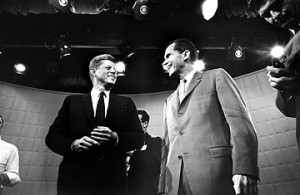
Jack Kennedy, left, and Dick Nixon before their 1st TV debate.

Today, I attended a training course on communicating assertively. It was filled with a lot of great takeaways, and the focus was around adapting your approach towards others for optimum results. The instructor brought up the three “V’s” when communicating with others: verbal, vocal, and visual. It is primarily the vocal (tone) and visual (appearance, facial expressions, body language) that impact communication. Together, these two V’s count for 93% of the impact. Of course, this is context dependent, but the statement led one of my colleagues to mention the famous Kennedy vs. Nixon debate.

In case you are unaware, this was the first presidential debate ever broadcasted on TV. The debate of course was also broadcasted on the radio, and for those listeners who were polled, more said that Nixon was the winner than Kennedy. For those who were lucky enough to watch the debate on TV, more said that Kennedy was the winner. The conclusion—Kennedy’s visual appearance and presence was superior to Nixon’s, and this made him the clear winner, at least to those who watched it on TV.

I was not around for this debate and have not had a chance to watch it yet, but from what I have read, some words used to describe Kennedy after the debate were handsome, dapper, calm, confident, and poised, while Nixon was described as sickly, clammy-faced, awkward, and sweaty. We all know that Kennedy went on to win the presidency, and many believe that this televised debate was what took him from a young, relatively unknown senator to a star in one night.

After hearing this story, I searched for some articles about this debate to investigate. Some argue that the polls used were not statistically significant, and I will leave that up to you to decide. In the end, I do believe that when it comes to communicating and presenting, tone and body language influence the verbal message. It is not simply what we say, but how we say it, and how we look while saying it. We all need to take this into consideration when presenting for impact.

Interesting Time Article on the debate and its impact on the world.

SCHUTZER, PAUL. Democratic and Republican presidential candidates Jack Kennedy, left, and Dick Nixon stand underneath glaring lights prior to beginning their 1st TV debate. Digital image. How the Nixon-Kennedy Debate Changed the World. Time, 23 Sept. 2010. Web. 14 Aug. 2014.
Notes on Abraham Lincoln

Abraham Lincoln, our 16th President, is one of the most admired and studied leaders in history. His gift for storytelling, his humor, his spiritual depth, and extraordinary wisdom continue to inspire and amaze. How did this unknown, modest country lawyer from Illinois, who grew up poor, lacking college training or formal education achieve such remarkable feats of leadership? Sixteen thousand books and even entire libraries have been devoted to an effort to understand his greatness.

Lincoln is perhaps best known for the leadership he provided during the Civil War. He freed the slaves and saved the Union. I believe that one of the most remarkable qualities he possessed was a primary management practice learning theme: effective team management. A key to Lincoln’s successful leadership was his ability and skill to bring people together under one mission.

Doris Kearns Goodwin, in her book Team of Rivals, makes the insightful and compelling case that a vital factor of Lincoln’s leadership was his willingness to assemble his cabinet from the men who had opposed him for the 1860 Republican Presidential nomination – notably William Seward, the governor of New York who would become Lincoln’s secretary of State, Salmon Chase, Ohio’s Governor who was appointed as Treasury Secretary and later Supreme Court Justice, and Edward Bates from Missouri as Attorney General.
Lincoln had an amazing ability to recognize the unique strengths that each of his rivals would offer and that they all possessed invaluable talents that the country needed if it was going to survive the Civil War.

It has been said that a nation can be known and judged by its heroes, by whom it honors above all others. We pay ourselves the highest compliment, when we say that Abraham Lincoln is that hero for us.

Sources:

Goodwin, Doris Kearns. Team of Rivals: The Political Genius of Abraham Lincoln. Simon and Schuster, New York. 2005

McDonald, Alonzo L., Abraham Lincoln: The Spiritual Growth of a Public Man. Trinity Forum 1993

Koehn, Nancy F. Abraham Lincoln and the Civil War. Harvard Business School Case 9-805-115. Rev. May 21, 2007

Spontaneous Production

Mark Twain once said “It usually takes me three weeks to prepare a good spontaneous performance.” Twain was also known for writing out his speeches verbatim and keeping it hidden under a stack of papers while he presented at the podium.  Unfortunately preparation is not always a luxury. From dreaded cold calls in class, to receiving an accolade only for it to be followed with “speech, speech, speech!” or being blind-sided in a meeting; forced into a production, there are times where one has to spring into action at a moment’s notice. Often times these interactions can be more frequent than and just as important as a formal presentation. You never know when you may have a chance to make a good impression, so being able to think on your feet is a great skill to have.

There are a few recommendations I would like to highlight, some form an article from MindTools:  http://www.mindtools.com/pages/article/ThinkingonYourFeet.htm as well as some of my own.


  1. Relax – If you have a poker face, now is the time to use it. Most people can spot the deer in headlights look fairly easily. Take a moment, ask yourself exactly what is expected of you at this instance, whether it be a spontaneous speech, an off-the-wall interview question, etc. and start coming up with a plan.


  1. Take your time– It is okay to repeat the question to ensure you completely understand. It is also permissible to buy a little time to construct a plan in your head. Most expect a little thought to go into a spontaneous production. As bad as awkward silence can be, rushing into a performance with little to no plan can lead to a garbled, confusing storyline that neither the audience nor the presenter can follow.

garbledspeech

  1. Stick to one main point or theme, and support it – Much like jumping right in without a plan, trying to hit on too many points at once can lose the audience quickly. There will likely be time for follow-up to tackle remaining details, so ensure the main point is communicated clearly and adequately supported.


  1. Be confident – Confidence does not happen by chance. It takes time to build up confidence in one’s delivery. Formal presentations, controlled environments like Toastmasters, and other forums that allow you to work on delivery, as well as formulate opinions and articulate them clearly and quickly will be the difference in experiencing dread or experiencing a feeling of opportunity the next time you are called upon suddenly.

Performance evaluation

As part of this semester’s MP course I wanted to solicit feedback on my performance from constituents beyond my direct supervisor. I looked through the web for different options, and I found that I favor MIT’s performance evaluation templates the most. They have two formats that I think can be used to capture a lot of information about feedback on our professional performances.

One of them is focused on a quantitative evaluation of your performance along several parameters; the other is more narrative style and asks for stories regarding your development in your role and your organization.

As a quick summary, here are the parameters around which the quant one measures performance:

1. Proficiency/skill in carrying out assignments (ability/competency)

2. Planning/organizing/prioritizing work load (analysis/time management)

3. Holds self accountable for assigned responsibilities (accountability/reliability)

4. Proficiency at improving work methods/procedures (continual improvement)

5. Effective communicator

6. Ability to work independently/ or with a team

7.  Willingness to take on additional responsibilities

8. Adeptness in analyzing facts, problem solving, decision-making, and demonstrating good judgement (sensible thinker)

All managers are different, and some people may have managers that have unclear expectations, or do not communicate their expectations. This points to the importance of being able to manage oneself. I think that pointers such as these can lead the individual to continually reflect and evaluate their own performance. Of course, we may not be as objective as an outside source (but heck, they are likely not to be objective either!), but at least we can bring a greater awareness to monitoring our performance. By bringing a higher level of awareness, we should be able to hone in on issues, and do a little trouble-shooting ourselves.


Introducing…. Power Pivot (with Excel)

I think everyone can agree that pivot tables are great excel tools which make analyzing and sorting massive amounts of data a life saver. However, over the course of the past couple years I have been introduced to Power Pivot. Yes, Power Pivot. Pivot tables on steroids. At first, I was pretty intimidated because of the sheer size and complexity on the surface. But after spending some time learning and taking “lunch n’ learn” course at work, Power Pivots and I are becoming friends. My favorite part is being able to run pivot tables essentially off other pivot tables. At work, we’ve also created many tools that allow our leaders to simply and easily run their own reports for specific requests, which saves everyone time. (The analyst teams refresh the data regularly as needed).

I’ve included a couple links below about Power Pivot, and would encourage all to consider using the valuable tool the next time you are looking to crush some colossal data. It’s available as a free add-on for Excel 2010 and now comes standard on Excel 2013.

Happy Pivot Tabling!


WJEM


https://www.youtube.com/watch?v=URy_uQYS49s

http://info.110consulting.com/blog/bid/374825/Top-10-Benefits-of-Using-Excel-PowerPivot

http://blogs.office.com/2010/10/01/top-5-ways-powerpivot-helps-excel-pros/

MEMBA learning community, Fall 2016- Spring 2017