I personally have found that every project I start I find myself re-integrating with a new team. On one project I may be working with a local group of people I know well and the next day (or even a few minutes later) the team I work with may have oceans between them both geographically and in our experience/knowledge base. I find myself constantly searching for a new role to play on each team. Every time the team changes, new expectations or even demands are imposed upon me.
Being able to succeed in these constant environment changes isn’t easy; it demands that I develop myself to be flexible in the roles I play on each team. I cannot always be the best communicator or the best analyst or the best manager; I may be assigned projects for which I am the least knowledgeable person on the team. Yet, I need to always find a role to play that adds value if I am to be successful.
In Amy C. Edmondson’s blog she describes “The Three Pillars of a Teaming Culture” that fuel successful teams in this rapidly changing environment. She states that we should create a culture of; curiosity towards each team member’s abilities and knowledge, be passionate about the task at hand to motivate cooperation and be empathetic enough to not only hear but rather comprehend other opinions.
These three “pillars” have already helped me re-think the way I approach my constantly changing environment. By listening and engaging more with the people I am working with, we have collectively gained an understanding of where each other’s frustrations and inspiration comes from. We are exponentially increasing the quality of work we do collaboratively and independently, as we are now able to gather thoughts, debate them and decide on a direction more efficiently without hesitation.
Do you think the three pillars can help you get more out of yourself and your team? Are you able to constantly find a way to bring value to a changing environment? Do you feel that working in a team is making you more productive? Do you teach others, learn from others or truly collaborate as a team? How do you team?
More on the 3 pillars:
http://blogs.hbr.org/2013/12/the-three-pillars-of-a-teaming-culture/
As I reflected on Professor Noonan’s closing remarks last week, I thought about how can I make a difference to my team. How can I bring value not only to my department, but also to my employer. Professor Noonan emphasized that everyone has the potential to make a contribution, to think of some process or task that can help drive results and improve productivity.
I came across this article on Forbes that drove home this point for me, “4 Ways You can Drive Seismic Performance”
http://www.forbes.com/sites/ericschiffer/2014/08/13/3-ways-you-can-drive-seismic-performance/
The article suggests the following key takeaways:
1) Face Yourself On the Stand And Fire Away – Step back and reflect on what matters most to the company to elevate it. It can be as simple as automating a report.
2) Act to Kill – This sounds a little violent :), but it is just a sensational way that the article suggests that you should be deliberate and consistent in achieving your daily professional goals. Act!
3) Commit or Go Home – Commit and do not fear failure.
4) Rewire the Jet at 36000 feet – Keep progressing even in the face of hindrances.
The phrase “work can be fun” may seem like an oxymoron. But it doesn’t have to be! Now it doesn’t mean we all should start coming to work in Hawaiian shirts and drinking mai tais at the office (as fun as that may sound). But we all can certainly make work less monotonous in a few easy ways — and help motivate your team as well.
One simple way to boost morale is to throw a potluck. We frequently do this at my work to celebrate promotions, new babies, weddings, etc. Everyone on the team contributes, so it’s a nice way to celebrate relatively inexpensively. We usually set it up in the office so people can stop whenever they get a moment. This way, people can take a quick break from the normal workday, but it doesn’t cut into productivity. Plus, it’s just a nice way to make your co-workers feel appreciated!
I also love Barbara Corcoran’s idea of “surprising” your office or team with something fun. Corcoran is a successful businesswoman and judge on the show “Shark Tank”. In her article below, she described how she got some of her best ideas while “playing” outside the office. Of course, she has the resources to rent hot air balloons or camels to ride at the company picnic. But I don’t think the surprises have to be grand. It could simply be letting everyone wear costumes to work for Halloween, or buying the first round of drinks at the company happy hour.
One thing I would not recommend is cutting “fun things” from the budget, especially when times are tough. I know it may seem like an easy way to save money, but it can really affect morale in the office. A few years ago, management decided to cut out the annual holiday party. When they made the announcement, it was like someone had let the air out of the office. People complained for days about how unappreciated they felt. I also remember the level of animosity toward the management. Luckily, a few astute supervisors saved the day by putting together an “unofficial” party at a nearby restaurant. But it really affected the mood of the office for weeks.
So the next time your team needs a little motivation, take some advice from Barbara — and go have fun.
When it comes to planning and managing a project, there have been many fantastic blog posts about the big picture. There have been posts about listing the work, breaking down the work, delegating the work, and everything in between. However, I thought it might be a good time to look at some more specific, nitty-gritty details within the topic. More specifically, I wanted to delve into project management software and similar tools because our office is researching what is currently available and ultimately deciding on the best option to use.
There are hundreds of project management tools out there. There are so many, each with its own strengths and weaknesses, it can feel overwhelming when asked to vet and decide on the right software for your organization. Over at Idealware (a consulting company for nonprofits), they asked nine project managers what project management software meant to them. Although the answers varied, they all had six overlapping, underlying themes.
Overall, the interviewees said the project management software should allow the user to plan projects (I certainly hope so), manage tasks, share and collaborate on documents, share calendars and contact lists, manage issues, and track time. Unfortunately there doesn’t seem to be a single software package that can do it all. There are many programs that do one or two of these six topics really well but may not include any other feature. The author stresses that one should not overlook these standalone tools either. These tools include Manymoon, Remember the Milk, Zoho, and Google Docs (aka Google Drive). Not to mention, many of these options are free.
There are many different programs mentioned in the article that it’s not feasible to research them all. However the author of the article specifically calls out a couple programs that seem to be the most useful, Microsoft Project and Basecamp. For any of these programs, it’s important to understand its strengths and weaknesses in order to get the most out of the program or suite of programs eventually used to manage projects. So for about the next month, I’ll be vetting a few of these programs for our office.
I would love to hear about others’ experiences. What do you and/or your office use to manage projects? What’s great about the software and what makes you want to take a bat to your computer in true Office Space-style?
Recently I made a presentation what I think every successful leader needs for management practice. It’s what I called the 4p’s of successful leadership. Those 4p’s are Performance, Perception, Personality and Passion.
I found this article because after presenting I was interested in seeing what other people’s opinion are on what qualities should leaders possess and I thought it would worth sharing. This article asked 332, 860 professionals-what skills have the greatest impact on a leader’s success in a position the respondent’s currently hold?
What is interesting is number one with 38% said Inspires and motivates. That aligns right with one of my P’s, personality.
See the full article to see the rankings on characteristics of a leader.
Why do so many people choose not to speak up at work? Interestingly, it’s not always because we fear retribution or other negative consequences. In fact, the biggest reason people do not speak to their managers concerning feedback or suggestions is that they feel nothing would change even if they did speak up. According to a survey from the Cornel University Survey Research Institute, respondents chose not to speak up to their managers because they think it is “a waste of time.” This feeling of futility can have far reaching effects on employees and the work environment as a whole.
The problem reminds me of the psychological theory of learned helplessness. Learned helplessness is the idea that depression and other negative mental states and illnesses “result from a perceived absence of control over the outcome of the situation.” Although the theory was originally studied in animals, it has applications in people too, particularly in the workplace. When employees feel like they have no control, they begin to feel helpless; and when they feel helpless or like all of their feedback ‘falls on deaf ears,’ why would they speak up at work?
Treat people that do speak up with dignity and respect. Ensure that they know they are being heard.
Explain why you are not doing something. If there’s no explanation for not following their suggestions, employees will assume that the new ideas brought to the table are simply being ignored.
Act on your employees’ suggestions. Claire states that the best way to encourage employees to speak up more and create a positive workplace is to act on the feedback offered – no matter how small.
These changes are relatively small and very easy to implement, but they have a huge impact on the company culture and on the employees working there. The next hurdle might be actually getting managers to listen to feedback about feedback…
I’ve always been fascinated by the Space Race of the 1960s. I am particularly amazed by the fact that in less than ten short years we went from considering space the realm of Hollywood and science-fiction to the kind of reality that you could watch live on the television in your living room. How did they do it? Computers? A bottomless budget? Sure, there were major advances in computer processing and increases in federal financing, but how did they go from being behind the Soviet Union to surpassing them en route to being the first nation to rendezvous, dock and land on the moon? I believe it has a lot to do with the team management practices that were exercised by NASA’s space flight leadership team. In former Flight Director Gene Kranz’s book Failure is not an Option he described how the NASA team was able to advance quickly through the Apollo program towards landing on the moon by saying, “Apollo succeeded at critical moments like this because the bosses had no hesitation about assigning critical tasks to one individual, trusting his judgment and then getting out of his way.” The basis for this trust was largely due to the emphasis NASA leadership placed on communicating, mapping out systematic solutions to complex problems, and establishing clear responsibilities for solving those problems and executing their designed solutions.
What’s interesting is that this is exactly what we were taught to do in MP. Upon reviewing the slides Professor Noonan presented during the Fall Semester, it is apparent that many of the lessons shared by our own “decision Jedi” were actually put to use by NASA in their effort to win the Space Race. Two slides, in particular seem applicable, which I’ve paraphrased below:
Intro Deck, Slide #24:
MP learning objectives and topics include: (a) defining the central problem in a situation; (b) connecting that problem to effective teamwork; (c) developing and delivering valuable insights; and (d) connecting those insights to effective action. “Excellence is an art won by training and habituation.” – Aristotle
Part 3 Deck, Slide #2:
How can we organize and manage team effort? (A) Appropriate work stream: (i) Targeted analyses, (ii) Spanning the tree, (iii) Driven by issues, and (iv) Focused using hypotheses; (B) Productive: (i) Focused info, resource needs; (ii) Clear, specific deliverables and declines; and (C) Effective use of team: (i) Responsibility and (ii) Coordination.
During the Space Race, the engineers and test pilots at NASA trained religiously, and spent extensive time developing rules and procedures for their flights. Since no one had ever flown in space before, each new mission provided an opportunity to literally “write the manual” on how certain objectives should be reached. Because the lives of the colleagues and friends, as well as the future of the nation, depended upon their precision, these engineers would try to consider every step of every mission from all angles before lighting a single rocket. In doing so, they were essentially asking themselves closing their eyes and asking themselves, “what do we need to do to achieve X?” and then building out mental “issue trees,” branches of which were then assigned to specific departments or team members to research, resolve and execute.
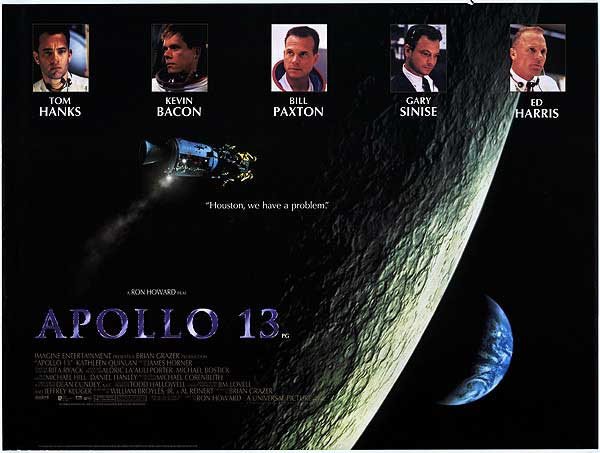
Apollo 13 (Theatrical Poster)
Although this kind of structured team management and leadership was a part of each stage of the Space Race, the most enduring display came in April of 1970, during the Apollo 13 mission. One of the most detailed accounts of how the Apollo 13 problems were tackled can be found in Flight Director Gene Kranz’s account in Failure is not an Option. Kranz describes how he broke the task down into key parts (e.g., power, trajectory, using the LM as a lifeboat for three men when it was designed for two, etc.) and then began in a structured and disciplined form of “brain storming” (or what some might call “brain steering”) during which every option was explored to ensure that the issue tree was mutually exclusive and collectively exhaustive.Short of reading Kranz’s book yourself, you can get an idea of what happened during the Apollo 13 mission by viewing the 1995 film starring Tom Hanks. Below are some key points in the film and links to YouTube clips that help provide a nice representation of this kind of team management:
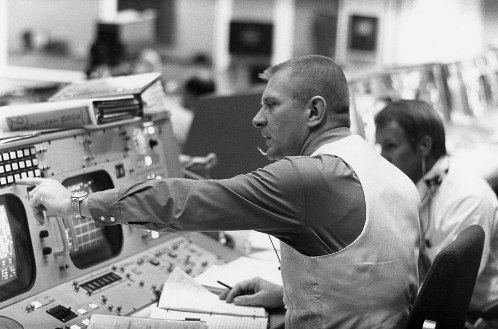
Flight Director, Gene Kranz – sporting his famous “white team” vest
1) Shortly after the explosion occurs on the Command Module, mission control begins to devolve into chaos over the news that the Apollo 13 spacecraft is mysteriously venting oxygen into outer space. Gene Kranz focuses the group by saying, “Let’s work the problem people, let’s not make things worse by guessing.” (NOTE, only the first 42 seconds of this clip are from the scene that I’m referring to here, you can ignore the rest). Kranz’s statement reframes the crisis as a problem that can be solved, not a moment for mindless panic, and in so doing he returns his team to the tasks they’ve been trained to do: solve space flight problems in a systematic fashion. Moreover, although it’s hard to appreciate from this short clip, you can get a sense for how direct the lines of communication are in mission control. Every person has a role to play and their area of expertise is distinct. Gene Kranz sources information from each of them and provides specific instructions to each group. He never says, “somebody go do that” it’s always clear communication directed at a specific individual or sub-team so everyone knows who is responsible for generating the answer to a specific question.
2) After relocating the astronauts to the LM (a/k/a Lunar Module, LEM), Gene Kranz makes it clear that the old flight plan is being tossed out the window and he focuses the team’s brainstorm efforts on the key question, “How do we get our people home?” When the sling-shot around the moon idea is presented a debate ensues, displaying how team members are wearing “different colored hats,” to essentially test the strength of the proposed solution.
3) When faced with the challenge of managing the power supply, a man named “John” proposes that everything must be turned off otherwise the LM will run out of power in 16 hours, not 45 hours. A cacophony of negative responses fills the room but Gene Kranz assesses the situation, makes the decision to power down the LM and moves on with the remaining team members to say they need to find a squeeze every amp out of the electronics in the spacecraft –“failure is not an option!” This particular scene displays the trust Kranz placed in his team members and their expertise, and, again, the power of positioning each challenge as a problem that can be solved by specific team members or sub-groups of team members.
4) As one team works on the electronic power issues, another is just discovering that the CO2 levels in the LEM are rising and that the filters from the Odyssey and the LEM are not compatible. This leads to the famous “Square peg in a round hole” problem. This might be the most incredible problem solved during the mission, and if you’d like to read more about it, you can do so here. The work done by Ed Smylie’s “tiger team” unquestionably saved the lives of the three astronauts, but again it shows the value of breaking a big problem (“how do we get our guys home?”) into smaller questions and dividing the task of researching and resolving those problems up to be the responsibility of smaller groups or individuals.
Years later, the Apollo 13 the flight commander, Jim Lovell, during a separate interview, suggested the Apollo 13 mission and provides several key takeaways for business leaders:
Identify the problem and figure out what you have to solve it;
Communicate – you need to share information with your team members in order to solve the problem;
Good leadership and good teamwork are marked by perseverance and initiative.
Thanks to this structured approach to problem solving and team management, NASA was able to bring the crew of Apollo 13 home and in the process they achieved what is largely regarded as the administration’s finest hour. If you’re interested in learning how you too can achieve this level of success within your own organization, I would invite you to review the aforementioned slides and check out the movie Apollo 13 on iTunes or your preferred viewing platform. Remember, “FAILURE IS NOT AN OPTION!”
Apollo 13 crew members Fred W. Haise, James A. Lovell, and John L. “Jack” Swigert, arriving at the USS Iwo Jema after safely landing in the South Pacific Ocean.
In our office, it’s nearing the end of the fiscal year and that means performance reviews. The annual performance review was completely redesigned this year. In addition, there has been a huge push from above to make sure many more employees averaged close to a “3” in a 1-5 performance scale. Due to these changes, there was a lot of general confusion about what was expected of each employee for their personal review as well as what to expect at one-on-one reviews with supervisors. These changes ultimately had little to no effect on raise decisions; however while speaking with colleagues, it became obvious that the cumulative effect of these changes was a destruction of morale and trust that had nothing to do with money.
Destruction of morale is just a small part of the damage a performance review might have on an organization. An article in the Wall Street Journal discusses several reasons why performance reviews, as they are commonly structured, are damaging and ill-advised. A few of these reasons are detailed below:
1. The boss and subordinate have two different mindsets walking into a review. The boss wants to talk about “skill limitations and relationships,” while the subordinate wants to negotiate a raise. At best, this discussion accomplishes nothing but, the author states, it more likely causes ill-will between the two people that has far reaching problems in day-to-day life.
2. There’s a widely held belief that performance determines pay; however raises are generally determined by the yearly budget and the overall economy and marketplace. The performance review often turns into a thinly-veiled justification for the raise the employee will receive, good or bad.
3. Performance reviews are generally set up to appear “objective” but because a single person is reviewing a number of people, the assessment cannot be free of the bias, motives, and feelings of the reviewer at that moment.
4. This same boss who must review a number of people simultaneously might be comparing very different people with sometimes very different job responsibilities but holding them all to the same criteria. For example, a trait that might be seen as an asset in one instance or by one reviewer could be seen as an impediment in a different situation or by a different reviewer. Similarly, two different employees may have two different ways to get a job done. Although both employees might achieve the same outcome, the boss may agree with one methodology and rate one person higher than the other. Unfortunately, this rating has little to do with actual performance.
5. Reviews in general impede personal development. If employees need help, they’re often afraid to speak to their bosses. Employees may feel that by acknowledging that there is a gap in their ability or knowledge, bosses will see that in a negative light and will decrease their potential raises for the upcoming year. Therefore, people do not grow as employees because they fear the retribution from asking questions.
Performance reviews seem to be a necessary evil but do they have to be? Perhaps there are alternatives to the performance review. The writer of the WSJ article focuses on addressing reviews as a team endeavor between the boss and subordinate and not as an adversarial experience in which both players enter the discussion on the defensive. He defines these meetings as “previews” instead of “reviews” in which both the boss and subordinate assess each other and when there is a problem with their teamwork, both members of the team must discuss and work to fix the problem at hand. The hope is that perhaps these changes lead to a more productive and healthy work environment and less game-playing and morale destruction.
“You don’t drive races on paper” – Kimi Raikkonen.
I have been a Formula1 racing aficionado since a kid. I would watch live telecast of a race hosted in any time-zone and also attended the Grand Prix at Austin. Their planning, strategy, risk management and precision has always amazed me. For once I saw the race from the eyes of a Project Manager and not a race car aficionado. There is so much that I have learnt which helped me in handling my projects much efficiently.
If we compare, Formula1 season is like a project and each race is like a milestone. The season has a Scope, Timelines, Requirements, Resources, Budget, Strategy, WBS, Quality assurance, KPIs and so does each race. Engineers, designers, mechanics, PR all work for the driver to help him minimize risk and increase the opportunities to win the race.
A race car driver is faced with competition, risk of crash, financial loss if any damage to the car and more. With all these, it is only imperative that the team provide an early identification and assessment of risks. The point is to know and stick to a threshold. We need to go through the hardship of taking the risk to either be successful or learn the lesson and move on.
“ I accept every time I get into my car, that there is a 20% chance I could die, and I can live with that risk – but not 1% more” – Nikki Lauda
Project management shall lead to the team success. Project plan which is monitored and updated as necessary, maintaining communication with all the stakeholders, maintain all the project documentation including meetings notes, technical reports, Analytics, diagnostic reports, KPIs and develop contingency plan for all the risks. All the above apply equally the same to Formula1 or software development or construction of a building or any other project. Any slight error to capture or communicate information would have an impact on the productivity and performance. Thereby posing huge threat on the budget or deadlines.
The project manager should be wise to have the technical resources working only on the dedicated project without having any internal pressure to work on other projects. If resources have to be shared project manager should plan to have the phase prior to entering the core of project work as switching projects would interfere with engineer’s concentration. All communication should happen at the discretion of the project manager, who in turn should be capable of knowing what to speak, when and to whom.
It is also very important to know who is responsible and who is accountable for what. During the race the Pit stop-team is responsible for changing the tires, cleaning driver’s helmet, replacing the damaged body parts, etc. It is the responsibility of one ‘lollypop man’ to control the car’s departure from the pit stop. The precise timing and millimeter perfect choreography plays an important role in the race. If a nut is loose, someone at the pit-stop is held accountable. If departure timing conflicts with another race car, the lollypop man is held accountable. In any projects RACSI (Responsible, Accountable, Consulted, Supported and Informed) plays a vital role to manage the roles and responsibilities of stakeholders and team members of a project.
I could writes pages and never give a closure to this article. There is a lot to be explored and learnt and every race gives me a new insight.
This is an interesting and short article from INC magazine on the traits of successful startup CEOs. After running a business for about 3 years, a lot of these make good sense.
1. Good at hiring and firing – hiring people is easy and makes you feel good about yourself. But knowing when to cut loses is hard, and delaying can result in bigger problems. It’s not easy to do, I struggled with this for a long time.
2. Builds a culture, not a company – a company cannot grow if it has the wrong culture. Spend time finding employees with the right skill set AND the right culture. The first hires at a startup are crucial to building the right culture.
3. Listens to feedback
4. Resilient – someone said to me early on “sometimes the road is straight and easy, other days you can’t see 10 feet ahead of you.” Keep chugging along.
5. Has a vision – People need to believe that you have a plan and direction.
6. Stay focused – I interpret this as not getting distracted by other things that may pop up. Keep your head clear and focused to the important matter.
7. Speak clearly – When I first started I talked a lot to be friendly, thinking that I could get people to be more willing to do stuff for me. But all that did was confuse people. Now I know to keep my instructions simple and concise. Explanations may or may not be necessary.
8. Customer advocate – I have to say “the customer is not always right.” Sometimes you have to fire customers. There’s certain customers that I don’t deal with, either because they are cheap, or because I know they will never be happy.
9. Good at convincing people – also related to being concise and clear. Don’t talk yourself into a trap, learn to stop