I personally have found that every project I start I find myself re-integrating with a new team. On one project I may be working with a local group of people I know well and the next day (or even a few minutes later) the team I work with may have oceans between them both geographically and in our experience/knowledge base. I find myself constantly searching for a new role to play on each team. Every time the team changes, new expectations or even demands are imposed upon me.
Being able to succeed in these constant environment changes isn’t easy; it demands that I develop myself to be flexible in the roles I play on each team. I cannot always be the best communicator or the best analyst or the best manager; I may be assigned projects for which I am the least knowledgeable person on the team. Yet, I need to always find a role to play that adds value if I am to be successful.
In Amy C. Edmondson’s blog she describes “The Three Pillars of a Teaming Culture” that fuel successful teams in this rapidly changing environment. She states that we should create a culture of; curiosity towards each team member’s abilities and knowledge, be passionate about the task at hand to motivate cooperation and be empathetic enough to not only hear but rather comprehend other opinions.
These three “pillars” have already helped me re-think the way I approach my constantly changing environment. By listening and engaging more with the people I am working with, we have collectively gained an understanding of where each other’s frustrations and inspiration comes from. We are exponentially increasing the quality of work we do collaboratively and independently, as we are now able to gather thoughts, debate them and decide on a direction more efficiently without hesitation.
Do you think the three pillars can help you get more out of yourself and your team? Are you able to constantly find a way to bring value to a changing environment? Do you feel that working in a team is making you more productive? Do you teach others, learn from others or truly collaborate as a team? How do you team?
More on the 3 pillars:
http://blogs.hbr.org/2013/12/the-three-pillars-of-a-teaming-culture/
As I reflected on Professor Noonan’s closing remarks last week, I thought about how can I make a difference to my team. How can I bring value not only to my department, but also to my employer. Professor Noonan emphasized that everyone has the potential to make a contribution, to think of some process or task that can help drive results and improve productivity.
I came across this article on Forbes that drove home this point for me, “4 Ways You can Drive Seismic Performance”
http://www.forbes.com/sites/ericschiffer/2014/08/13/3-ways-you-can-drive-seismic-performance/
The article suggests the following key takeaways:
1) Face Yourself On the Stand And Fire Away – Step back and reflect on what matters most to the company to elevate it. It can be as simple as automating a report.
2) Act to Kill – This sounds a little violent :), but it is just a sensational way that the article suggests that you should be deliberate and consistent in achieving your daily professional goals. Act!
3) Commit or Go Home – Commit and do not fear failure.
4) Rewire the Jet at 36000 feet – Keep progressing even in the face of hindrances.
The phrase “work can be fun” may seem like an oxymoron. But it doesn’t have to be! Now it doesn’t mean we all should start coming to work in Hawaiian shirts and drinking mai tais at the office (as fun as that may sound). But we all can certainly make work less monotonous in a few easy ways — and help motivate your team as well.
One simple way to boost morale is to throw a potluck. We frequently do this at my work to celebrate promotions, new babies, weddings, etc. Everyone on the team contributes, so it’s a nice way to celebrate relatively inexpensively. We usually set it up in the office so people can stop whenever they get a moment. This way, people can take a quick break from the normal workday, but it doesn’t cut into productivity. Plus, it’s just a nice way to make your co-workers feel appreciated!
I also love Barbara Corcoran’s idea of “surprising” your office or team with something fun. Corcoran is a successful businesswoman and judge on the show “Shark Tank”. In her article below, she described how she got some of her best ideas while “playing” outside the office. Of course, she has the resources to rent hot air balloons or camels to ride at the company picnic. But I don’t think the surprises have to be grand. It could simply be letting everyone wear costumes to work for Halloween, or buying the first round of drinks at the company happy hour.
One thing I would not recommend is cutting “fun things” from the budget, especially when times are tough. I know it may seem like an easy way to save money, but it can really affect morale in the office. A few years ago, management decided to cut out the annual holiday party. When they made the announcement, it was like someone had let the air out of the office. People complained for days about how unappreciated they felt. I also remember the level of animosity toward the management. Luckily, a few astute supervisors saved the day by putting together an “unofficial” party at a nearby restaurant. But it really affected the mood of the office for weeks.
So the next time your team needs a little motivation, take some advice from Barbara — and go have fun.
I’ve always been fascinated by the Space Race of the 1960s. I am particularly amazed by the fact that in less than ten short years we went from considering space the realm of Hollywood and science-fiction to the kind of reality that you could watch live on the television in your living room. How did they do it? Computers? A bottomless budget? Sure, there were major advances in computer processing and increases in federal financing, but how did they go from being behind the Soviet Union to surpassing them en route to being the first nation to rendezvous, dock and land on the moon? I believe it has a lot to do with the team management practices that were exercised by NASA’s space flight leadership team. In former Flight Director Gene Kranz’s book Failure is not an Option he described how the NASA team was able to advance quickly through the Apollo program towards landing on the moon by saying, “Apollo succeeded at critical moments like this because the bosses had no hesitation about assigning critical tasks to one individual, trusting his judgment and then getting out of his way.” The basis for this trust was largely due to the emphasis NASA leadership placed on communicating, mapping out systematic solutions to complex problems, and establishing clear responsibilities for solving those problems and executing their designed solutions.
What’s interesting is that this is exactly what we were taught to do in MP. Upon reviewing the slides Professor Noonan presented during the Fall Semester, it is apparent that many of the lessons shared by our own “decision Jedi” were actually put to use by NASA in their effort to win the Space Race. Two slides, in particular seem applicable, which I’ve paraphrased below:
Intro Deck, Slide #24:
MP learning objectives and topics include: (a) defining the central problem in a situation; (b) connecting that problem to effective teamwork; (c) developing and delivering valuable insights; and (d) connecting those insights to effective action. “Excellence is an art won by training and habituation.” – Aristotle
Part 3 Deck, Slide #2:
How can we organize and manage team effort? (A) Appropriate work stream: (i) Targeted analyses, (ii) Spanning the tree, (iii) Driven by issues, and (iv) Focused using hypotheses; (B) Productive: (i) Focused info, resource needs; (ii) Clear, specific deliverables and declines; and (C) Effective use of team: (i) Responsibility and (ii) Coordination.
During the Space Race, the engineers and test pilots at NASA trained religiously, and spent extensive time developing rules and procedures for their flights. Since no one had ever flown in space before, each new mission provided an opportunity to literally “write the manual” on how certain objectives should be reached. Because the lives of the colleagues and friends, as well as the future of the nation, depended upon their precision, these engineers would try to consider every step of every mission from all angles before lighting a single rocket. In doing so, they were essentially asking themselves closing their eyes and asking themselves, “what do we need to do to achieve X?” and then building out mental “issue trees,” branches of which were then assigned to specific departments or team members to research, resolve and execute.
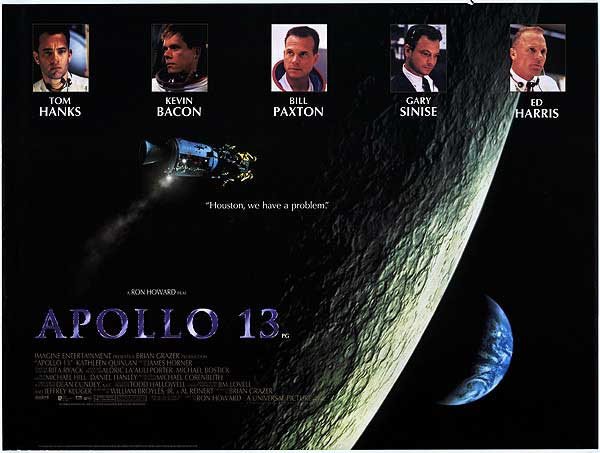
Apollo 13 (Theatrical Poster)
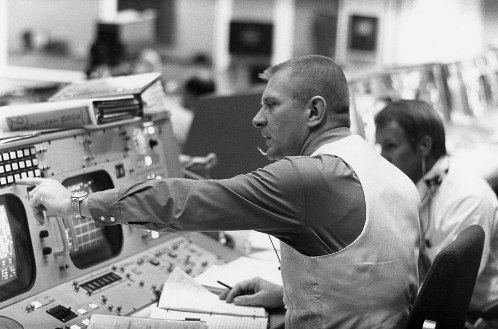
Although this kind of structured team management and leadership was a part of each stage of the Space Race, the most enduring display came in April of 1970, during the Apollo 13 mission. One of the most detailed accounts of how the Apollo 13 problems were tackled can be found in Flight Director Gene Kranz’s account in Failure is not an Option. Kranz describes how he broke the task down into key parts (e.g., power, trajectory, using the LM as a lifeboat for three men when it was designed for two, etc.) and then began in a structured and disciplined form of “brain storming” (or what some might call “brain steering”) during which every option was explored to ensure that the issue tree was mutually exclusive and collectively exhaustive.Short of reading Kranz’s book yourself, you can get an idea of what happened during the Apollo 13 mission by viewing the 1995 film starring Tom Hanks. Below are some key points in the film and links to YouTube clips that help provide a nice representation of this kind of team management:
Flight Director, Gene Kranz – sporting his famous “white team” vest
1) Shortly after the explosion occurs on the Command Module, mission control begins to devolve into chaos over the news that the Apollo 13 spacecraft is mysteriously venting oxygen into outer space. Gene Kranz focuses the group by saying, “Let’s work the problem people, let’s not make things worse by guessing.” (NOTE, only the first 42 seconds of this clip are from the scene that I’m referring to here, you can ignore the rest). Kranz’s statement reframes the crisis as a problem that can be solved, not a moment for mindless panic, and in so doing he returns his team to the tasks they’ve been trained to do: solve space flight problems in a systematic fashion. Moreover, although it’s hard to appreciate from this short clip, you can get a sense for how direct the lines of communication are in mission control. Every person has a role to play and their area of expertise is distinct. Gene Kranz sources information from each of them and provides specific instructions to each group. He never says, “somebody go do that” it’s always clear communication directed at a specific individual or sub-team so everyone knows who is responsible for generating the answer to a specific question.
2) After relocating the astronauts to the LM (a/k/a Lunar Module, LEM), Gene Kranz makes it clear that the old flight plan is being tossed out the window and he focuses the team’s brainstorm efforts on the key question, “How do we get our people home?” When the sling-shot around the moon idea is presented a debate ensues, displaying how team members are wearing “different colored hats,” to essentially test the strength of the proposed solution.
3) When faced with the challenge of managing the power supply, a man named “John” proposes that everything must be turned off otherwise the LM will run out of power in 16 hours, not 45 hours. A cacophony of negative responses fills the room but Gene Kranz assesses the situation, makes the decision to power down the LM and moves on with the remaining team members to say they need to find a squeeze every amp out of the electronics in the spacecraft –“failure is not an option!” This particular scene displays the trust Kranz placed in his team members and their expertise, and, again, the power of positioning each challenge as a problem that can be solved by specific team members or sub-groups of team members.
4) As one team works on the electronic power issues, another is just discovering that the CO2 levels in the LEM are rising and that the filters from the Odyssey and the LEM are not compatible. This leads to the famous “Square peg in a round hole” problem. This might be the most incredible problem solved during the mission, and if you’d like to read more about it, you can do so here. The work done by Ed Smylie’s “tiger team” unquestionably saved the lives of the three astronauts, but again it shows the value of breaking a big problem (“how do we get our guys home?”) into smaller questions and dividing the task of researching and resolving those problems up to be the responsibility of smaller groups or individuals.
Years later, the Apollo 13 the flight commander, Jim Lovell, during a separate interview, suggested the Apollo 13 mission and provides several key takeaways for business leaders:
Identify the problem and figure out what you have to solve it;
Communicate – you need to share information with your team members in order to solve the problem;
Good leadership and good teamwork are marked by perseverance and initiative.
Thanks to this structured approach to problem solving and team management, NASA was able to bring the crew of Apollo 13 home and in the process they achieved what is largely regarded as the administration’s finest hour. If you’re interested in learning how you too can achieve this level of success within your own organization, I would invite you to review the aforementioned slides and check out the movie Apollo 13 on iTunes or your preferred viewing platform. Remember, “FAILURE IS NOT AN OPTION!”
Apollo 13 crew members Fred W. Haise, James A. Lovell, and John L. “Jack” Swigert, arriving at the USS Iwo Jema after safely landing in the South Pacific Ocean.
Giving feedback can be one of the hardest things we do as managers or employees. Somehow the word “feedback” has taken on a negative connotation. But getting or giving feedback doesn’t have to be painful — and it’s a skill we are all going to have to learn.
One of the biggest complaints I’ve heard at my company is the fact we don’t get enough feedback throughout the year. Many people joke that if they don’t hear any complaints, they just assume they are doing a good job. But feedback is essential for mitigating problems — and helping employees realize their full potential.
Forbes has a great article on tips to how to make the feedback process better for you and your employees. Here are some of the key tips I got out of it:
1. Be honest. Employees can spot a manager that’s not being straightforward a mile away. Just keep your comments short and sweet.
2. Give real-life examples. Keep track of what the employees is doing wrong or right. It helps you to understand where they’re coming from, and why they’re doing certain things.
3. Lay out a plan of action. Figure out ahead of time how to mitigate negative behavior or reward good work. It doesn’t help to say “You need to work on this,” or “Great job!” You and the employee need to put a plan in place that’s actionable, achievable and will help them move forward.
4. Be willing to accept feedback yourself. Employees aren’t perfect. And neither are managers. This helps foster trust between employees and managers if you can take your own advice!
So what’s been your best or worst experience with feedback?
Often in our workplace we think of our success as being dependent upon our skills and ability to perform in a timely manner. I thought the same until I stumbled upon this article and it really changed my frame of mind. Honestly, now that I think about it, before my performance and skills even come into play, it is someone endowing trust upon me to even utilize my skills.
In undergrad I was taught that business is a system of integrated relationships of skilled people that are working to achieve personal and organizational goals. As this article points out, trust is at the center of every relationship.
I, like many of you, am constantly working on a project teams and in some cases, managing a project team. The author of the article Roger Dean Duncan states that “With high trust, teamwork is more of a reality than a hollow buzzword. Innovation is vibrant. Productivity tends to be strong and is typically more sustainable.”
This article begins by discussing what it really means to have trust. Later in the article Duncan begins to have a conversational interview with Barbara Brooks Kimmel, the executive director of Trust Across America. In the conversation Kimmel mentions a model that can be used to facilitate the earning of trust. She calls it the VIP Trust Model™.
Below are the attributes of the model to gain trust:
Vision and Values
Integrity
Promises
See article below for the full conversation on trust and how to use the VIP Trust Model.
I took a class in undergrad about “Servant Leadership” by Robert Greenleaf. I started questioning the difference between a manager and a leader, and have been intrigued by the concept ever since. As I was interviewing for my current position, I was questioned as to what type of leader I would be in the organization.
I pondered, and proceeded to explain the type of manager I would be and the skills that I would bring to the table. I described that I did not feel that someone could place me in the role of “leader”. It was a position that others saw me as based on how they felt about my abilities. They would make the decision to follow, I could not decide that for them.
I stumbled upon this article in the Wall Street Journal regarding this very topic. It discusses the importance of differentiating between a manager and a leader as the concept of the knowledge worker becomes more profound in our society.
“The leader originates, the leader challenges, the leader is an individual, the leader focuses on people.”
Take a look at the article and see how your natural characteristics fall into the spectrum. I believe that leadership is a way of life. It’s a characteristic that exudes from you, both in the professional world and your personal life. Leaders are the people that I select as mentors. The fact that I have placed them in that position in my life re-iterates how I feel about their ability to lead and challenge me.
My father is a mouthy, Italian businessman with salt and pepper hair. He has drowned me in the business world from a very young age. Along the way, I have gathered a few Tony-isms from him about this matter:
“You can promote people and make them managers, but you cannot make them leaders. That trait is who you are. When it comes out, people will know.”
“The person who knows how and why will always have a leg up on the person who only knows how or why.”
He’s a deep fellow.
Decide the type of position you want to hold in the lives of your co-workers, and work towards being looked at in that light. These abilities will alter the way you present, the way you communicate, and the way you analyze situations.
I leave you with one final Tony-ism: “Be cautious not to take too much advice.”
We often have to work with people in different cities in my business, and sometimes even different time zones! It can be a huge challenge to coordinate work with people you usually don’t see on a day to day basis. It seems like more and more companies are moving to teleworking, so I thought it would be good to go over some key tips on managing a virtual team:
1) Organize regular meetings with individuals as well as the team as a whole.
This doesn’t have to be in-person; a phone call or Skype can be just as effective. The main thing is you want to make sure everyone is on the same page. The team needs to feel cohesive and like they are all “in the loop” on what’s happening. We do daily “show calls” with all of our team members in Abu Dhabi, London and here in Atlanta. While this may not be feasible for every team, even a set weekly/monthly phone call can be good to foster communication and a sense of inclusiveness. A phone meeting is also a good way to address any team problems out in the open.
2) Rotate locations: Try to make sure members spend some time physically with the team in their home base, even if all members can’t all be there at once.
This is a critical part of getting a team to work together effectively. Once you put a face with that voice on the phone, you form a personal connection with that person. It’s also good to see how people function differently while working in the same room. This gives you the opportunity to confront any workflow or personnel issues. This would also be a good time to help the team bond through a social activity, games, etc.
3) Recognize cultural sensitivity. Be aware of cultural differences on your team so you can head off any potential issues.
I work with people from a variety of backgrounds and walks of life. It is so important to be aware that people often have very different styles of communication and management. A good way to head off issues is to make the team aware of the expectations for communication and conflict resolution. For example, a manager could instruct team members to mediate conflict themselves, before rushing to upper management to handle the situation. Team building exercises and cultural awareness classes could also help.
The biggest takeaway I got from this article is the importance of having good communication! It’s not easy managing a team flung across different cities or countries. But the team will work a lot more smoothly if everyone is kept in the loop, and any problems are dealt with quickly and transparently.
If there is anything that I have learned during my career thus far it is that change is constant. Over the past ten months, my team has undergone two monumental restructures. Although I believe that both of these changes have been for the best, the change itself was not easy.
While recently reviewing “Leadership Sustainability” by Dave Ulrich, I came across several key takeaways that are simple yet very powerful. Even though I didn’t have this content as I went in to the recent restructures, I realized that the process that my team was following was very similar to several of the key principles identified in the book. However, there is one that we haven’t quite mastered as well as the others.
The book identifies five rules of the Leadership Code:
Shape the future
Make things happen
Engage today’s talent
Build the next generation
Invest in yourself
They sound simple enough, right? I thought so, too.
Throughout the organizational changes that we’ve recently undergone, I’ve found that keeping my team engaged is proving to be harder than I initially anticipated. Through a series of meetings, surveys and conversations, I have identified a few areas that I believe are at the root of the issue.
The first area that I’ve identified is a strong sense of community. Even though the majority of my team does have a strong sense of community, for some, that community factor is missing. For these few individuals, they remain distant and do not take initiative to interact with other members of the team besides the required interactions for various projects that they are working on.
The second area that stands out is recognition. Each individual craves different forms of recognition and several members of my team were looking for additional recognition. I’ve found that complements and encouragement is one of the easiest ways to boost a team member’s confidence. However, for some, they feel most rewarded when they are recognized for their work in front of others. Therefore, I’ve been intentional lately to try to recognize people using a combination of the two. I’ve noticed that team members really appreciate this and will take action to try to remain in the spotlight when they know that they will be recognizing for their efforts.
The third area that my team struggles with from time to time is cultural differences. Our company has a very strong corporate culture that is conservative in nature. However, many members of our team have beliefs that differ from the cultural norms. I highly value these differences in thought and encourage members to always be themselves. However, that is much easier said than done and team members can easily become disengaged when the culture doesn’t align well with their own views.
I’m curious to know if other organizations struggle with keeping their teams engaged in the company and the work that they’re doing. If so, is it for similar reasons that I’ve described and what ways have you discovered that work well for keeping them better engaged?
In a recent blog post on hbr.org, Professor Monique Valcour presents a powerful suggestion for managers to connect with and get the most out of employees. She argues that “if your job involves leading others, the implications are clear: the most important thing you can do each day is to help your team members experience progress at meaningful work.”
So how do you know what is meaningful to them? By developing a coaching relationship and having coaching conversations. These conversations will allow managers to understand what drives each person, help build connections between each person’s work and the organization’s mission and strategic objectives, provide timely feedback, and help each person learn and grow on an ongoing basis. The goal is to develop the employee, just as the goal of a pitching coach is to develop his pitchers.
To do so, she lays out 5 tactics for managers.
Listen deeply. Listen with your full attention, and create a high-quality connection that invites your team member to open up and to think creatively.
Ask, don’t tell. In a coaching conversation, it’s essential to restrain your impulse to provide the answers. Your path is not your employee’s path. Similar to the Socratic method, open-ended questions, not answers, are the tools of coaching.
Create and sustain a developmental alliance. Follow-up is critical to build trust and to make your coaching more effective. The more you follow through on supporting your employees’ developmental plans, the more productive your coaching becomes, the greater your employees’ trust in you, and the more engaged you all become. It’s a virtuous cycle.
Focus on moving forward positively. Similar to Professor Smith’s recommendation to have a 5:1 positive to negative feedback ratio, the reverse is true here — when an employee focuses on the negatives during coaching conversations, it’s the job of the manager to end the venting session and steer the discussion into a positive, solution-based dialogue. You might ask, “Which of the activities you mention offer the greatest potential for building your knowledge and adding value to the company?” “Could you schedule two hours of time for developmental activities each week as a recurring appointment?” “Are there skills or relationships that would increase your ability to meet your primary deliverables?” “How could we work more efficiently within the team to free up and protect time for development?”
Build accountability. In addition to making sure you follow through on any commitments you make to employees in coaching conversations, it’s also useful to build accountability for the employee’s side of formulating and implementing developmental plans. Accountability increases the positive impact of coaching conversations and solidifies their rightful place as keys to organizational effectiveness.
I wanted to share this article because viewing management through a coaching lens resonates with me. To this day, I deeply appreciate and have nothing but fond thoughts towards my high school athletic coaches — they took a genuine interest in developing me as an athlete and as a person. I’ve yet to have a manager take this same kind of interest my own development, but I imagine my response to that kind of attention would be to make my time at work more meaningful and encourage me to do more meaningful work.