
Bain & Company published an article, “How Organizations Make Great Decisions” by Michael Mankins and Jenny Davis-Peccoud. Mankins and Davis-Peccoud claim that organizations whose decisions fail are due to dysfunctional processes.
Through their experience, they found that firms which established a “structured approach to decisions, one that ensures agreement on criteria, facts, alternatives, commitment and closure” are successful in making great decisions. These companies not only have high-quality decisions and execution but their enablers allow the decision process to move smoothly and quickly.
Every company’s structured decision approach is going to differ based on company culture and governance but they should include five critical elements: criteria, facts, alternatives, commitment and closure.
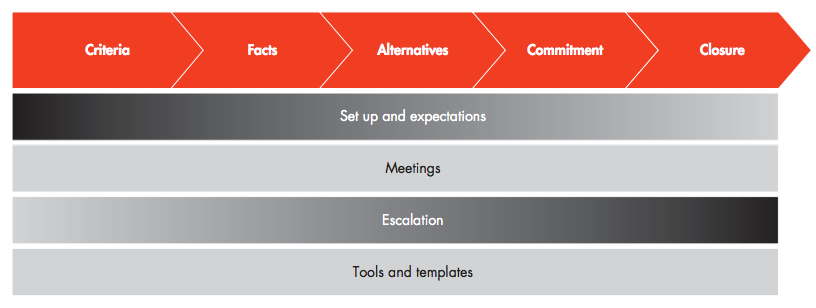
- Criteria: Know the goal of your decision and clarify the criteria for making the decision. For example, if the firm wants to give an end-of-month discount offer for customers, the goal will be to increase end-of-month sales by 15%. The criteria tells us whether the decision to offer a discount was effective.
- Facts: Find the precise facts you need to understand the scenario, create alternatives and come to your decision. If the facts directly relate to the decision making criteria, you can use the data, there is not a need to find all data available.
- Alternatives: Evaluating alternatives improves the quality of decision making. Ask the recommender, “What alternatives did you consider and reject and why?”
- Commitment: The group must commit to the decision. Hopefully everyone agrees on it as well, but once the decision is made, all parties must support the decision for it to succeed.
- Closure: Making the decision and committing to it is only the first step. Without communication of the decision, taking responsibility for execution, setting timelines for Implementation, and creating a feedback loop to monitor the performance of the Implementation, the decision will not happen.
The last element spoke to me the most. Often decisions at my company are made that are not properly implemented. The decisions are executed poorly and never reach their intended effect. Or the decision fades away and is never implemented.
In my opinion, the last element could be the most time consuming part of the decision making process. It is imperative for management to work through the challenges facing the implementation, monitoring the feedback loop for the decision’s progress. If the decision is not achieving its desired result, management must act quickly to adjust the implementation.
Mankins and Davis-Peccoud identified four ways that companies can enable great decisions:
- Take the time to plan, prepare and implement the decision
- Do not try to accomplish everything in one meeting
- Discuss operating reviews and strategy conversations separately
- Discuss facts, alternatives, and make the decision in separate meetings
- Only escalate if necessary and have guidelines to know when decision making escalation is necessary
- Use company created tools and templates for many, if not all, strategic decisions
My main take-away from the four enablers is to not use one meeting to accomplish all steps of the decision making process. For a large decision that affects many people, it is better to focus on each step of the decision making process separately. At first this sounds like too many meetings to come to a decision. However, if Mankins and Davis-Peccoud are correct, setting a meeting for each stage of the decision making process will keep the process moving and allow management to consider the facts, alternatives, make the right decision, and set the implementation plan.
My department is currently considering changing how we approach software implementations. We want to be seen more as marketing consultants than software trainers. I am going to take this decision making approach to my team and ask that we use this process as we go through changing our implementation strategy.