All posts by Nate Feather

How Effective Leaders Solve Problems

Effective leaders tend to find a strong balance between data analysis and intuition. Many times, the aspect of intuition comes from recognizing patterns or trends. A big part of problem solving is recognizing these trends and finding ways to minimize its reoccurrence. Additionally, it is important for leaders to understand the true essence of the problem rather than finding a temporary fix that will likely rise again in the near future. This gives leaders more time to focus on other areas of the business rather than continuing to fix the same problem over and over again.

Understanding the intricacies of every aspect of the business is one way to develop a strong sense of how your decisions can affect specific areas of the business. Effective leaders don’t look at problems as a nuisance; effective leaders see problems as an opportunity for ongoing improvements.

Forbes has come up with four characteristics that make an effective leader:

1) Transparent Communication: The main takeaway is that transparent communication allows for other people to be heard. It fosters an environment where people are willing to speak up if there is an issue.

2) Break Down Silos: The importance of this characteristic is to eliminate boundaries. It is important to solve problems that affect the overall business rather than one segment of the business.

3) Open-Minded People: Effective leaders are ones who are not discouraged to find innovative ways to solve a problem. They are individuals that do not avoid the problem; they are not afraid to face problems head-on.

4) A Solid Foundational Strategy: As we have learned in our Strategy course, a business without a strategy is dangerous. Effective leaders go beyond figuring out the problem; they find ways to implement a strategy to solve the problem. This includes resource allocation and budgeting.

Some final takeaways are:

  • Always step back and assess the situation; never take a blind guess when solving a problem.
  • Find ways to solve the cause of the problem to eliminate it from reoccurring.
  • Learn from your previous failures and use those lessons learned to solve future problems.
  • Don’t avoid problem solving; challenge yourself to solve the problem head-on.

To read more about becoming an effective leader, feel free to visit the article: http://www.forbes.com/sites/glennllopis/2013/11/04/the-4-most-effective-ways-leaders-solve-problems/.

A Recap on the Strategic Problem-Solving Model

Oftentimes, we can be inundated with information from work, school, and other obligations. We have covered a lot of this information in our MP course, but it is good information to look at and keep in mind when faced with trying to solve a problem in your business. McKinsey has developed a strategic problem-solving model that is specifically set in place to help MBA students build knowledge and skillsets in strategy.

Here is McKinsey’s strategic problem-solving model:

We must first start with defining the problem and determining what information is required to expand your research on that problem. This is where you “frame the problem” and then develop a hypothesis based on that problem. At this step, we develop an issue tree to break down our ideas into smaller components.

Once you develop an issue tree, you need to sort out the information into what you know and what you don’t know. Then you seek out more information on those topics that you don’t know by using fact-finding and interviewing techniques to gather information.

Here are a few tips to keep in mind when following this problem-solving model:

  • Be sure to follow facts, not intuition
  • Figure out the underlying issue before diving into the project
  • Don’t reinvent the wheel; follow the frameworks given to you
  • Look to other resources to help guide you with your research
  • Garbage in = garbage out
  • First, look at the annual report, then outliers in data as well as best practices in the industry

For more information on this strategic problem-solving model, be sure to visit http://www.webpages.uidaho.edu/~mbolin/donaldson.html.

A Methodical Approach to Problem Solving

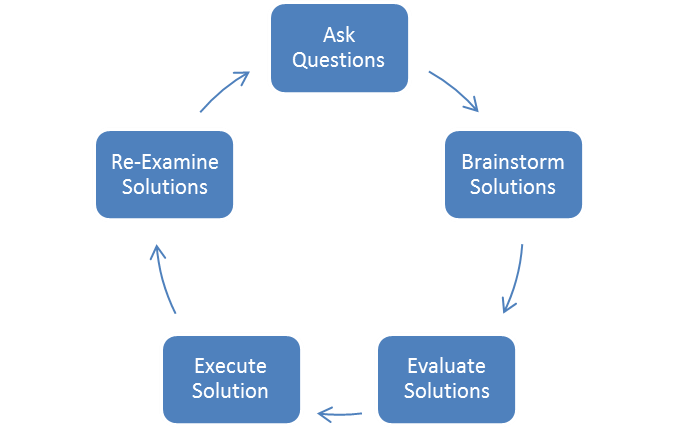
Oftentimes, we equate ‘problem solving’ with ‘critical thinking.’ However, in this case we’re referring to ‘problem solving’ as a method for finding solutions to short-term complications or setbacks. Although strong intuition is important for problem solving, you must also rely on the research and data that you encounter. What is most important is what you do with that combination of intuition and research. Here are the five steps to becoming a better problem solver:

problem-solving-process

  1. Ask a lot of questions to identify the underlying problem. Don’t jump to conclusions.
  2. Brainstorm all of the possible solutions to the problem that you identified.
  3. Evaluate the solutions that you came up with. Determine the feasibility of those ideas.
  4. Execute the most feasible idea. Good problem solvers are responsible for implementing a solution.
  5. Re-evaluate the project throughout its execution. Sometimes you will find out that you are either not solving the underlying problem or there are more problems that need to be solved.

For more information on the myths and facts of problem solving, feel free to visit the link below. This process can be applied in any business setting. By practicing these skills over-and-over, you can become a better problem solver.

http://www.entrepreneur.com/article/217516

Dig Deeper to Solve the Underlying Problems

For the sake of switching things up, I thought that I would share with you a show that really knows how to “dig deep” (pun completely intended) into the things that we often take for granted. If you have the time and are interested in finding ways to approach problems in a very different and unique way, I highly suggest you watch “Going Deep with David Rees” on National Geographic (the show just started airing a couple of weeks ago).

Why does this matter and how does it apply to this course? Sure, the topics may seem silly, ranging from learning how to tie a shoe to creating the perfect ice cube for your scotch, but the show does a great job at taking a simple concept and really understanding the components that go into it. Let me explain one of the episodes to help give you some better insight. The steps are rather detailed, but that’s really the point.

How some of us think about digging a hole:

    1. Grab a shovel.
    2. Dig.

How David Rees thinks about digging a hole:

    1. He first addresses the problem and what he’s looking to accomplish (he wants to build a “party hole”).
    2. David went to an experimental mine at the Colorado School of Mines to understand how these subject matter experts dig holes in the mine. From there, he determines that digging a hole into a rock is too dangerous for him and as a result the scope of his project changes.
    3. He goes to a soil biologist to figure out the best combination of sand, silt, and clay to dig the perfect hole (medium loom).
    4. David then goes to visit “Dr. Shovel” at Penn State University where he tests out a number of shovels to determine which ones are most efficient for him to use. From there, he learns that you actually need a couple of types of shovels for different stages of a dig.
    5. David learns that the hole he designed was actually flawed and potentially dangerous if he doesn’t “shore up the sides.” This discovery makes him adapt and change his original plans.
    6. So where does he go to learn how to shore up the sides? He goes to a golf course to learn how to keep his hole intact.
    7. From there, David goes to a cemetery to meet with a professional digger to learn better techniques on how to dig a hole. They first mark down the location and dimensions of the hole they are going to dig.
    8. He then goes to Harvard University to understand how the field mouse burrows a hole. There, he learns that these field mice dig much faster when they dig together instead of alone. As a result, David learns that he will be much more efficient if he has his friends help dig the hole with him.

Whether you’re a project manager, part of the product development team, or your manager asks you to give a presentation on the dynamics of your competition within the industry, you can use some of the analysis and problem solving skills that are utilized throughout this show. That, and you may get a good laugh out of the show as well. And you thought digging a hole was easy?

Spoiler alert. He ends up digging his party hole.

Constructing Your Message in a Logical Manner

Let’s say your manager has assigned you to a task to help solve an internal problem the company has been facing. You’ve been able to structure the problem and gather data. Now it’s time to use that data and convert it into meaningful information in order for you to present your case to your manager. How do you do that?

I came across some good tips on different ways to analyze information and create logical thinking to build your case. As we all know, the most basic logical structure is the conditional statement (“If you leave the European market, then sales will go down.”). Here are a few tips that might be helpful when constructing the way you want to communicate your message:

1. Converse statement: Just like the conditional statement, but reversed (conclusion, then premise). “If sales go down, then it was because you left the European market.”

2. Inverse statement: Original premise and original conclusion, but both are negated. “If you don’t leave the European market, sales will not go down.”

3. Necessary condition: A condition that must be met for a certain result to be achieved. “In order for sales not to go down, you cannot leave the European market. Therefore, entering the European market is necessary to prevent sales from going down.”

Although each statement nearly says the same thing, the message that is received from your manager can be very different. Think of it like the difference between the messages you’re trying to convey of “We need to enter this new market in order to drive sales” versus “If we don’t enter this new market, we will lose out on sales.” The latter creates the notion for a call to action for your manager, the former is merely a suggestion.

For more tips to sharpen your logical thinking, you can visit this link: http://www.techrepublic.com/blog/10-things/10-tips-for-sharpening-your-logical-thinking/.

Use Buckets to Solve Complex Problems

One way that you can go about organizing your thoughts and structuring a problem is by putting your thoughts into “buckets.” Here are a few examples that you can use when starting a new project:

Bucket by:

1) Time: Sort by past, present, and future. This helps show different phases of a project.

2) Function: A process flow chart will help visualize which functions are impacted by the project. This will also help give you a visual on what time(s) your function is affected.

3) Root cause: A fish-bone diagram will help show you all of the resource-related items that are grouped together. It also helps show how these root causes add value to the problem.

If you are interested in learning more about using bucketing to structure your problem, you can visit this link: http://consultantsmind.com/2013/05/16/structuring-problems-consultants-use-buckets/.

Building Your Case Starts with Asking the Right Questions

The concept of building your case begins well before you gather all of your information. It is easy to fall into a trap of fitting your case around the information you gathered, however this can lead to many problems such as developing a solution to the wrong problem, not solving the underlying root cause of the problem, or even providing answers to the client that they already know. There are strategies that you can use to gather the right information prior to building your case, which in the end, will become your case.

When doing research on the topic of building a case, I came across some short but powerful tips that HBR has come up with regarding the topic. Here are a few tips that I find helpful:

  • Don’t’ settle for the first developed business case; explore alternative solutions
  • Get the impacted clients and employees involved
  • Ask questions to clarify what the client is asking of you
  • Ask “what” and “why” questions to expand on the client’s thought

Remember, all of these activities should occur well before you gather your information and develop a solution for your client. Neglecting any of these activities may cause your project to start over from the beginning or even lose the business from your client. For those who are interested in this topic, there are a few more tips that you can use to help build your case: http://hbr.org/tip/2012/05/10/build-a-better-business-case and http://hbr.org/tip/2013/03/01/use-questions-to-build-your-case.