A few weeks ago my manager said “I love your inclination to take on a new projects and your willingness to move your schedule around”. I thought that was great… till she continued on to say “what we need to figure out is how I help you get it all done in time”… ending with “once I get something from you I do know it will be good work”.
Yes! You probably noticed that I had just been sandwiched. While I would have have preferred a more direct feedback method, I do agree with her remarks. I need to get better at managing my projects so I can more consistently deliver on time. To be completely transparent, this is not the first, second or 100th time I have heard that. It’s time to do something about it…which based on past efforts isn’t going to be easy.
Now that I’ve identified the issue at hand, I need to go gather data, analyze it and come up with a solution (sound familiar?). I decided to start by speaking with people I had worked with in the past to get more feedback. I’m sorry to say they all said the same un-helpful thing “Omry, that’s just who you are…”, only strengthening my thoughts on how hard making this change is going to be. I continued by comparing my project management style to others doing similar work. I noticed the expected… they all have project lists, they all have clear due dates/schedules set for each project and they all get their projects in on time. I may not be great at it but I do have lists and schedules, I just apparently have trouble sticking to them. I needed to search more and decided to turn to my trusted searching tool “Google”. I searched and searched through what seemed to be hundreds of pages… till I came to a page called “50 Tricks to Get Things Done Faster, Better, and More Easily”. 50 was a bit much, especially for someone who already can’t find time for everything, but a few tricks caught my attention:
Ubiquitous Capture: Everything needs to be documented! Whether I have an idea for a project or think of something that needs to get done, it needs to be written down. At first this sounded like a lot of work, but because I can do this on my phone and don’t have to care about grammar, it only takes a few seconds and I can jot things down anywhere I go.
80/20 by 50-30-20: This is a combination of two tricks. The first is the realization that 80% of results come from 20% of the work and therefore I should spend my time accordingly. The second is that in my project prioritization I should take my own life/career goals in mind. Spend 50% of time on tasks that will have the largest impact on my career, 30% of time on the tasks that advance my middle term career and 20% on everything else.
Do your worst: I shouldn’t expect perfection in every task on the first run. I can always go back to improving it later. Put pen to paper and start a project to see where it goes. The end result will only reveal itself after I have started the process. In simpler words, Stop Procrastinating.
More tricks for getting things done: http://www.lifehack.org/articles/productivity/50-tricks-to-get-things-done-faster-better-and-more-easily.html
When it comes to planning and managing a project, there have been many fantastic blog posts about the big picture. There have been posts about listing the work, breaking down the work, delegating the work, and everything in between. However, I thought it might be a good time to look at some more specific, nitty-gritty details within the topic. More specifically, I wanted to delve into project management software and similar tools because our office is researching what is currently available and ultimately deciding on the best option to use.
There are hundreds of project management tools out there. There are so many, each with its own strengths and weaknesses, it can feel overwhelming when asked to vet and decide on the right software for your organization. Over at Idealware (a consulting company for nonprofits), they asked nine project managers what project management software meant to them. Although the answers varied, they all had six overlapping, underlying themes.
Overall, the interviewees said the project management software should allow the user to plan projects (I certainly hope so), manage tasks, share and collaborate on documents, share calendars and contact lists, manage issues, and track time. Unfortunately there doesn’t seem to be a single software package that can do it all. There are many programs that do one or two of these six topics really well but may not include any other feature. The author stresses that one should not overlook these standalone tools either. These tools include Manymoon, Remember the Milk, Zoho, and Google Docs (aka Google Drive). Not to mention, many of these options are free.
There are many different programs mentioned in the article that it’s not feasible to research them all. However the author of the article specifically calls out a couple programs that seem to be the most useful, Microsoft Project and Basecamp. For any of these programs, it’s important to understand its strengths and weaknesses in order to get the most out of the program or suite of programs eventually used to manage projects. So for about the next month, I’ll be vetting a few of these programs for our office.
I would love to hear about others’ experiences. What do you and/or your office use to manage projects? What’s great about the software and what makes you want to take a bat to your computer in true Office Space-style?
I’ve always been fascinated by the Space Race of the 1960s. I am particularly amazed by the fact that in less than ten short years we went from considering space the realm of Hollywood and science-fiction to the kind of reality that you could watch live on the television in your living room. How did they do it? Computers? A bottomless budget? Sure, there were major advances in computer processing and increases in federal financing, but how did they go from being behind the Soviet Union to surpassing them en route to being the first nation to rendezvous, dock and land on the moon? I believe it has a lot to do with the team management practices that were exercised by NASA’s space flight leadership team. In former Flight Director Gene Kranz’s book Failure is not an Option he described how the NASA team was able to advance quickly through the Apollo program towards landing on the moon by saying, “Apollo succeeded at critical moments like this because the bosses had no hesitation about assigning critical tasks to one individual, trusting his judgment and then getting out of his way.” The basis for this trust was largely due to the emphasis NASA leadership placed on communicating, mapping out systematic solutions to complex problems, and establishing clear responsibilities for solving those problems and executing their designed solutions.
What’s interesting is that this is exactly what we were taught to do in MP. Upon reviewing the slides Professor Noonan presented during the Fall Semester, it is apparent that many of the lessons shared by our own “decision Jedi” were actually put to use by NASA in their effort to win the Space Race. Two slides, in particular seem applicable, which I’ve paraphrased below:
Intro Deck, Slide #24:
MP learning objectives and topics include: (a) defining the central problem in a situation; (b) connecting that problem to effective teamwork; (c) developing and delivering valuable insights; and (d) connecting those insights to effective action. “Excellence is an art won by training and habituation.” – Aristotle
Part 3 Deck, Slide #2:
How can we organize and manage team effort? (A) Appropriate work stream: (i) Targeted analyses, (ii) Spanning the tree, (iii) Driven by issues, and (iv) Focused using hypotheses; (B) Productive: (i) Focused info, resource needs; (ii) Clear, specific deliverables and declines; and (C) Effective use of team: (i) Responsibility and (ii) Coordination.
During the Space Race, the engineers and test pilots at NASA trained religiously, and spent extensive time developing rules and procedures for their flights. Since no one had ever flown in space before, each new mission provided an opportunity to literally “write the manual” on how certain objectives should be reached. Because the lives of the colleagues and friends, as well as the future of the nation, depended upon their precision, these engineers would try to consider every step of every mission from all angles before lighting a single rocket. In doing so, they were essentially asking themselves closing their eyes and asking themselves, “what do we need to do to achieve X?” and then building out mental “issue trees,” branches of which were then assigned to specific departments or team members to research, resolve and execute.
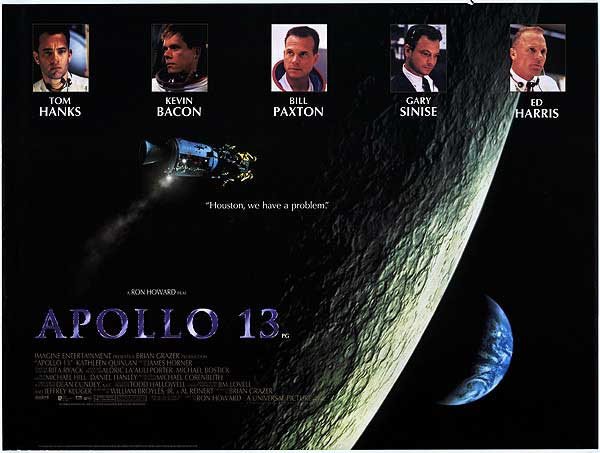
Apollo 13 (Theatrical Poster)
Although this kind of structured team management and leadership was a part of each stage of the Space Race, the most enduring display came in April of 1970, during the Apollo 13 mission. One of the most detailed accounts of how the Apollo 13 problems were tackled can be found in Flight Director Gene Kranz’s account in Failure is not an Option. Kranz describes how he broke the task down into key parts (e.g., power, trajectory, using the LM as a lifeboat for three men when it was designed for two, etc.) and then began in a structured and disciplined form of “brain storming” (or what some might call “brain steering”) during which every option was explored to ensure that the issue tree was mutually exclusive and collectively exhaustive.Short of reading Kranz’s book yourself, you can get an idea of what happened during the Apollo 13 mission by viewing the 1995 film starring Tom Hanks. Below are some key points in the film and links to YouTube clips that help provide a nice representation of this kind of team management:
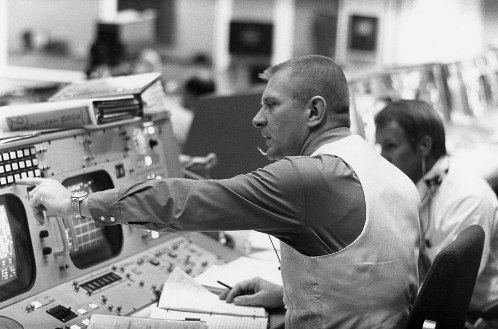
Flight Director, Gene Kranz – sporting his famous “white team” vest
1) Shortly after the explosion occurs on the Command Module, mission control begins to devolve into chaos over the news that the Apollo 13 spacecraft is mysteriously venting oxygen into outer space. Gene Kranz focuses the group by saying, “Let’s work the problem people, let’s not make things worse by guessing.” (NOTE, only the first 42 seconds of this clip are from the scene that I’m referring to here, you can ignore the rest). Kranz’s statement reframes the crisis as a problem that can be solved, not a moment for mindless panic, and in so doing he returns his team to the tasks they’ve been trained to do: solve space flight problems in a systematic fashion. Moreover, although it’s hard to appreciate from this short clip, you can get a sense for how direct the lines of communication are in mission control. Every person has a role to play and their area of expertise is distinct. Gene Kranz sources information from each of them and provides specific instructions to each group. He never says, “somebody go do that” it’s always clear communication directed at a specific individual or sub-team so everyone knows who is responsible for generating the answer to a specific question.
2) After relocating the astronauts to the LM (a/k/a Lunar Module, LEM), Gene Kranz makes it clear that the old flight plan is being tossed out the window and he focuses the team’s brainstorm efforts on the key question, “How do we get our people home?” When the sling-shot around the moon idea is presented a debate ensues, displaying how team members are wearing “different colored hats,” to essentially test the strength of the proposed solution.
3) When faced with the challenge of managing the power supply, a man named “John” proposes that everything must be turned off otherwise the LM will run out of power in 16 hours, not 45 hours. A cacophony of negative responses fills the room but Gene Kranz assesses the situation, makes the decision to power down the LM and moves on with the remaining team members to say they need to find a squeeze every amp out of the electronics in the spacecraft –“failure is not an option!” This particular scene displays the trust Kranz placed in his team members and their expertise, and, again, the power of positioning each challenge as a problem that can be solved by specific team members or sub-groups of team members.
4) As one team works on the electronic power issues, another is just discovering that the CO2 levels in the LEM are rising and that the filters from the Odyssey and the LEM are not compatible. This leads to the famous “Square peg in a round hole” problem. This might be the most incredible problem solved during the mission, and if you’d like to read more about it, you can do so here. The work done by Ed Smylie’s “tiger team” unquestionably saved the lives of the three astronauts, but again it shows the value of breaking a big problem (“how do we get our guys home?”) into smaller questions and dividing the task of researching and resolving those problems up to be the responsibility of smaller groups or individuals.
Years later, the Apollo 13 the flight commander, Jim Lovell, during a separate interview, suggested the Apollo 13 mission and provides several key takeaways for business leaders:
Identify the problem and figure out what you have to solve it;
Communicate – you need to share information with your team members in order to solve the problem;
Good leadership and good teamwork are marked by perseverance and initiative.
Thanks to this structured approach to problem solving and team management, NASA was able to bring the crew of Apollo 13 home and in the process they achieved what is largely regarded as the administration’s finest hour. If you’re interested in learning how you too can achieve this level of success within your own organization, I would invite you to review the aforementioned slides and check out the movie Apollo 13 on iTunes or your preferred viewing platform. Remember, “FAILURE IS NOT AN OPTION!”
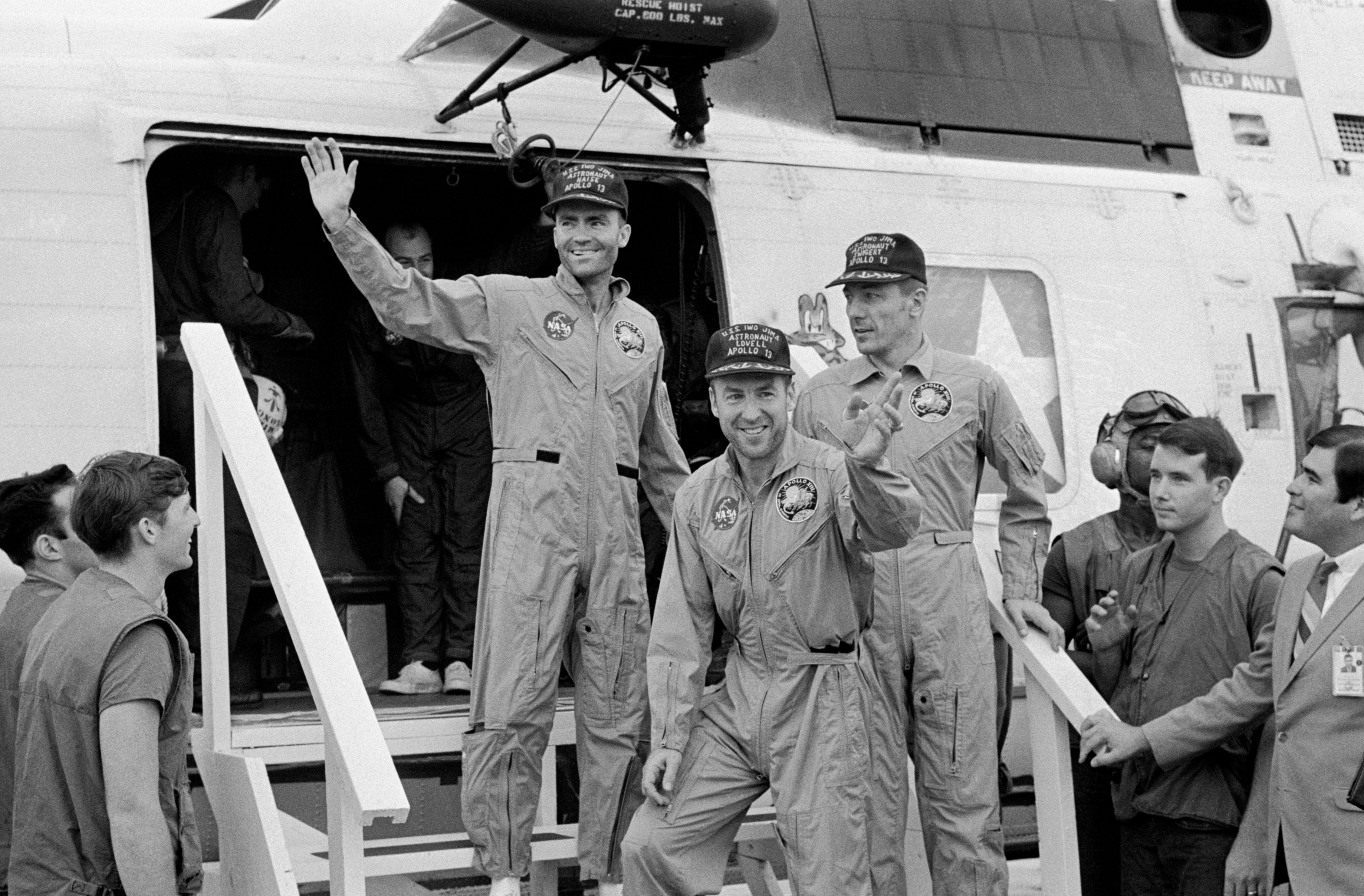
Apollo 13 crew members Fred W. Haise, James A. Lovell, and John L. “Jack” Swigert, arriving at the USS Iwo Jema after safely landing in the South Pacific Ocean.
“You don’t drive races on paper” – Kimi Raikkonen.
I have been a Formula1 racing aficionado since a kid. I would watch live telecast of a race hosted in any time-zone and also attended the Grand Prix at Austin. Their planning, strategy, risk management and precision has always amazed me. For once I saw the race from the eyes of a Project Manager and not a race car aficionado. There is so much that I have learnt which helped me in handling my projects much efficiently.
If we compare, Formula1 season is like a project and each race is like a milestone. The season has a Scope, Timelines, Requirements, Resources, Budget, Strategy, WBS, Quality assurance, KPIs and so does each race. Engineers, designers, mechanics, PR all work for the driver to help him minimize risk and increase the opportunities to win the race.
A race car driver is faced with competition, risk of crash, financial loss if any damage to the car and more. With all these, it is only imperative that the team provide an early identification and assessment of risks. The point is to know and stick to a threshold. We need to go through the hardship of taking the risk to either be successful or learn the lesson and move on.
“ I accept every time I get into my car, that there is a 20% chance I could die, and I can live with that risk – but not 1% more” – Nikki Lauda
Project management shall lead to the team success. Project plan which is monitored and updated as necessary, maintaining communication with all the stakeholders, maintain all the project documentation including meetings notes, technical reports, Analytics, diagnostic reports, KPIs and develop contingency plan for all the risks. All the above apply equally the same to Formula1 or software development or construction of a building or any other project. Any slight error to capture or communicate information would have an impact on the productivity and performance. Thereby posing huge threat on the budget or deadlines.
The project manager should be wise to have the technical resources working only on the dedicated project without having any internal pressure to work on other projects. If resources have to be shared project manager should plan to have the phase prior to entering the core of project work as switching projects would interfere with engineer’s concentration. All communication should happen at the discretion of the project manager, who in turn should be capable of knowing what to speak, when and to whom.
It is also very important to know who is responsible and who is accountable for what. During the race the Pit stop-team is responsible for changing the tires, cleaning driver’s helmet, replacing the damaged body parts, etc. It is the responsibility of one ‘lollypop man’ to control the car’s departure from the pit stop. The precise timing and millimeter perfect choreography plays an important role in the race. If a nut is loose, someone at the pit-stop is held accountable. If departure timing conflicts with another race car, the lollypop man is held accountable. In any projects RACSI (Responsible, Accountable, Consulted, Supported and Informed) plays a vital role to manage the roles and responsibilities of stakeholders and team members of a project.
I could writes pages and never give a closure to this article. There is a lot to be explored and learnt and every race gives me a new insight.
Staff meetings. We know the drill. I think we’ve all had experience with good ones, and ones that are just plain awful.
In my experience, staff meetings have served a number of different purposes: updating others on the progress of projects, decision-making, feedback on work, getting insight from team members, problem-solving etc. The success of those meetings depended on the number of people who attended, how prepared individuals were when they went to the meeting, knowing the purpose of the meeting, and knowing the end goal of the meeting—not be confused with “what” the end goal is going to look like. For example, before you go into the meeting, you know that you want to come out with a solution to your most recent sales issues with a customer—you don’t know what that solution may be until the end of the meeting.
There’s no clear objective. To avoid this, make sure the objective of the meeting is clear so that “participants […] know what to expect and how to prepare.”
There’s no focused agenda (despite having a clear meeting objective). This means that the agenda items are unclear (and not detailed enough). Speak to attendees beforehand to determine what exactly they want to discuss and how much time to allot to them.
Not everyone in the room has a chance to speak. Ask directs questions, give “the mic” to them to speak, let the interrupters know they’ll have their time to speak = more engagement from everyone.
Endless debates without a conclusion. This goes back to Mistake #2. If folks have an idea of what the agenda is beforehand, then they can come prepared with data to back potential arguments or provide useful feedback.
Not reaching a consensus on an action item. Before you leave the meeting (or soon after), identify what’s supposed to be done, who is supposed to do it, and when it’s supposed to be done by.
No remembering to give “kudos” to individuals. Towards the end of the meeting, make sure that you still recognize certain individuals or teams for their efforts. Help bring everyone’s efforts and hard work full circle—remind them of the overall goal.
Now I wanted to ask you…
What “mistakes” have you made in a meeting?
Based on your experience, what tips do you have on leading a successful meeting?
What do you do just before a meeting? Right after a meeting?
This article describes three areas that managers generally go wrong when trying to plan and execute strategies and deliverables: http://www.forbes.com/sites/billconerly/2013/08/15/3-strategic-planning-pitfalls/
The one take-away I derive is a quote given by the author (Bill Conerly) in an associated link to the article that states, “The value of a goal is not the goal itself but the determination of the action steps most likely to lead to achieving the goal”.
In my line of work, where a lot of project management is involved, I find that a lot of goals are set by my department as well as other departments that oversee the work of my particular unit. However, there is usually a recurrence of problems particularly with managing vendors, deadlines and budgets. Most of these issues we face as a department can be avoided if the “Value of a Goal” defined above is properly adhered to. The three pitfalls in strategy go a long way into substantiating the “Value of a goal”.
The first pitfall, “Avoiding ‘No’ ” describes how a company’s strategy may start off with a well defined focus but would then allow a lot of scope creep to blur the overall vision. The article suggests that this is usually due to the unwillingness of corporate leaders to say ‘No’.
The second pitfall, “Not connecting to actions” is an embodiment of the old cliche, “talk is cheap”. Usually, employees get caught in the moment during a meeting and are excited about certain deliverables. However, the follow through and understanding of certain actionable items tend to lack.
Finally, the third pitfall, “Vague action steps”, which I found to be pretty similar to the second pitfall, also illustrates how lacking a sequential actionable plan could lead to the collapse of a well thought out strategy.
I subscribe to the fact that for a corporate goal to be successful, it should answer the SMART framework. In essence, a goal should be Specific, Measurable, Attainable, Relevant and Time-bound (SMART). I strongly believe that a goal that meets the SMART framework essentially avoids the three pitfalls described in the article and completely captures the true definition of the ‘Value of a Goal’.
Like many of my classmates, a significant reason for pursuing my MBA at Emory is the desire to change to a newer, better and more fulfilling job. So the title of this article by Colleen Egan was an easy grab for my eye. While it’s more like a self-help-bullet-point slideshow than an informative article (“Nurture your Network”!), it did get me to thinking about the state of my job search process. Apparently, I am well behind the times when it comes to marketing myself.
Don’t get me wrong, I do have a LinkedIn account with a slowly expanding network of connections and I even took the time to set up my profile and upload my resume. And earlier this semester, I took advantage of a mock-interview workshop through our Career Management Center. (Which I highly recommend to all of my classmates, by the way.) But that is about the extent of my self-promotion and preparation. I have never posted a comment on LinkedIn, nor have I ever commented on someone else’s posting.
The author cites “DailyWorth” (www.dailyworth.com) career coach Alexandra Levit, saying: “Do a Google search of your name once a month to see if you’re happy with what is there”. Well, I just Googled myself and came up with … nothing. (Unless you count a picture of a 1960 baseball card for the New York Yankees catcher “John Blanchard” that Professor Shanken mentioned in our first night of Finance class. I thought that was a nice “full circle” for the summer semester. But, I digress … ) The article also introduced me to something called Google+ (https://plus.google.com). Not really sure what it’s for, but I’ll do some more digging.
Haven’t opened up my Facebook in several years and have long since forgotten my Instagram and Pinterest passwords. Never “tweeted”. Long story short, my “online presence” is a ghost town. That might explain why I’ve gotten very little response from companies that I’ve applied to. If they were trying to find me online, their first impression was one of frustration.
In addition to social media, Levit also recommends “setting up a basic, but well-done website with contact information, links to your work and professional accomplishments.”
So if I’m really serious about finding that dream job, I need to stop dreaming and start promoting myself.
Reprinted through the Wall Street Journal’s MarketWatch website:
http://www.marketwatch.com/story/how-to-nail-your-next-job-before-you-even-apply-2014-08-02
The author, after returning from a cross-country flight to Kitty Hawk, NC.
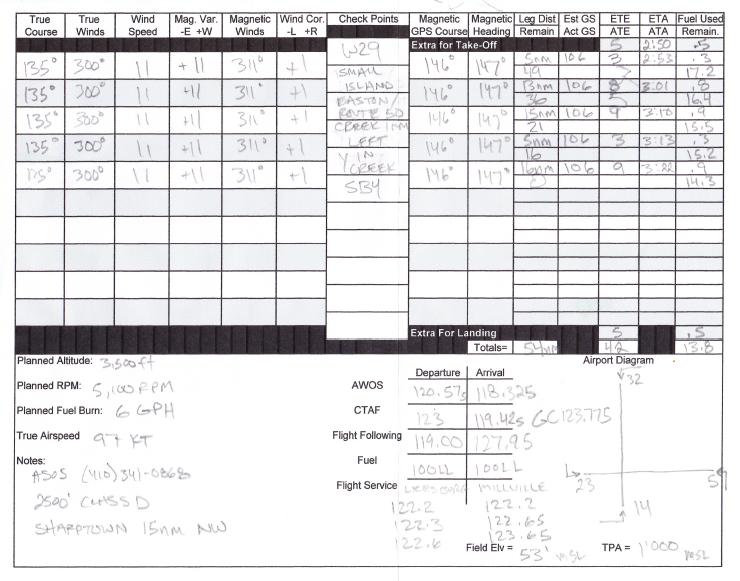
One the most exciting and challenging days in the life of a student pilot is the day he or she sets out on their long solo cross-country flight (“Cross-Country”). Although the name suggests a flight across the United States of America, in this context the term Cross-Country refers to a journey that is at least 150 nautical miles, involves full stops at three different airports, and a leg of at least 50 nautical miles between two of the stops. Although it is only one of the final steps before a pilot’s license can be awarded, it is largely viewed as the true test of a student’s ability to responsibly map out and execute a flight plan. It requires a demonstration of skill, discipline and focus, and for this reason it is considered a rite of passage that separates real “pilots” from mere “flyers.” Reflecting upon my own my Cross-Country experience, I can see now that the principles applied in preparing for that flight can also be applied to planning a business project. If you search, “how to plan a Cross-Country flight” on Google, you’ll receive a number of hits, ranging from brief overviews to detailed instructor guides, but my personal favorite guide is Rod Machodo’s Private Pilot Handbook. Below, I’ve selected the most relevant points from all of these sources, and a quote from Mr. Machodo’s chapter 14 titled “Flight Planning: Getting there from here,” and I then explain how these practices can be applied as a framework for planning out a business project:
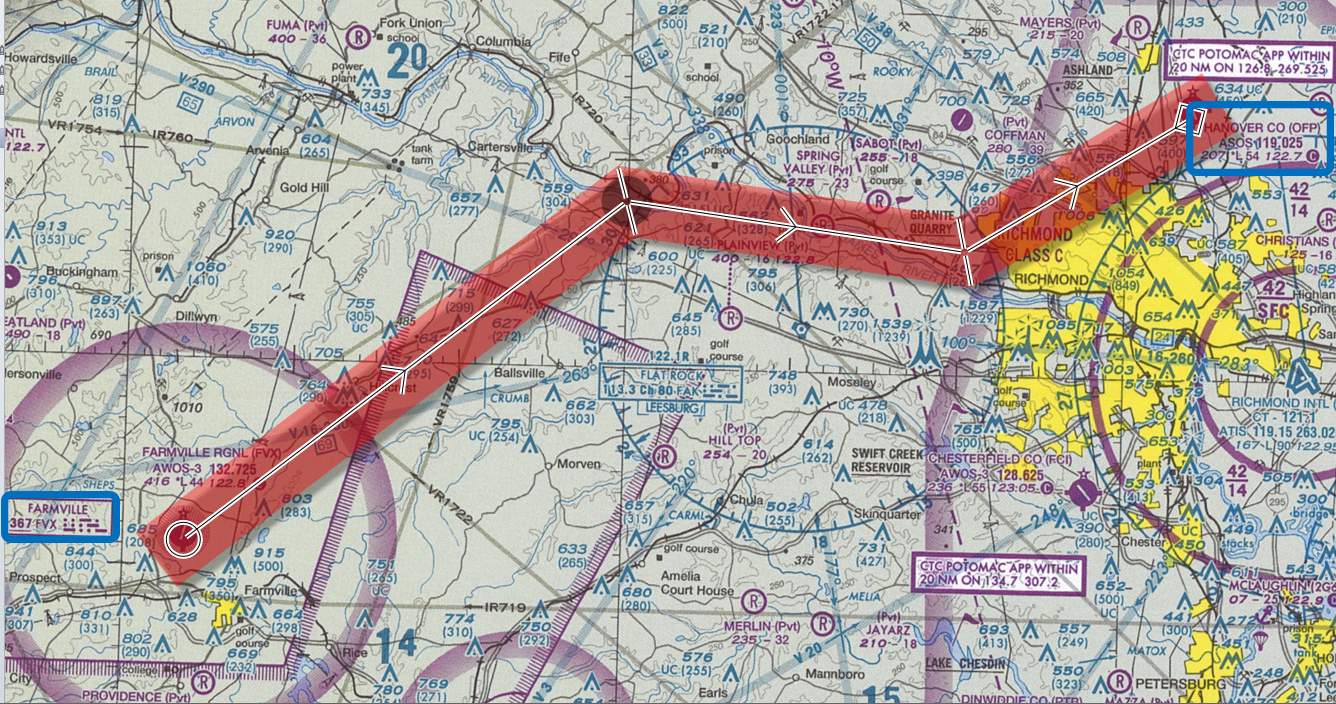
A sectional chart
A flight plan with way-points, course headings, and estimated time marks.
“Flight planning is information management. Your job is to assemble, interpret, and put to use all the information needed to safely make a flight from Point A to Point B.” - Rod Machado
Identify your destination. All general aviation Cross-Countries begin with the choice of a destination. While you might get into your car just to go “drive around town,” with the peace of mind that if you need to get fuel or food, you will be able to find it along the way, you would never do the same with an airplane. As a pilot, you always need to know where you’re going –even if “there” is just doing touch-and-go’s in the traffic pattern of your home base airport. The reason you need to know where you’re going when you take-off is that the destination will govern important details such as how much fuel you will need to store, which sectional map to examine to identify waypoints, what radio frequencies you will use to communicate with other airplanes and controllers on the ground, what weather you will need to look out for en route, and what kind of provisions you should pack in the event of an emergency (e.g., are you flying over water, a desert, snow-capped mountains? Survival in each environment requires different provisions).
Planning out a project in business is no different. As discussed during the Fall Semester, there’s a tendency to just want to dive-in and start smashing the watermelon, but just as a pilot’s choice of destination will affect such basic decisions as how much fuel he needs to load into his tanks and what map he’ll need to examine for way-point identification, the selection of a business project’s objective or “destination” is equally important. Without knowing the objective, it’s impossible to plan out how to achieve it.
Selecting a Route. Once a destination is selected, it’s time to choose a route. This process begins by selecting the correct aviation map, known as a sectional chart. Within the U.S., there are over 50 sectional charts to choose from, each focusing on a different part of the country, so again, identifying the destination is a prerequisite to choosing the right chart. Examining the chart is an essential step because of how much information a pilot can obtain from a careful reading. In addition to showing the location of airports, these charts also provide information on geographic formations that are visible from the air, obstructions (e.g., cell towers) that should be avoided, radio frequencies used by ground based operations and other aircraft in the region, private airstrips, airspace classification (which connotes different rules and procedures that need to be applied), and much more.
Although there is tendency to want to take the shortest route by drawing a straight line between two points on the chart, the truth is that the shortest route is not always the best. I distinctly recall when I was planning my flight from an airport south of Washington, DC to Ocean City, MD and then down to the mouth of the Chesapeake Bay, that the most direct path would take me through restricted airspace, controlled by the U.S. Navy. Moreover, the most direct path would not bring me within eyesight of significant landmarks that would be distinguishable from the air. As the flight involved a significant amount of flying over-water, it was essential that I select a route along which I could double-check my heading, and measure my actual progress against my predicted time-marks by looking out the window. Accordingly, I selected a less direct route that would bring me in close range of several distinguishable landmarks to make sure I remained on course and on-time .
In business, once the objective has been identified, there’s a similar tendency to want to select the fastest route towards achieving that objective; however, the fastest route is not necessarily the best one for you or your resources. The fastest route may be the most costly, it might involve exposure to unacceptable risk, or it might not be feasible with the resources that are available. Moreover, like a flight plan, a project plan must include distinguishable way-points (a more colloquial term might be “mile markers”) against which the team can measure its performance and ensure it remains on course, and just like the use of time-marks the plan should layout realistic deadlines for when those way-points will be reached. Simply telling someone “go solve this problem and come back when its done,” is not as effective as saying, “go solve this problem by completing these 10 specific steps and as you complete each step check back with me so we know we’re on point.” Laying out a plan that allows you to break the project up into these measurable tasks and metrics will enhance your ability to track your team’s progress and report on that progress to the stakeholders, just like a pilot tracks his progress and reports it to the controllers on the ground.
Plan for Uncertainty. The “if” in “If everything goes according to plan,” is something no pilot can afford to ignore. Rarely does everything go exactly according to plan. Something as mundane as the direction of the wind could change and in so doing it would alter your airspeed, heading, and even the runway you had planned to take-off or land-on, and of course there are no shortage of more major “if’s” that could alter your plans. With this in mind, a good pilot needs to plan for contingencies (e.g., identifying alternative/emergency landing spots along his route), manage his own and his passengers’ expectations about timing and variability of conditions, and always make sure reserve fuel is left in the tank. It also means a pilot needs to consider what kind of provisions (e.g., survival gear, communication devices, food, water, temporary shelter, etc.) he might need to survive in the event he is forced to put the plane down along his route.
While some business projects are couched as “do or die,” “bet the company,” or even “get it done, no matter the cost,” projects, every plan needs to consider what resources are required to achieve the objective, whether these resources are available, and what contingencies should be put into effect if certain scenarios arise. While all business environments may not be as unpredictable as the weather, relying on a blind belief that “everything will go as planned” in your industry is no small folly. Accordingly, a good plan must at least acknowledge the points that are uncertain or that could be variable, and consider what should happen if those variables change.
Executing. Executing a flight plan properly requires skill, discipline, and flexibility. A pilot needs to be (a) skilled at maintaining his desired heading, speed, altitude, and communications while also on the lookout for incoming traffic and obstructions; (b) disciplined at checking his progress along his route, clocking in at regular intervals to measure changes in both the internal performance of his plane (e.g., engine RPMs) and the effect of outside forces (e.g., head or tail winds) on his progress; and (c) flexible in his ability to deviate from the plan as new information comes to him (e.g., materialization of a summer thunderstorm directly in his flight path). This last point on flexibility is particularly essential because one of the biggest causes of general aviation accidents is a disease known as “get-home-itis,” wherein the pilot becomes so focused on the idea of getting home that he may compromise his normal risk tolerances and decide to try to fly through bad weather or mechanical failures in an effort to “just get home” rather than divert to another airport or delay his departure. Get-home-itis is characterized by a loss of sight of the big picture, which is to stay alive and well.
In business, the proper execution of a plan also requires this combination of skill, discipline, and flexibility. The skill of coordinating of team members and the discipline to follow-up with each of them to make sure a project is meeting its way-points on-time and on-budget are essential, but again, flexibility is particularly important. There are countless examples of companies that became so consumed with a project and the sunk costs associated with it that they were unwilling to cut their losses before it was too late. The formulation of a plan is essential to achieving an objective, but sometimes the plan needs to be changed, and sometimes the individual objective may even need to be modified, so that it remains consistent with the company’s overall goal. No matter how good your plan executed, it will never be viewed as a success if it undermines the big picture objective of your company.
Conclusion. All too often, people are inclined to think of planning as a static, stagnant, and un-dynamic process. The prevalence of phrases like “analysis paralysis” in the business suggest a lack of respect for putting in the time and energy necessary to develop a proper plan from the start; many people -desperate to start “taking action” – prefer to smash the watermelon first and ask questions later. This demonstrates a fundamental misunderstanding for what planning is and how it should be done. Mr. Machado’s assertion that when you plan, “your job is to assemble, interpret, and put to use all the information needed” to achieve your objective, beautifully explains that planning is an active process. It’s not static or stagnant and it’s not something you do at the beginning and then never revisit –if it is you’re doing it wrong. It’s about actively examining the goals and the steps needed to achieve them, and just as a flight plan can evolve mid-flight, business project planners should also be prepared to evolve their plans mid-project, as new information comes to them. So the next time you get tasked with a new project, I encourage you to think of yourself as a pilot. Identify your destination, break out your map, and begin selecting the right route for you and your resources. When the time comes to execute, be disciplined in trying to reach the way-points and in measuring whether your reaching them on-time and on-budget, and if not, don’t be afraid to re-calibrate your plan the way a pilot might adjust his heading to account for changes in wind direction. Above all else, avoid your own form of “get-home-itis.” Put the objective of your project in context with the overall goal of your company. If everything goes according to plan, you’ll be soaring above the competition, but since everything rarely goes according to plan, at least you’ll be prepared for whatever comes your way.
Shaking hands with my CFI after my first solo flight. Summer 2006.
Often in our workplace we think of our success as being dependent upon our skills and ability to perform in a timely manner. I thought the same until I stumbled upon this article and it really changed my frame of mind. Honestly, now that I think about it, before my performance and skills even come into play, it is someone endowing trust upon me to even utilize my skills.
In undergrad I was taught that business is a system of integrated relationships of skilled people that are working to achieve personal and organizational goals. As this article points out, trust is at the center of every relationship.
I, like many of you, am constantly working on a project teams and in some cases, managing a project team. The author of the article Roger Dean Duncan states that “With high trust, teamwork is more of a reality than a hollow buzzword. Innovation is vibrant. Productivity tends to be strong and is typically more sustainable.”
This article begins by discussing what it really means to have trust. Later in the article Duncan begins to have a conversational interview with Barbara Brooks Kimmel, the executive director of Trust Across America. In the conversation Kimmel mentions a model that can be used to facilitate the earning of trust. She calls it the VIP Trust Model™.
Below are the attributes of the model to gain trust:
Vision and Values
Integrity
Promises
See article below for the full conversation on trust and how to use the VIP Trust Model.
We often have to work with people in different cities in my business, and sometimes even different time zones! It can be a huge challenge to coordinate work with people you usually don’t see on a day to day basis. It seems like more and more companies are moving to teleworking, so I thought it would be good to go over some key tips on managing a virtual team:
1) Organize regular meetings with individuals as well as the team as a whole.
This doesn’t have to be in-person; a phone call or Skype can be just as effective. The main thing is you want to make sure everyone is on the same page. The team needs to feel cohesive and like they are all “in the loop” on what’s happening. We do daily “show calls” with all of our team members in Abu Dhabi, London and here in Atlanta. While this may not be feasible for every team, even a set weekly/monthly phone call can be good to foster communication and a sense of inclusiveness. A phone meeting is also a good way to address any team problems out in the open.
2) Rotate locations: Try to make sure members spend some time physically with the team in their home base, even if all members can’t all be there at once.
This is a critical part of getting a team to work together effectively. Once you put a face with that voice on the phone, you form a personal connection with that person. It’s also good to see how people function differently while working in the same room. This gives you the opportunity to confront any workflow or personnel issues. This would also be a good time to help the team bond through a social activity, games, etc.
3) Recognize cultural sensitivity. Be aware of cultural differences on your team so you can head off any potential issues.
I work with people from a variety of backgrounds and walks of life. It is so important to be aware that people often have very different styles of communication and management. A good way to head off issues is to make the team aware of the expectations for communication and conflict resolution. For example, a manager could instruct team members to mediate conflict themselves, before rushing to upper management to handle the situation. Team building exercises and cultural awareness classes could also help.
The biggest takeaway I got from this article is the importance of having good communication! It’s not easy managing a team flung across different cities or countries. But the team will work a lot more smoothly if everyone is kept in the loop, and any problems are dealt with quickly and transparently.