Tag Archives: Problem Solving

How to pitch to VCs, and why accounting does not matter

While most of our class was enjoying accounting, I had a pleasure of taking Charlie Goetz’s Entrepreneurship class.  Charlie is a fascinating person – full of energy and entrepreneurial spirit , he could survive anywhere. He is also extremely successful, building multiple business from the ground up and selling them to wealthy investors for large sums of money (including a business that exclusively sold french fries).  While working  on a project in  his class, I finally realized that it is not just about ideas and execution – Charlie’s pitch and presentation were keys to his success. One might have the best idea and great execution – but if you can’t sell it to real people, especially people with money and connections, all those ideas will be worthless.

One presentation that each entrepreneur hopes to have is a pitch to a venture capitalist – that means your idea made it past the idea stage, and you have an opportunity to make it big. If you can sell your idea to a venture capitalist, you can sell your presentation to anyone, whether it is your boss,  Professor Noonan,  or even Dean Lewis. So how does one prepare for this presentation – “the Money Game” section at WSJ has few tips:

Present Yourself:

Modesty does not pay. Each presentation, whether to a venture capitalist or to your classmates, is a lot like a date. People want to know something about you,   they want to know why they should listen to you.  Going to straight to your presentation is a lot like like going on a date and saying “Let’s get it on”.

–  Tell it to mom:

Keep is simple.  Steve Jobs once said:

“Simple can be harder than complex: You have to work hard to get your thinking clean to make it simple. But it’s worth it in the end because once you get there, you can move mountains.”

When making a presentation, keep it simple and understandable. It is always easier to send more information to ones who need more details,  but once you loose your audience, it is impossible to get them back. One caveat – the assumption needs to be clearly explained, and your pitch needs to be grounded in reality.

Don’t Play with numbers:

Integrity is paramount. Whether pitching to a VC or your Boss, you cannot undermine their trust. A lot of presenters try to focus on the positive, but what one needs to show is they have though of the negatives and have a plan to address it.  It absolutely necessary that your audience can trust you.

Stay on the radar:

In class, the presentation may end on the day of the class. Yet in the real world,  this is just a start – persistence pays off.  Even if you receive a no at the first pitch, you should keep in touch with the investor.

Your can read the rest of the article at WSJ.

PS. Accounting is crucial to business, and multiple accounting scandals of the 2000s certainly proved that.  However, the is always a CPA when you need an accounting advice, but you are the one who needs to make the pitch.



So What? or “Appreciation” – Framework

Hey all, I found some more information regarding the “so what?” framework if you all are interested. According to mindtools.com, the framework is actually called ‘Appreciation.’

  • Appreciation helps us uncover factors that we might have ordinarily missed
  • Originally developed by the military to help commanders gain a comprehensive understanding of any fact, problem or situation that it was faced with in battle
  • You use Appreciation by asking “So What” repeatedly. This helps you to extract all important information implied by a fact.
  • What are the implications of that fact?
  • Why is this fact important?
  • Word of caution: 
  • Can restrict you to one line of thinking. For instance, once you’ve answered your first “So what?” question, you might follow a single line of inquiry to its conclusion. To avoid this, repeat the appreciation process several times over to make sure that you’ve covered all bases. Alternatively, consider using other problem solving techniques in conjunction with this one to ensure a broad-based approach

http://www.mindtools.com/pages/article/newTMC_01.htm

A Recap on the Strategic Problem-Solving Model

Oftentimes, we can be inundated with information from work, school, and other obligations. We have covered a lot of this information in our MP course, but it is good information to look at and keep in mind when faced with trying to solve a problem in your business. McKinsey has developed a strategic problem-solving model that is specifically set in place to help MBA students build knowledge and skillsets in strategy.

Here is McKinsey’s strategic problem-solving model:

We must first start with defining the problem and determining what information is required to expand your research on that problem. This is where you “frame the problem” and then develop a hypothesis based on that problem. At this step, we develop an issue tree to break down our ideas into smaller components.

Once you develop an issue tree, you need to sort out the information into what you know and what you don’t know. Then you seek out more information on those topics that you don’t know by using fact-finding and interviewing techniques to gather information.

Here are a few tips to keep in mind when following this problem-solving model:

  • Be sure to follow facts, not intuition
  • Figure out the underlying issue before diving into the project
  • Don’t reinvent the wheel; follow the frameworks given to you
  • Look to other resources to help guide you with your research
  • Garbage in = garbage out
  • First, look at the annual report, then outliers in data as well as best practices in the industry

For more information on this strategic problem-solving model, be sure to visit http://www.webpages.uidaho.edu/~mbolin/donaldson.html.

A Methodical Approach to Problem Solving

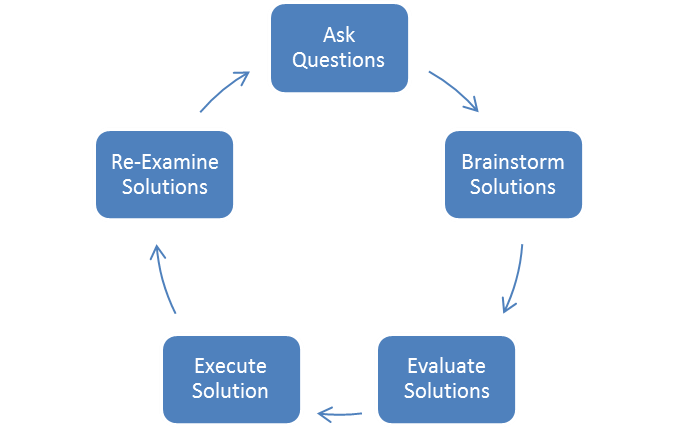
Oftentimes, we equate ‘problem solving’ with ‘critical thinking.’ However, in this case we’re referring to ‘problem solving’ as a method for finding solutions to short-term complications or setbacks. Although strong intuition is important for problem solving, you must also rely on the research and data that you encounter. What is most important is what you do with that combination of intuition and research. Here are the five steps to becoming a better problem solver:

problem-solving-process

  1. Ask a lot of questions to identify the underlying problem. Don’t jump to conclusions.
  2. Brainstorm all of the possible solutions to the problem that you identified.
  3. Evaluate the solutions that you came up with. Determine the feasibility of those ideas.
  4. Execute the most feasible idea. Good problem solvers are responsible for implementing a solution.
  5. Re-evaluate the project throughout its execution. Sometimes you will find out that you are either not solving the underlying problem or there are more problems that need to be solved.

For more information on the myths and facts of problem solving, feel free to visit the link below. This process can be applied in any business setting. By practicing these skills over-and-over, you can become a better problem solver.

http://www.entrepreneur.com/article/217516

Dig Deeper to Solve the Underlying Problems

For the sake of switching things up, I thought that I would share with you a show that really knows how to “dig deep” (pun completely intended) into the things that we often take for granted. If you have the time and are interested in finding ways to approach problems in a very different and unique way, I highly suggest you watch “Going Deep with David Rees” on National Geographic (the show just started airing a couple of weeks ago).

Why does this matter and how does it apply to this course? Sure, the topics may seem silly, ranging from learning how to tie a shoe to creating the perfect ice cube for your scotch, but the show does a great job at taking a simple concept and really understanding the components that go into it. Let me explain one of the episodes to help give you some better insight. The steps are rather detailed, but that’s really the point.

How some of us think about digging a hole:

    1. Grab a shovel.
    2. Dig.

How David Rees thinks about digging a hole:

    1. He first addresses the problem and what he’s looking to accomplish (he wants to build a “party hole”).
    2. David went to an experimental mine at the Colorado School of Mines to understand how these subject matter experts dig holes in the mine. From there, he determines that digging a hole into a rock is too dangerous for him and as a result the scope of his project changes.
    3. He goes to a soil biologist to figure out the best combination of sand, silt, and clay to dig the perfect hole (medium loom).
    4. David then goes to visit “Dr. Shovel” at Penn State University where he tests out a number of shovels to determine which ones are most efficient for him to use. From there, he learns that you actually need a couple of types of shovels for different stages of a dig.
    5. David learns that the hole he designed was actually flawed and potentially dangerous if he doesn’t “shore up the sides.” This discovery makes him adapt and change his original plans.
    6. So where does he go to learn how to shore up the sides? He goes to a golf course to learn how to keep his hole intact.
    7. From there, David goes to a cemetery to meet with a professional digger to learn better techniques on how to dig a hole. They first mark down the location and dimensions of the hole they are going to dig.
    8. He then goes to Harvard University to understand how the field mouse burrows a hole. There, he learns that these field mice dig much faster when they dig together instead of alone. As a result, David learns that he will be much more efficient if he has his friends help dig the hole with him.

Whether you’re a project manager, part of the product development team, or your manager asks you to give a presentation on the dynamics of your competition within the industry, you can use some of the analysis and problem solving skills that are utilized throughout this show. That, and you may get a good laugh out of the show as well. And you thought digging a hole was easy?

Spoiler alert. He ends up digging his party hole.

The Top-Down Approach to Critical Thinking

In this article, which I found on Business Insider, the author discusses how to be a more effective critical thinker and problem solver. He speaks about how after obtaining a position as a strategy consultant after his MBA, he struggled to solve problems quickly and effectively for clients. A mentor then coached him to “START WITH THE ANSWERS.” This advice that was very foreign to the author at the time. He struggled with this concept but his mentor taught him how to start with the basic structure of a problem they were trying to solve and then develop some hypotheses around that problem based on any given knowledge or prior experience. Then they would put the hypotheses down into a structured diagram with answers that tie to the logic of the problem they were trying to solve. The mentor noted that once they knew the structure of the problem and the possible solutions, they could plan the data that proves or disproves their theories.

This immediately made me think of Issue Trees; a concept I struggled with when first presented to us by Professor Noonan in fall semester. I felt that I could not come up with possible solutions before knowing all of the facts or researching all of the relevant information I needed to try to find the solution. But the mentor in this article also makes a good point that the key to this top-down approach to critical thinking is to not be married to the original answer but by having an original hypothesis or hypotheses, one can begin to focus the data that one collects regarding the solution, as well as begin to socialize the “answers” to illicit feedback and reactions, which can help to hone in on a real and viable solution.


Read more: http://www.businessinsider.com/the-better-way-to-solve-problems-in-business-2010-7#ixzz37IYQ5WMo


The Treasure Map — A path to finding ‘business gold’: solutions

One of my two selected topics focuses on solutions.

Treasure Map, Chart your path
A Treasure Map of Solutions

In my preliminary research, I ran across an article in Business Insider, “Nine Steps to Effective Business Problem Solving” by Martin Zwilling. As Zwilling writes, managing any company is all about problem solving. Every employee at every level of the company is constantly evaluating issues and scenarios, coming up with solutions, and implementing them to benefit the company and customers. However, just because everyone participates in the decision making process does not mean everyone has a natural proclivity at finding the best solution for the problem.

In my case, I struggle with ‘solving’ an issue before the person presenting the problem has finished speaking. I need to develop a method where I can process the problem, understand the underlying issues, and identify a couple possible solutions before I jump to a single answer.

Based on Brian Tracy’s “The Power of Self-Discipline,” Zwilling defines the decision making process in his words:

  1. Take the time to define the problem clearly.
  2. Pursue alternate paths on “facts of life” and opportunities.
  3. Challenge the definition from all angles.
  4. lteratively question the cause of the problem.
  5. Identify multiple possible solutions.
  6. Prioritize potential solutions.
  7. Make a decision.
  8. Assign responsibility.
  9. Set a measure for the solution.

Looking at Zwilling’s descriptions of each separate step and my weaknesses, the areas I can most improve when finding a solution are: pausing to understand the problem (no jumping to conclusions!), defining the root cause of the problem, prioritizing potential solutions, and measuring the solution.

These are the four pieces of the decision making process I will research and share in subsequent blog posts. Four pieces that I will use to create my own map of finding ‘golden’ solutions to problems.

Along with further research of the topic, I will be putting my research into practice while at work. My first practice is recognizing when I need to make a decision and simply taking a step back to fully absorb the situation and context of the problem without jumping to conclusions. Look for a story on how I handle this test at work in a subsequent post.