When I first started using PowerPoint, it was full of ClipArt stick figures and tons of text. Slowly, the art of presentation evolved (thankfully!), and ClipArt was no longer an acceptable way to add images to your slides. But, the evolution didn’t necessarily refine our presentation skills that much. The horrendous ClipArt images were only to be replaced by ‘slideuments’ and chart junk. Now, our slides were full of bar graphs and pie charts that didn’t explain anything and a text overload that bored the pants off of the audience. For this semster’s assignment, I turned to Garr Reynolds, author of Presentation Zen, to help with my information design skills. His book is available on Amazon and I highly recommend it to anyone who wants to work on their slide making skills. As a teaser, I am sharing a few of his tips here, some that I found particularly valuable.
Don’t be afraid to use Multimedia
I have seen multimedia being used effectively by many great presenters. Using video clips or even music can impact how the audience reacts to your presentation and how they retain it. A purely narrative style combined with a text heavy presentation can lose the audience’s interest quickly.
Simplify your visuals
If your visuals can’t be understood in 3 seconds, then redesign them to communicate your idea better. Some images or graphics looks great, but if they are too complicated, then it’s time to ditch them for a simpler design.
Less is More
This is something we have heard a lot in any talk/ article about effective presentation but it is an advbice worth repeating. Reduce the text on your slides. The slides should complement the narrator, not make you redundant. Another aspect of less is more is limiting the ideas to just one main idea per slide. It effectively takes the same amount of time to communicate 3 ideas on 3 slides that it takes to go through 3 ideas on one slide. But it will help your audience process each idea better when they are presented separately.
Back off on the Animation
Animation seems to be the shiny new toy everyone is playing with, but be careful not to overdo it. Animation on every slide can distract the audience from your narration.
Buy the book at : http://www.amazon.com/Presentation-Zen-Design-Principles-Presentations-ebook/dp/B00GXADSUU/ref=sr_1_2?ie=UTF8&qid=1407770573&sr=8-2&keywords=presentation+zen
While most of our class was enjoying accounting, I had a pleasure of taking Charlie Goetz’s Entrepreneurship class. Charlie is a fascinating person – full of energy and entrepreneurial spirit , he could survive anywhere. He is also extremely successful, building multiple business from the ground up and selling them to wealthy investors for large sums of money (including a business that exclusively sold french fries). While working on a project in his class, I finally realized that it is not just about ideas and execution – Charlie’s pitch and presentation were keys to his success. One might have the best idea and great execution – but if you can’t sell it to real people, especially people with money and connections, all those ideas will be worthless.
One presentation that each entrepreneur hopes to have is a pitch to a venture capitalist – that means your idea made it past the idea stage, and you have an opportunity to make it big. If you can sell your idea to a venture capitalist, you can sell your presentation to anyone, whether it is your boss, Professor Noonan, or even Dean Lewis. So how does one prepare for this presentation – “the Money Game” section at WSJ has few tips:
– Present Yourself:
Modesty does not pay. Each presentation, whether to a venture capitalist or to your classmates, is a lot like a date. People want to know something about you, they want to know why they should listen to you. Going to straight to your presentation is a lot like like going on a date and saying “Let’s get it on”.
– Tell it to mom:
Keep is simple. Steve Jobs once said:
“Simple can be harder than complex: You have to work hard to get your thinking clean to make it simple. But it’s worth it in the end because once you get there, you can move mountains.”
When making a presentation, keep it simple and understandable. It is always easier to send more information to ones who need more details, but once you loose your audience, it is impossible to get them back. One caveat – the assumption needs to be clearly explained, and your pitch needs to be grounded in reality.
– Don’t Play with numbers:
Integrity is paramount. Whether pitching to a VC or your Boss, you cannot undermine their trust. A lot of presenters try to focus on the positive, but what one needs to show is they have though of the negatives and have a plan to address it. It absolutely necessary that your audience can trust you.
– Stay on the radar:
In class, the presentation may end on the day of the class. Yet in the real world, this is just a start – persistence pays off. Even if you receive a no at the first pitch, you should keep in touch with the investor.
PS. Accounting is crucial to business, and multiple accounting scandals of the 2000s certainly proved that. However, the is always a CPA when you need an accounting advice, but you are the one who needs to make the pitch.
I’ve always been fascinated by the Space Race of the 1960s. I am particularly amazed by the fact that in less than ten short years we went from considering space the realm of Hollywood and science-fiction to the kind of reality that you could watch live on the television in your living room. How did they do it? Computers? A bottomless budget? Sure, there were major advances in computer processing and increases in federal financing, but how did they go from being behind the Soviet Union to surpassing them en route to being the first nation to rendezvous, dock and land on the moon? I believe it has a lot to do with the team management practices that were exercised by NASA’s space flight leadership team. In former Flight Director Gene Kranz’s book Failure is not an Option he described how the NASA team was able to advance quickly through the Apollo program towards landing on the moon by saying, “Apollo succeeded at critical moments like this because the bosses had no hesitation about assigning critical tasks to one individual, trusting his judgment and then getting out of his way.” The basis for this trust was largely due to the emphasis NASA leadership placed on communicating, mapping out systematic solutions to complex problems, and establishing clear responsibilities for solving those problems and executing their designed solutions.
What’s interesting is that this is exactly what we were taught to do in MP. Upon reviewing the slides Professor Noonan presented during the Fall Semester, it is apparent that many of the lessons shared by our own “decision Jedi” were actually put to use by NASA in their effort to win the Space Race. Two slides, in particular seem applicable, which I’ve paraphrased below:
Intro Deck, Slide #24:
MP learning objectives and topics include: (a) defining the central problem in a situation; (b) connecting that problem to effective teamwork; (c) developing and delivering valuable insights; and (d) connecting those insights to effective action. “Excellence is an art won by training and habituation.” – Aristotle
Part 3 Deck, Slide #2:
How can we organize and manage team effort? (A) Appropriate work stream: (i) Targeted analyses, (ii) Spanning the tree, (iii) Driven by issues, and (iv) Focused using hypotheses; (B) Productive: (i) Focused info, resource needs; (ii) Clear, specific deliverables and declines; and (C) Effective use of team: (i) Responsibility and (ii) Coordination.
During the Space Race, the engineers and test pilots at NASA trained religiously, and spent extensive time developing rules and procedures for their flights. Since no one had ever flown in space before, each new mission provided an opportunity to literally “write the manual” on how certain objectives should be reached. Because the lives of the colleagues and friends, as well as the future of the nation, depended upon their precision, these engineers would try to consider every step of every mission from all angles before lighting a single rocket. In doing so, they were essentially asking themselves closing their eyes and asking themselves, “what do we need to do to achieve X?” and then building out mental “issue trees,” branches of which were then assigned to specific departments or team members to research, resolve and execute.
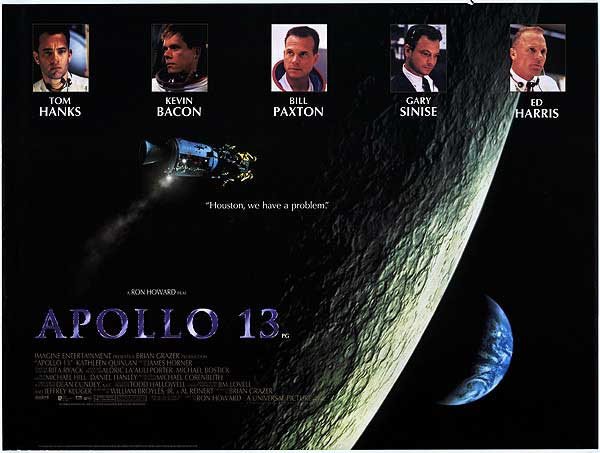
Apollo 13 (Theatrical Poster)
Although this kind of structured team management and leadership was a part of each stage of the Space Race, the most enduring display came in April of 1970, during the Apollo 13 mission. One of the most detailed accounts of how the Apollo 13 problems were tackled can be found in Flight Director Gene Kranz’s account in Failure is not an Option. Kranz describes how he broke the task down into key parts (e.g., power, trajectory, using the LM as a lifeboat for three men when it was designed for two, etc.) and then began in a structured and disciplined form of “brain storming” (or what some might call “brain steering”) during which every option was explored to ensure that the issue tree was mutually exclusive and collectively exhaustive.Short of reading Kranz’s book yourself, you can get an idea of what happened during the Apollo 13 mission by viewing the 1995 film starring Tom Hanks. Below are some key points in the film and links to YouTube clips that help provide a nice representation of this kind of team management:
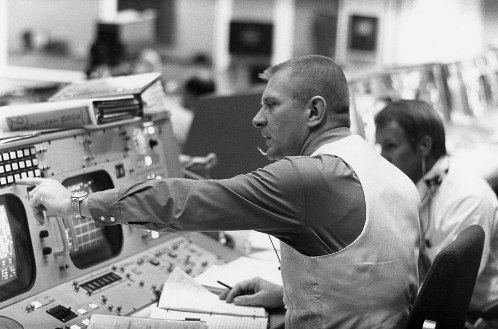
Flight Director, Gene Kranz – sporting his famous “white team” vest
1) Shortly after the explosion occurs on the Command Module, mission control begins to devolve into chaos over the news that the Apollo 13 spacecraft is mysteriously venting oxygen into outer space. Gene Kranz focuses the group by saying, “Let’s work the problem people, let’s not make things worse by guessing.” (NOTE, only the first 42 seconds of this clip are from the scene that I’m referring to here, you can ignore the rest). Kranz’s statement reframes the crisis as a problem that can be solved, not a moment for mindless panic, and in so doing he returns his team to the tasks they’ve been trained to do: solve space flight problems in a systematic fashion. Moreover, although it’s hard to appreciate from this short clip, you can get a sense for how direct the lines of communication are in mission control. Every person has a role to play and their area of expertise is distinct. Gene Kranz sources information from each of them and provides specific instructions to each group. He never says, “somebody go do that” it’s always clear communication directed at a specific individual or sub-team so everyone knows who is responsible for generating the answer to a specific question.
2) After relocating the astronauts to the LM (a/k/a Lunar Module, LEM), Gene Kranz makes it clear that the old flight plan is being tossed out the window and he focuses the team’s brainstorm efforts on the key question, “How do we get our people home?” When the sling-shot around the moon idea is presented a debate ensues, displaying how team members are wearing “different colored hats,” to essentially test the strength of the proposed solution.
3) When faced with the challenge of managing the power supply, a man named “John” proposes that everything must be turned off otherwise the LM will run out of power in 16 hours, not 45 hours. A cacophony of negative responses fills the room but Gene Kranz assesses the situation, makes the decision to power down the LM and moves on with the remaining team members to say they need to find a squeeze every amp out of the electronics in the spacecraft –“failure is not an option!” This particular scene displays the trust Kranz placed in his team members and their expertise, and, again, the power of positioning each challenge as a problem that can be solved by specific team members or sub-groups of team members.
4) As one team works on the electronic power issues, another is just discovering that the CO2 levels in the LEM are rising and that the filters from the Odyssey and the LEM are not compatible. This leads to the famous “Square peg in a round hole” problem. This might be the most incredible problem solved during the mission, and if you’d like to read more about it, you can do so here. The work done by Ed Smylie’s “tiger team” unquestionably saved the lives of the three astronauts, but again it shows the value of breaking a big problem (“how do we get our guys home?”) into smaller questions and dividing the task of researching and resolving those problems up to be the responsibility of smaller groups or individuals.
Years later, the Apollo 13 the flight commander, Jim Lovell, during a separate interview, suggested the Apollo 13 mission and provides several key takeaways for business leaders:
Identify the problem and figure out what you have to solve it;
Communicate – you need to share information with your team members in order to solve the problem;
Good leadership and good teamwork are marked by perseverance and initiative.
Thanks to this structured approach to problem solving and team management, NASA was able to bring the crew of Apollo 13 home and in the process they achieved what is largely regarded as the administration’s finest hour. If you’re interested in learning how you too can achieve this level of success within your own organization, I would invite you to review the aforementioned slides and check out the movie Apollo 13 on iTunes or your preferred viewing platform. Remember, “FAILURE IS NOT AN OPTION!”
Apollo 13 crew members Fred W. Haise, James A. Lovell, and John L. “Jack” Swigert, arriving at the USS Iwo Jema after safely landing in the South Pacific Ocean.
Think back to the first time you had to make a decision in a corporate setting. Take a moment and ask yourself some question:
– What was the problem at hand?
– Did you have all of the information that you needed to accurately make a decision?
– Did you have enough time to think over all of the potential outcomes?
– Or conversely, did you have so much time, that you started to second guess yourself?
Now, I will ask a different question. Think about the first bad decision that you made; a decision that had an outcome that was not what you were hoping for. Ask yourself the same questions. Then ask yourself, what would have been different, had you sought help from those around you, and made a decision as a group, rather than as an individual?
I personally find the group mentality to be frustrating, even maddening, at times, since, typically the more minds that come together, the more lag there will be until a decision. I know that many share my feelings, and in fact, the majority of corporate decisions are made on an individual basis. It is always easiest to have someone to point the blame at if things go wrong. Is this mentality the most effective decision making tool that we have in our arsenal?
In the HBR article entitled, The Five Habits of Highly Effective Hives, Thomas Seeley analogies the group think process to that of Honey Bees. Professor Seeley explains an effective method for maximizing our collective IQ, and ultimately obtaining better solutions then one might without a group. His five step method is below:
Remind the group’s members of their shared interests and foster mutual respect, so they work together productively.
Explore diverse solutions to the problem, to maximize the group’s likelihood of uncovering an excellent option.
Aggregate the group’s knowledge through a frank debate.
Minimize the leader’s influence on the group’s thinking.
Balance interdependence (information sharing) and independence (absence of peer pressure) among the group’s members.
Decision making is arguably the most overlooked competency in organizations today. People are promoted based on an assumption that they are better decision makers than others. Yet, group decision making proves to be an insurmountable hurdle for many corporations today. Mastery of both theory and implementation of this soft skill will not only positively impact your corporation, but also your personal brand. Practice this skill and help to raise the collective IQ of the group.
In our office, it’s nearing the end of the fiscal year and that means performance reviews. The annual performance review was completely redesigned this year. In addition, there has been a huge push from above to make sure many more employees averaged close to a “3” in a 1-5 performance scale. Due to these changes, there was a lot of general confusion about what was expected of each employee for their personal review as well as what to expect at one-on-one reviews with supervisors. These changes ultimately had little to no effect on raise decisions; however while speaking with colleagues, it became obvious that the cumulative effect of these changes was a destruction of morale and trust that had nothing to do with money.
Destruction of morale is just a small part of the damage a performance review might have on an organization. An article in the Wall Street Journal discusses several reasons why performance reviews, as they are commonly structured, are damaging and ill-advised. A few of these reasons are detailed below:
1. The boss and subordinate have two different mindsets walking into a review. The boss wants to talk about “skill limitations and relationships,” while the subordinate wants to negotiate a raise. At best, this discussion accomplishes nothing but, the author states, it more likely causes ill-will between the two people that has far reaching problems in day-to-day life.
2. There’s a widely held belief that performance determines pay; however raises are generally determined by the yearly budget and the overall economy and marketplace. The performance review often turns into a thinly-veiled justification for the raise the employee will receive, good or bad.
3. Performance reviews are generally set up to appear “objective” but because a single person is reviewing a number of people, the assessment cannot be free of the bias, motives, and feelings of the reviewer at that moment.
4. This same boss who must review a number of people simultaneously might be comparing very different people with sometimes very different job responsibilities but holding them all to the same criteria. For example, a trait that might be seen as an asset in one instance or by one reviewer could be seen as an impediment in a different situation or by a different reviewer. Similarly, two different employees may have two different ways to get a job done. Although both employees might achieve the same outcome, the boss may agree with one methodology and rate one person higher than the other. Unfortunately, this rating has little to do with actual performance.
5. Reviews in general impede personal development. If employees need help, they’re often afraid to speak to their bosses. Employees may feel that by acknowledging that there is a gap in their ability or knowledge, bosses will see that in a negative light and will decrease their potential raises for the upcoming year. Therefore, people do not grow as employees because they fear the retribution from asking questions.
Performance reviews seem to be a necessary evil but do they have to be? Perhaps there are alternatives to the performance review. The writer of the WSJ article focuses on addressing reviews as a team endeavor between the boss and subordinate and not as an adversarial experience in which both players enter the discussion on the defensive. He defines these meetings as “previews” instead of “reviews” in which both the boss and subordinate assess each other and when there is a problem with their teamwork, both members of the team must discuss and work to fix the problem at hand. The hope is that perhaps these changes lead to a more productive and healthy work environment and less game-playing and morale destruction.
This past Thursday I, along with the rest of my classmates, had the opportunity to hear our professor, Professor Noonan, tell his story. I thought bout how would I tell a story, in a way that is purposeful and powerful.
I stumbled upon this article describing how to tell a great story. One who can tell a great story holds the power of influence. The good thing is the article tells us that the art of story telling is not something innate, but it is something that can be learned. I know that story telling is something that I would love to improve on. I am pretty loquacious myself so I would prefer to give an interesting story while talking. So what does it take to tell a great story. Well the article explains that you want to ensure that you:
Start With A Message
Know who your audience is and begin with a message that speaks to them or the problem you want to acknowledge
Mine Your Own Experiences
Use personal and life experience to express your message so that the audience can relate to what you’re saying
Don’t Make Yourself The Hero
Let the details of the story be the essence of the story and not yourself.
Highlight A Struggle
The author of the blog describes it best that “A story without a challenge simply isn’t very interesting”
Keep It Simple
Don’t let unnecessary details overshadow the true message
Practice Makes Perfect
Storytelling is an art and like any art it requires practice
Although the MP projects we were given the previous two semesters were real issues, one aspect that was limited (due to the sheer number of students) was a constant engagement between us and the firm we were trying to help, to narrow the scope. Boiling down to the scope was part of the MP learning process, however Detlof von Winterfeld and Barbara Fasolo point out in “Structuring Decision Problems: A Case Studying and Reflections for Practitioners” how much of an iterative process structuring a problem and decision analysis can be. Shown below is the decision analysis ‘snake diagram’ that clearly shows the back and forth that is necessary, especially in the early stages of a project, between the decision board (decision makers) and the decision team (decision analysts – those that are responsible for formulating a solution). After being given the scope of the problem, the decision team has the decision board sign off on their understanding of the problem prior to moving on. This gives the decision analysts an opportunity to refine the scope of the project with the assistance of the decision makers.
Brainstorming is also included in the way of developing alternatives and assessing them. Not surprisingly the Plan for Action and Implementation only take up a third of this process with most of the foundation work being done prior, as was suggested in MP.
Figure 1. Spetzler Snake Diagram for Decision Analysis. von Winterfeldt, Detlof and Fasolo, Barbara, “Structuring Decision Problems: A Case Studying and Reflections for Practitioners” (2009). Published Articles & Papers. Paper 30.
“You don’t drive races on paper” – Kimi Raikkonen.
I have been a Formula1 racing aficionado since a kid. I would watch live telecast of a race hosted in any time-zone and also attended the Grand Prix at Austin. Their planning, strategy, risk management and precision has always amazed me. For once I saw the race from the eyes of a Project Manager and not a race car aficionado. There is so much that I have learnt which helped me in handling my projects much efficiently.
If we compare, Formula1 season is like a project and each race is like a milestone. The season has a Scope, Timelines, Requirements, Resources, Budget, Strategy, WBS, Quality assurance, KPIs and so does each race. Engineers, designers, mechanics, PR all work for the driver to help him minimize risk and increase the opportunities to win the race.
A race car driver is faced with competition, risk of crash, financial loss if any damage to the car and more. With all these, it is only imperative that the team provide an early identification and assessment of risks. The point is to know and stick to a threshold. We need to go through the hardship of taking the risk to either be successful or learn the lesson and move on.
“ I accept every time I get into my car, that there is a 20% chance I could die, and I can live with that risk – but not 1% more” – Nikki Lauda
Project management shall lead to the team success. Project plan which is monitored and updated as necessary, maintaining communication with all the stakeholders, maintain all the project documentation including meetings notes, technical reports, Analytics, diagnostic reports, KPIs and develop contingency plan for all the risks. All the above apply equally the same to Formula1 or software development or construction of a building or any other project. Any slight error to capture or communicate information would have an impact on the productivity and performance. Thereby posing huge threat on the budget or deadlines.
The project manager should be wise to have the technical resources working only on the dedicated project without having any internal pressure to work on other projects. If resources have to be shared project manager should plan to have the phase prior to entering the core of project work as switching projects would interfere with engineer’s concentration. All communication should happen at the discretion of the project manager, who in turn should be capable of knowing what to speak, when and to whom.
It is also very important to know who is responsible and who is accountable for what. During the race the Pit stop-team is responsible for changing the tires, cleaning driver’s helmet, replacing the damaged body parts, etc. It is the responsibility of one ‘lollypop man’ to control the car’s departure from the pit stop. The precise timing and millimeter perfect choreography plays an important role in the race. If a nut is loose, someone at the pit-stop is held accountable. If departure timing conflicts with another race car, the lollypop man is held accountable. In any projects RACSI (Responsible, Accountable, Consulted, Supported and Informed) plays a vital role to manage the roles and responsibilities of stakeholders and team members of a project.
I could writes pages and never give a closure to this article. There is a lot to be explored and learnt and every race gives me a new insight.
The class got a brief glimpse into what Prezi can do during the final MP class on Thursday, but I thought that I would provide a few tips, tutorials and links that I used to orient myself with the program.
In the simplest terms, there are four steps to make a presentation in Prezi:
1. Enter content onto the canvas (words, pictures, videos, etc.)
2. Frame the content with one of the shaped frames (circle, square, brackets) or an invisible frame.
3. Connect the frames in a path (similar to re-arranging slides on the left-hand side of the page).
4. Re-position the frames to convey relation (drag and drop the frames on the canvas).
When creating spacial relations, remember that you can convey relation in three ways:
1. In the x-y direction, i.e. up, down or diagonal
2. Rotation (make sure that you don’t rotate slides too much, or the transitions may become confusing and difficult to follow. In general, its best to use rotations <45 degrees).
3. Size/Depth. The ability to zoom in and out can either be used to convey differences in size, relationship into or out of the page, or even both.
I believe that one of the hardest part of giving a great presentation, is the ability to persuade your audience. Sure, I can give you tons and tons of data to back up why my solution is the best. But showing data sometimes is not enough. How you structure how to present the solution is an important aspect as well.
The article “6 Steps to Building a Better Sales Pitch” shares that “You need to get to the heart of why this activity is in their best interest.” In other words, why should they care? It suggests that asking the six questions below will help put you on the right path of building a case.
1. What is the potential value in this situation?
You have to have a logical financial and strategic foundation to create value.
2. Who do you need to convince?
3. What motivates each party?
It’s important to understand what drives a stakeholder’s behavior and focus.
4. What items will you need to seal the deal?
5. What actions do you want each party to take?
Laying out a specific path the stakeholder definitely helps them visualize how this action plan can work for them.
6. How can you most effectively communicate the action you want them to take?
Presentation and format depend on your target. Tailor your message to the style of the audience.