Recent polls suggest Americans have had enough at work. The labor market seems to require more and more of the workforce – balancing continuing education, extracurriculars, and networking all while doing the job leads many of us to feel burntout. As a class of Evening MBA students, I’m sure every one of us can relate.
I’m quite a collector of “better living through research” materials and have noticed three burnout coping strategies that have proven themselves useful again and again.
1. Schedule daily quiet time.
“Everyday I start off happy, but then your boss is calling, your phone is ringing, and the dogs are barking. You’re trying to write an email and suddenly three people text you about a firedrill involving an SVP and a rejected project proposal. How am I supposed to manage stress if I can’t escape it?”
It’s a stress management trope for a reason: it works. Some call it unplugging, prayer, or meditation but no matter how you label it, humans were not designed to have constant stimuli interrupting their thoughts and functions. I subscribe to meditation twice a day, and have recently picked up transcendental meditation as a way to further my own practice.
2. Make time for nothing. Yes, nothing.
As my mother likes to say, “It’s your job to take care of you”. Schedule downtime and protect it fiercely. Sometimes that means protecting it from yourself – leave an hour a day to unwind and relax, and resist the temptation to fill that time with distractions like housework or chores (unless that means relaxation to you).
3. Learn to recognize burnout behaviors and have an action plan at the ready.
“I left the stove on last night, really? Yes, that is a nervous eyelid twitch. No, I will not stop watching Parks and Rec and eating waffles – Leslie Knope gets me.”
Humans are creatures of habit and when threatened, we tend to revisit the same patterns that make us feel safe – whether it’s drinking too much, sleeping in, or even becoming selectively forgetful; when we’re burntout or stressed, our personal coping mechanisms rear their ugly heads.
If there’s a behavior in your life that seems to appear every time you’re facing a heavy workload or are scraping the bottom of the energy barrel, it’s a safe bet that burnout is on the horizon. Once you recognize these patterns, have a plan ready to address them.
Recently I made a presentation what I think every successful leader needs for management practice. It’s what I called the 4p’s of successful leadership. Those 4p’s are Performance, Perception, Personality and Passion.
I found this article because after presenting I was interested in seeing what other people’s opinion are on what qualities should leaders possess and I thought it would worth sharing. This article asked 332, 860 professionals-what skills have the greatest impact on a leader’s success in a position the respondent’s currently hold?
What is interesting is number one with 38% said Inspires and motivates. That aligns right with one of my P’s, personality.
See the full article to see the rankings on characteristics of a leader.
I’ve always been fascinated by the Space Race of the 1960s. I am particularly amazed by the fact that in less than ten short years we went from considering space the realm of Hollywood and science-fiction to the kind of reality that you could watch live on the television in your living room. How did they do it? Computers? A bottomless budget? Sure, there were major advances in computer processing and increases in federal financing, but how did they go from being behind the Soviet Union to surpassing them en route to being the first nation to rendezvous, dock and land on the moon? I believe it has a lot to do with the team management practices that were exercised by NASA’s space flight leadership team. In former Flight Director Gene Kranz’s book Failure is not an Option he described how the NASA team was able to advance quickly through the Apollo program towards landing on the moon by saying, “Apollo succeeded at critical moments like this because the bosses had no hesitation about assigning critical tasks to one individual, trusting his judgment and then getting out of his way.” The basis for this trust was largely due to the emphasis NASA leadership placed on communicating, mapping out systematic solutions to complex problems, and establishing clear responsibilities for solving those problems and executing their designed solutions.
What’s interesting is that this is exactly what we were taught to do in MP. Upon reviewing the slides Professor Noonan presented during the Fall Semester, it is apparent that many of the lessons shared by our own “decision Jedi” were actually put to use by NASA in their effort to win the Space Race. Two slides, in particular seem applicable, which I’ve paraphrased below:
Intro Deck, Slide #24:
MP learning objectives and topics include: (a) defining the central problem in a situation; (b) connecting that problem to effective teamwork; (c) developing and delivering valuable insights; and (d) connecting those insights to effective action. “Excellence is an art won by training and habituation.” – Aristotle
Part 3 Deck, Slide #2:
How can we organize and manage team effort? (A) Appropriate work stream: (i) Targeted analyses, (ii) Spanning the tree, (iii) Driven by issues, and (iv) Focused using hypotheses; (B) Productive: (i) Focused info, resource needs; (ii) Clear, specific deliverables and declines; and (C) Effective use of team: (i) Responsibility and (ii) Coordination.
During the Space Race, the engineers and test pilots at NASA trained religiously, and spent extensive time developing rules and procedures for their flights. Since no one had ever flown in space before, each new mission provided an opportunity to literally “write the manual” on how certain objectives should be reached. Because the lives of the colleagues and friends, as well as the future of the nation, depended upon their precision, these engineers would try to consider every step of every mission from all angles before lighting a single rocket. In doing so, they were essentially asking themselves closing their eyes and asking themselves, “what do we need to do to achieve X?” and then building out mental “issue trees,” branches of which were then assigned to specific departments or team members to research, resolve and execute.
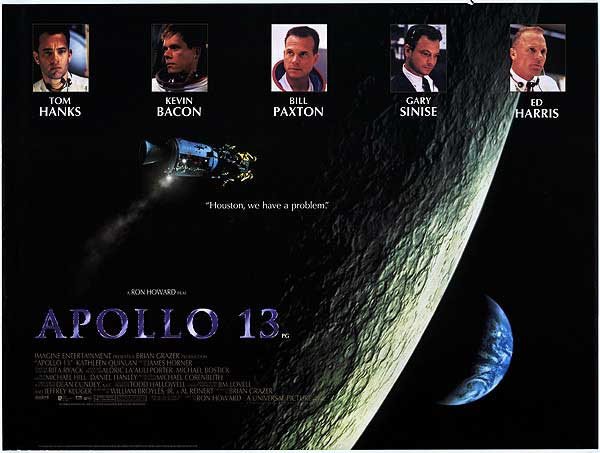
Apollo 13 (Theatrical Poster)
Although this kind of structured team management and leadership was a part of each stage of the Space Race, the most enduring display came in April of 1970, during the Apollo 13 mission. One of the most detailed accounts of how the Apollo 13 problems were tackled can be found in Flight Director Gene Kranz’s account in Failure is not an Option. Kranz describes how he broke the task down into key parts (e.g., power, trajectory, using the LM as a lifeboat for three men when it was designed for two, etc.) and then began in a structured and disciplined form of “brain storming” (or what some might call “brain steering”) during which every option was explored to ensure that the issue tree was mutually exclusive and collectively exhaustive.Short of reading Kranz’s book yourself, you can get an idea of what happened during the Apollo 13 mission by viewing the 1995 film starring Tom Hanks. Below are some key points in the film and links to YouTube clips that help provide a nice representation of this kind of team management:
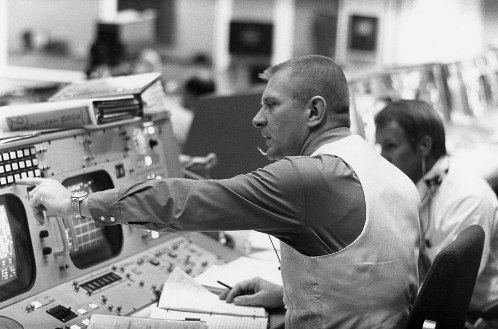
Flight Director, Gene Kranz – sporting his famous “white team” vest
1) Shortly after the explosion occurs on the Command Module, mission control begins to devolve into chaos over the news that the Apollo 13 spacecraft is mysteriously venting oxygen into outer space. Gene Kranz focuses the group by saying, “Let’s work the problem people, let’s not make things worse by guessing.” (NOTE, only the first 42 seconds of this clip are from the scene that I’m referring to here, you can ignore the rest). Kranz’s statement reframes the crisis as a problem that can be solved, not a moment for mindless panic, and in so doing he returns his team to the tasks they’ve been trained to do: solve space flight problems in a systematic fashion. Moreover, although it’s hard to appreciate from this short clip, you can get a sense for how direct the lines of communication are in mission control. Every person has a role to play and their area of expertise is distinct. Gene Kranz sources information from each of them and provides specific instructions to each group. He never says, “somebody go do that” it’s always clear communication directed at a specific individual or sub-team so everyone knows who is responsible for generating the answer to a specific question.
2) After relocating the astronauts to the LM (a/k/a Lunar Module, LEM), Gene Kranz makes it clear that the old flight plan is being tossed out the window and he focuses the team’s brainstorm efforts on the key question, “How do we get our people home?” When the sling-shot around the moon idea is presented a debate ensues, displaying how team members are wearing “different colored hats,” to essentially test the strength of the proposed solution.
3) When faced with the challenge of managing the power supply, a man named “John” proposes that everything must be turned off otherwise the LM will run out of power in 16 hours, not 45 hours. A cacophony of negative responses fills the room but Gene Kranz assesses the situation, makes the decision to power down the LM and moves on with the remaining team members to say they need to find a squeeze every amp out of the electronics in the spacecraft –“failure is not an option!” This particular scene displays the trust Kranz placed in his team members and their expertise, and, again, the power of positioning each challenge as a problem that can be solved by specific team members or sub-groups of team members.
4) As one team works on the electronic power issues, another is just discovering that the CO2 levels in the LEM are rising and that the filters from the Odyssey and the LEM are not compatible. This leads to the famous “Square peg in a round hole” problem. This might be the most incredible problem solved during the mission, and if you’d like to read more about it, you can do so here. The work done by Ed Smylie’s “tiger team” unquestionably saved the lives of the three astronauts, but again it shows the value of breaking a big problem (“how do we get our guys home?”) into smaller questions and dividing the task of researching and resolving those problems up to be the responsibility of smaller groups or individuals.
Years later, the Apollo 13 the flight commander, Jim Lovell, during a separate interview, suggested the Apollo 13 mission and provides several key takeaways for business leaders:
Identify the problem and figure out what you have to solve it;
Communicate – you need to share information with your team members in order to solve the problem;
Good leadership and good teamwork are marked by perseverance and initiative.
Thanks to this structured approach to problem solving and team management, NASA was able to bring the crew of Apollo 13 home and in the process they achieved what is largely regarded as the administration’s finest hour. If you’re interested in learning how you too can achieve this level of success within your own organization, I would invite you to review the aforementioned slides and check out the movie Apollo 13 on iTunes or your preferred viewing platform. Remember, “FAILURE IS NOT AN OPTION!”
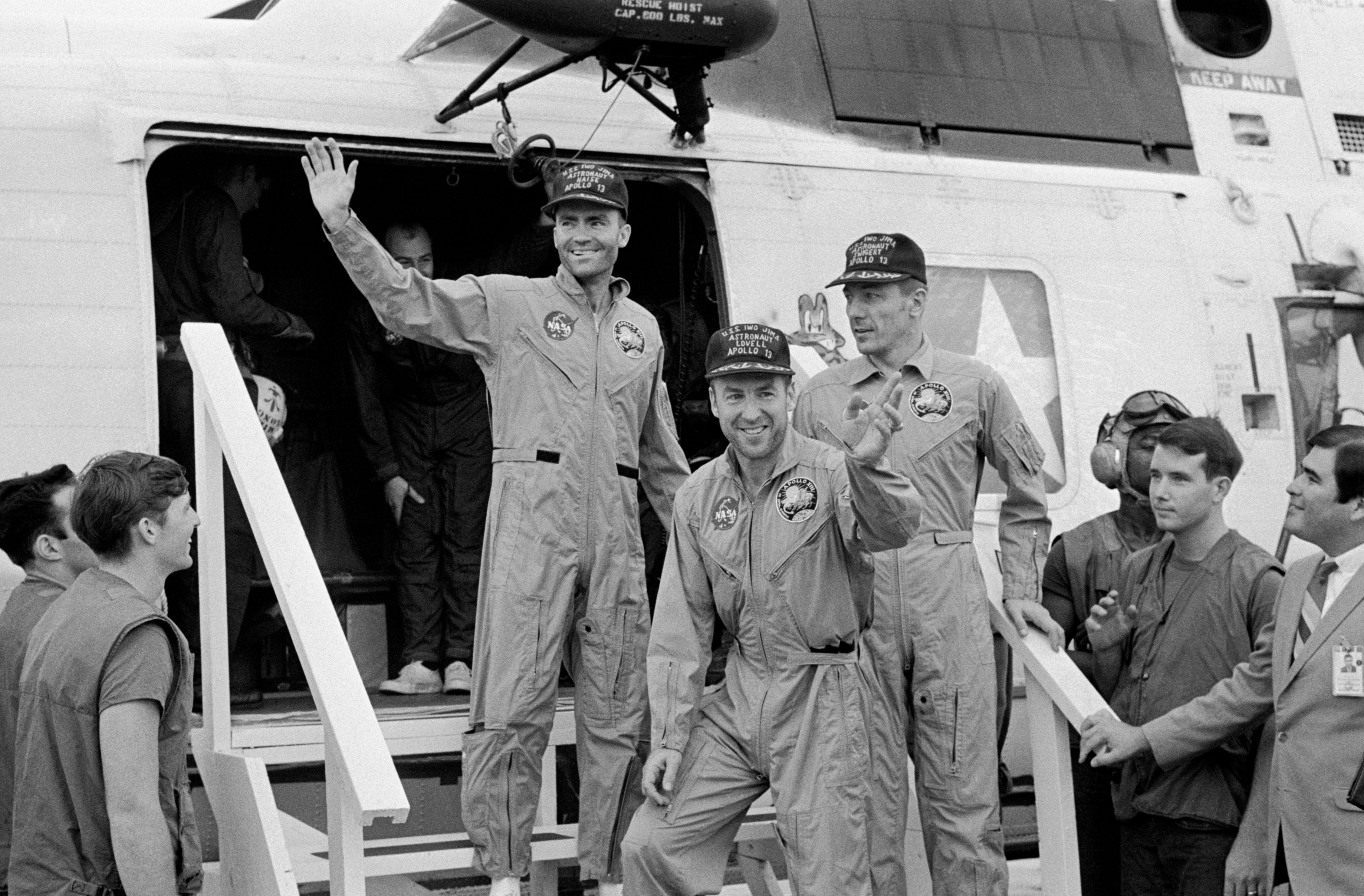
Apollo 13 crew members Fred W. Haise, James A. Lovell, and John L. “Jack” Swigert, arriving at the USS Iwo Jema after safely landing in the South Pacific Ocean.
Although the MP projects we were given the previous two semesters were real issues, one aspect that was limited (due to the sheer number of students) was a constant engagement between us and the firm we were trying to help, to narrow the scope. Boiling down to the scope was part of the MP learning process, however Detlof von Winterfeld and Barbara Fasolo point out in “Structuring Decision Problems: A Case Studying and Reflections for Practitioners” how much of an iterative process structuring a problem and decision analysis can be. Shown below is the decision analysis ‘snake diagram’ that clearly shows the back and forth that is necessary, especially in the early stages of a project, between the decision board (decision makers) and the decision team (decision analysts – those that are responsible for formulating a solution). After being given the scope of the problem, the decision team has the decision board sign off on their understanding of the problem prior to moving on. This gives the decision analysts an opportunity to refine the scope of the project with the assistance of the decision makers.
Brainstorming is also included in the way of developing alternatives and assessing them. Not surprisingly the Plan for Action and Implementation only take up a third of this process with most of the foundation work being done prior, as was suggested in MP.
Figure 1. Spetzler Snake Diagram for Decision Analysis. von Winterfeldt, Detlof and Fasolo, Barbara, “Structuring Decision Problems: A Case Studying and Reflections for Practitioners” (2009). Published Articles & Papers. Paper 30.
In this article, which I found on Business Insider, the author discusses how to be a more effective critical thinker and problem solver. He speaks about how after obtaining a position as a strategy consultant after his MBA, he struggled to solve problems quickly and effectively for clients. A mentor then coached him to “START WITH THE ANSWERS.” This advice that was very foreign to the author at the time. He struggled with this concept but his mentor taught him how to start with the basic structure of a problem they were trying to solve and then develop some hypotheses around that problem based on any given knowledge or prior experience. Then they would put the hypotheses down into a structured diagram with answers that tie to the logic of the problem they were trying to solve. The mentor noted that once they knew the structure of the problem and the possible solutions, they could plan the data that proves or disproves their theories.
This immediately made me think of Issue Trees; a concept I struggled with when first presented to us by Professor Noonan in fall semester. I felt that I could not come up with possible solutions before knowing all of the facts or researching all of the relevant information I needed to try to find the solution. But the mentor in this article also makes a good point that the key to this top-down approach to critical thinking is to not be married to the original answer but by having an original hypothesis or hypotheses, one can begin to focus the data that one collects regarding the solution, as well as begin to socialize the “answers” to illicit feedback and reactions, which can help to hone in on a real and viable solution.
Although my GBS colleague Jag Sheth is best known as a professor of marketing, when digging around in almost any field of management, sooner or later one finds his influence if not some of his actual work.
Management Practice is no different, and that doesn’t surprise me at bit, given Jag’s years of experience thinking and writing about the practice of marketing, on top of his theoretical and scholarly work.
One of the connections between Jag and MP can be found in his 2000 book Clients for Life, which he wrote with Andrew Sobel. As you know, we frame the MP course in a way that causes us to think of internal as well as external “clients.” In effect, we can see clients everywhere, even if we’re not explicitly working with them as someone in a professional services firm might.
Given that, Jag’s book offers some good advice for all of us who seek to have, as his introduction begins, “loyal clients who come back to use year after year.” We want that “double win” I keep mentioning: being seen as doing good work, and having that work credited with helping others make good decisions and take action.
Jag and his co-author frame their goal as moving people – you, for example – from “expert-for-hire” to “trusted advisor.” They want to help with professional growth, clearly. As such, it also intersects with the Leadership Development course that lies ahead for you after you complete MP.
Tackling the entire book is likely more than you need to take on during your MBA studies, but here is a PDF with the Introduction and Chapter One, to give you a sense of what they’re recommending. That might help you determine if and when you might want to take in the entire book. [The GBL is going to place this on e-reserves, and when it’s available by that route I’ll replace this attachment with a link.]