“It is not simply what we say, but how we say it, and how we look while saying it.”
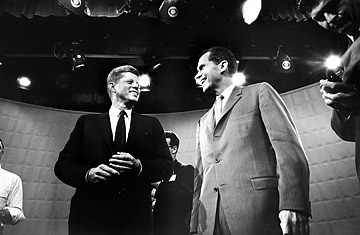
Jack Kennedy, left, and Dick Nixon before their 1st TV debate.
Today, I attended a training course on communicating assertively. It was filled with a lot of great takeaways, and the focus was around adapting your approach towards others for optimum results. The instructor brought up the three “V’s” when communicating with others: verbal, vocal, and visual. It is primarily the vocal (tone) and visual (appearance, facial expressions, body language) that impact communication. Together, these two V’s count for 93% of the impact. Of course, this is context dependent, but the statement led one of my colleagues to mention the famous Kennedy vs. Nixon debate.
In case you are unaware, this was the first presidential debate ever broadcasted on TV. The debate of course was also broadcasted on the radio, and for those listeners who were polled, more said that Nixon was the winner than Kennedy. For those who were lucky enough to watch the debate on TV, more said that Kennedy was the winner. The conclusion—Kennedy’s visual appearance and presence was superior to Nixon’s, and this made him the clear winner, at least to those who watched it on TV.
I was not around for this debate and have not had a chance to watch it yet, but from what I have read, some words used to describe Kennedy after the debate were handsome, dapper, calm, confident, and poised, while Nixon was described as sickly, clammy-faced, awkward, and sweaty. We all know that Kennedy went on to win the presidency, and many believe that this televised debate was what took him from a young, relatively unknown senator to a star in one night.
After hearing this story, I searched for some articles about this debate to investigate. Some argue that the polls used were not statistically significant, and I will leave that up to you to decide. In the end, I do believe that when it comes to communicating and presenting, tone and body language influence the verbal message. It is not simply what we say, but how we say it, and how we look while saying it. We all need to take this into consideration when presenting for impact.
Interesting Time Article on the debate and its impact on the world.
SCHUTZER, PAUL. Democratic and Republican presidential candidates Jack Kennedy, left, and Dick Nixon stand underneath glaring lights prior to beginning their 1st TV debate. Digital image. How the Nixon-Kennedy Debate Changed the World. Time, 23 Sept. 2010. Web. 14 Aug. 2014.