I recently listened to Walter Isaacson’s book Steve Jobs, in which the reader (or in my case the listener) is treated to a behind the scenes view of the rise of Apple, Inc. and the role played by its founder. One of the most memorable moments in the book comes when only a week before the scheduled launch of the Macintosh a small team of engineers and designers approaches Jobs to let him know they won’t be able to make the deadline. In an effort to rally and cajole his team to meet the deadline, he exclaims, “Real Artists Ship!”
The concept was that it doesn’t matter if you’re the most creative person in the world if you can’t deliver on that creativity. There are no shortages of accounts in Isaacon’s book that suggest Jobs was a lover of creative thinking and artistic design –some might say he held that in higher regard than anything else –but this particular instance indicates his clear understanding on the value of delivering the goods –on setting a deadline and sticking to it, no matter what.
All too often in life (with the exception of legal filing deadlines during my years as a litigator) I have been soft on deadlines. Whether it’s with myself or with people who are reporting to me. I adopt an “okay, we can push it back one more week,” mentality, believing, like Jobs’s engineers that one more read through of a contract or one more week spent practicing tennis before a big match is going to make a substantive difference. Jobs’s point, however, was that it does not matter if you have written the perfect contract or crafted the perfect forehand volley if you can’t get out there and share it with the world. The reason “real artists ship,” is that you only know about the artists that actually sat down and delivered their work –the others, well, they weren’t artists, they were just dreamers. So set your deadlines for yourself and your team and stick to them! Real Artists Ship!
If you’d like to read a firsthand account of what it was like trying to meet the Mac software deadline, you can do so here, where Andy Hertzfeld shares his perspective on running under the gun of Steve Jobs.
I’ve always been fascinated by the Space Race of the 1960s. I am particularly amazed by the fact that in less than ten short years we went from considering space the realm of Hollywood and science-fiction to the kind of reality that you could watch live on the television in your living room. How did they do it? Computers? A bottomless budget? Sure, there were major advances in computer processing and increases in federal financing, but how did they go from being behind the Soviet Union to surpassing them en route to being the first nation to rendezvous, dock and land on the moon? I believe it has a lot to do with the team management practices that were exercised by NASA’s space flight leadership team. In former Flight Director Gene Kranz’s book Failure is not an Option he described how the NASA team was able to advance quickly through the Apollo program towards landing on the moon by saying, “Apollo succeeded at critical moments like this because the bosses had no hesitation about assigning critical tasks to one individual, trusting his judgment and then getting out of his way.” The basis for this trust was largely due to the emphasis NASA leadership placed on communicating, mapping out systematic solutions to complex problems, and establishing clear responsibilities for solving those problems and executing their designed solutions.
What’s interesting is that this is exactly what we were taught to do in MP. Upon reviewing the slides Professor Noonan presented during the Fall Semester, it is apparent that many of the lessons shared by our own “decision Jedi” were actually put to use by NASA in their effort to win the Space Race. Two slides, in particular seem applicable, which I’ve paraphrased below:
Intro Deck, Slide #24:
MP learning objectives and topics include: (a) defining the central problem in a situation; (b) connecting that problem to effective teamwork; (c) developing and delivering valuable insights; and (d) connecting those insights to effective action. “Excellence is an art won by training and habituation.” – Aristotle
Part 3 Deck, Slide #2:
How can we organize and manage team effort? (A) Appropriate work stream: (i) Targeted analyses, (ii) Spanning the tree, (iii) Driven by issues, and (iv) Focused using hypotheses; (B) Productive: (i) Focused info, resource needs; (ii) Clear, specific deliverables and declines; and (C) Effective use of team: (i) Responsibility and (ii) Coordination.
During the Space Race, the engineers and test pilots at NASA trained religiously, and spent extensive time developing rules and procedures for their flights. Since no one had ever flown in space before, each new mission provided an opportunity to literally “write the manual” on how certain objectives should be reached. Because the lives of the colleagues and friends, as well as the future of the nation, depended upon their precision, these engineers would try to consider every step of every mission from all angles before lighting a single rocket. In doing so, they were essentially asking themselves closing their eyes and asking themselves, “what do we need to do to achieve X?” and then building out mental “issue trees,” branches of which were then assigned to specific departments or team members to research, resolve and execute.
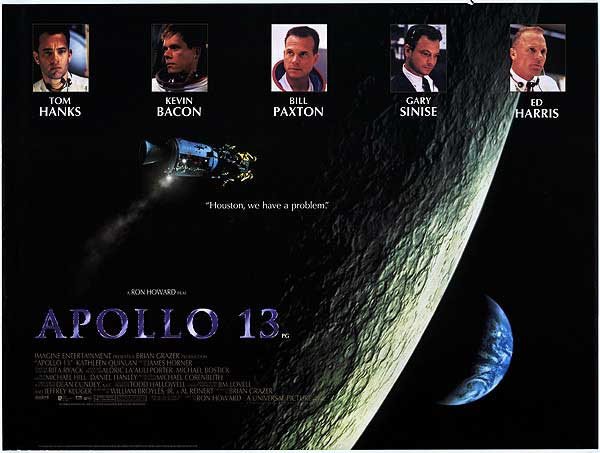
Apollo 13 (Theatrical Poster)
Although this kind of structured team management and leadership was a part of each stage of the Space Race, the most enduring display came in April of 1970, during the Apollo 13 mission. One of the most detailed accounts of how the Apollo 13 problems were tackled can be found in Flight Director Gene Kranz’s account in Failure is not an Option. Kranz describes how he broke the task down into key parts (e.g., power, trajectory, using the LM as a lifeboat for three men when it was designed for two, etc.) and then began in a structured and disciplined form of “brain storming” (or what some might call “brain steering”) during which every option was explored to ensure that the issue tree was mutually exclusive and collectively exhaustive.Short of reading Kranz’s book yourself, you can get an idea of what happened during the Apollo 13 mission by viewing the 1995 film starring Tom Hanks. Below are some key points in the film and links to YouTube clips that help provide a nice representation of this kind of team management:
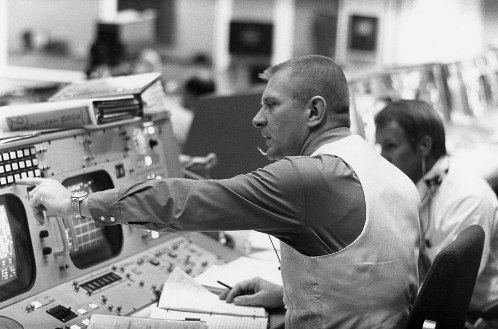
Flight Director, Gene Kranz – sporting his famous “white team” vest
1) Shortly after the explosion occurs on the Command Module, mission control begins to devolve into chaos over the news that the Apollo 13 spacecraft is mysteriously venting oxygen into outer space. Gene Kranz focuses the group by saying, “Let’s work the problem people, let’s not make things worse by guessing.” (NOTE, only the first 42 seconds of this clip are from the scene that I’m referring to here, you can ignore the rest). Kranz’s statement reframes the crisis as a problem that can be solved, not a moment for mindless panic, and in so doing he returns his team to the tasks they’ve been trained to do: solve space flight problems in a systematic fashion. Moreover, although it’s hard to appreciate from this short clip, you can get a sense for how direct the lines of communication are in mission control. Every person has a role to play and their area of expertise is distinct. Gene Kranz sources information from each of them and provides specific instructions to each group. He never says, “somebody go do that” it’s always clear communication directed at a specific individual or sub-team so everyone knows who is responsible for generating the answer to a specific question.
2) After relocating the astronauts to the LM (a/k/a Lunar Module, LEM), Gene Kranz makes it clear that the old flight plan is being tossed out the window and he focuses the team’s brainstorm efforts on the key question, “How do we get our people home?” When the sling-shot around the moon idea is presented a debate ensues, displaying how team members are wearing “different colored hats,” to essentially test the strength of the proposed solution.
3) When faced with the challenge of managing the power supply, a man named “John” proposes that everything must be turned off otherwise the LM will run out of power in 16 hours, not 45 hours. A cacophony of negative responses fills the room but Gene Kranz assesses the situation, makes the decision to power down the LM and moves on with the remaining team members to say they need to find a squeeze every amp out of the electronics in the spacecraft –“failure is not an option!” This particular scene displays the trust Kranz placed in his team members and their expertise, and, again, the power of positioning each challenge as a problem that can be solved by specific team members or sub-groups of team members.
4) As one team works on the electronic power issues, another is just discovering that the CO2 levels in the LEM are rising and that the filters from the Odyssey and the LEM are not compatible. This leads to the famous “Square peg in a round hole” problem. This might be the most incredible problem solved during the mission, and if you’d like to read more about it, you can do so here. The work done by Ed Smylie’s “tiger team” unquestionably saved the lives of the three astronauts, but again it shows the value of breaking a big problem (“how do we get our guys home?”) into smaller questions and dividing the task of researching and resolving those problems up to be the responsibility of smaller groups or individuals.
Years later, the Apollo 13 the flight commander, Jim Lovell, during a separate interview, suggested the Apollo 13 mission and provides several key takeaways for business leaders:
Identify the problem and figure out what you have to solve it;
Communicate – you need to share information with your team members in order to solve the problem;
Good leadership and good teamwork are marked by perseverance and initiative.
Thanks to this structured approach to problem solving and team management, NASA was able to bring the crew of Apollo 13 home and in the process they achieved what is largely regarded as the administration’s finest hour. If you’re interested in learning how you too can achieve this level of success within your own organization, I would invite you to review the aforementioned slides and check out the movie Apollo 13 on iTunes or your preferred viewing platform. Remember, “FAILURE IS NOT AN OPTION!”
Apollo 13 crew members Fred W. Haise, James A. Lovell, and John L. “Jack” Swigert, arriving at the USS Iwo Jema after safely landing in the South Pacific Ocean.
The author, after returning from a cross-country flight to Kitty Hawk, NC.
One the most exciting and challenging days in the life of a student pilot is the day he or she sets out on their long solo cross-country flight (“Cross-Country”). Although the name suggests a flight across the United States of America, in this context the term Cross-Country refers to a journey that is at least 150 nautical miles, involves full stops at three different airports, and a leg of at least 50 nautical miles between two of the stops. Although it is only one of the final steps before a pilot’s license can be awarded, it is largely viewed as the true test of a student’s ability to responsibly map out and execute a flight plan. It requires a demonstration of skill, discipline and focus, and for this reason it is considered a rite of passage that separates real “pilots” from mere “flyers.” Reflecting upon my own my Cross-Country experience, I can see now that the principles applied in preparing for that flight can also be applied to planning a business project. If you search, “how to plan a Cross-Country flight” on Google, you’ll receive a number of hits, ranging from brief overviews to detailed instructor guides, but my personal favorite guide is Rod Machodo’s Private Pilot Handbook. Below, I’ve selected the most relevant points from all of these sources, and a quote from Mr. Machodo’s chapter 14 titled “Flight Planning: Getting there from here,” and I then explain how these practices can be applied as a framework for planning out a business project:
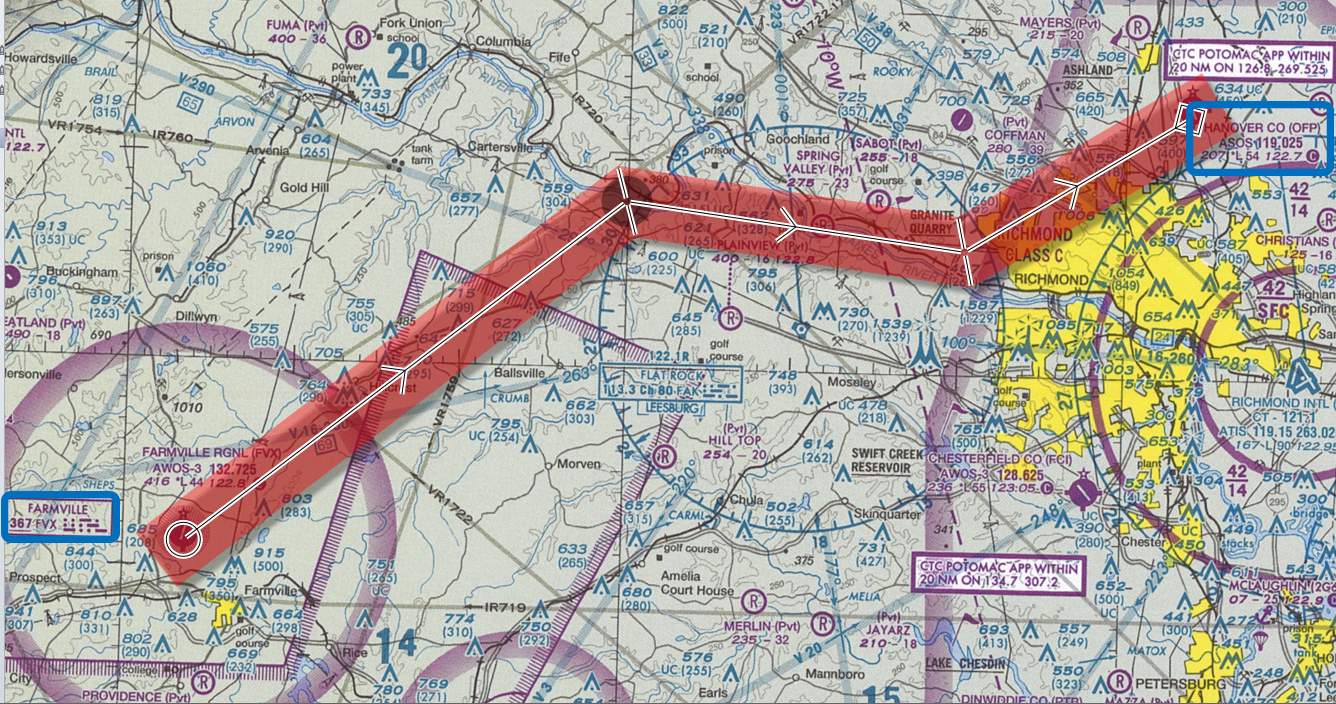
A sectional chart
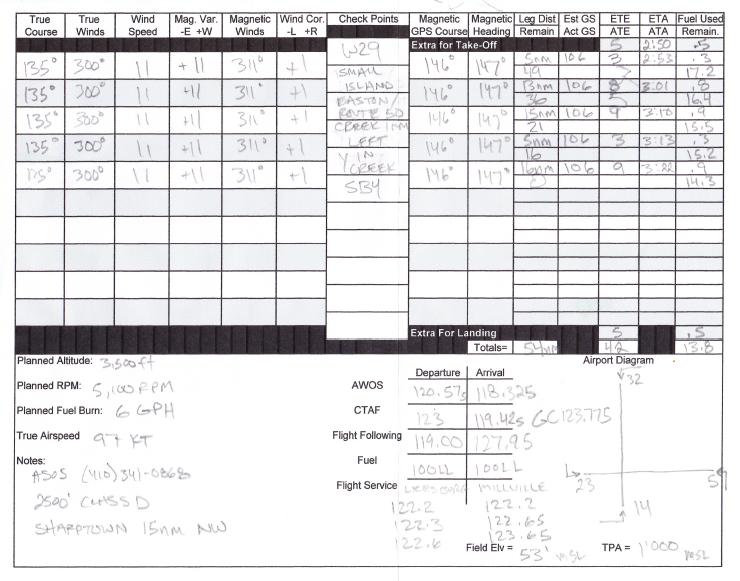
A flight plan with way-points, course headings, and estimated time marks.
“Flight planning is information management. Your job is to assemble, interpret, and put to use all the information needed to safely make a flight from Point A to Point B.” - Rod Machado
Identify your destination. All general aviation Cross-Countries begin with the choice of a destination. While you might get into your car just to go “drive around town,” with the peace of mind that if you need to get fuel or food, you will be able to find it along the way, you would never do the same with an airplane. As a pilot, you always need to know where you’re going –even if “there” is just doing touch-and-go’s in the traffic pattern of your home base airport. The reason you need to know where you’re going when you take-off is that the destination will govern important details such as how much fuel you will need to store, which sectional map to examine to identify waypoints, what radio frequencies you will use to communicate with other airplanes and controllers on the ground, what weather you will need to look out for en route, and what kind of provisions you should pack in the event of an emergency (e.g., are you flying over water, a desert, snow-capped mountains? Survival in each environment requires different provisions).
Planning out a project in business is no different. As discussed during the Fall Semester, there’s a tendency to just want to dive-in and start smashing the watermelon, but just as a pilot’s choice of destination will affect such basic decisions as how much fuel he needs to load into his tanks and what map he’ll need to examine for way-point identification, the selection of a business project’s objective or “destination” is equally important. Without knowing the objective, it’s impossible to plan out how to achieve it.
Selecting a Route. Once a destination is selected, it’s time to choose a route. This process begins by selecting the correct aviation map, known as a sectional chart. Within the U.S., there are over 50 sectional charts to choose from, each focusing on a different part of the country, so again, identifying the destination is a prerequisite to choosing the right chart. Examining the chart is an essential step because of how much information a pilot can obtain from a careful reading. In addition to showing the location of airports, these charts also provide information on geographic formations that are visible from the air, obstructions (e.g., cell towers) that should be avoided, radio frequencies used by ground based operations and other aircraft in the region, private airstrips, airspace classification (which connotes different rules and procedures that need to be applied), and much more.
Although there is tendency to want to take the shortest route by drawing a straight line between two points on the chart, the truth is that the shortest route is not always the best. I distinctly recall when I was planning my flight from an airport south of Washington, DC to Ocean City, MD and then down to the mouth of the Chesapeake Bay, that the most direct path would take me through restricted airspace, controlled by the U.S. Navy. Moreover, the most direct path would not bring me within eyesight of significant landmarks that would be distinguishable from the air. As the flight involved a significant amount of flying over-water, it was essential that I select a route along which I could double-check my heading, and measure my actual progress against my predicted time-marks by looking out the window. Accordingly, I selected a less direct route that would bring me in close range of several distinguishable landmarks to make sure I remained on course and on-time .
In business, once the objective has been identified, there’s a similar tendency to want to select the fastest route towards achieving that objective; however, the fastest route is not necessarily the best one for you or your resources. The fastest route may be the most costly, it might involve exposure to unacceptable risk, or it might not be feasible with the resources that are available. Moreover, like a flight plan, a project plan must include distinguishable way-points (a more colloquial term might be “mile markers”) against which the team can measure its performance and ensure it remains on course, and just like the use of time-marks the plan should layout realistic deadlines for when those way-points will be reached. Simply telling someone “go solve this problem and come back when its done,” is not as effective as saying, “go solve this problem by completing these 10 specific steps and as you complete each step check back with me so we know we’re on point.” Laying out a plan that allows you to break the project up into these measurable tasks and metrics will enhance your ability to track your team’s progress and report on that progress to the stakeholders, just like a pilot tracks his progress and reports it to the controllers on the ground.
Plan for Uncertainty. The “if” in “If everything goes according to plan,” is something no pilot can afford to ignore. Rarely does everything go exactly according to plan. Something as mundane as the direction of the wind could change and in so doing it would alter your airspeed, heading, and even the runway you had planned to take-off or land-on, and of course there are no shortage of more major “if’s” that could alter your plans. With this in mind, a good pilot needs to plan for contingencies (e.g., identifying alternative/emergency landing spots along his route), manage his own and his passengers’ expectations about timing and variability of conditions, and always make sure reserve fuel is left in the tank. It also means a pilot needs to consider what kind of provisions (e.g., survival gear, communication devices, food, water, temporary shelter, etc.) he might need to survive in the event he is forced to put the plane down along his route.
While some business projects are couched as “do or die,” “bet the company,” or even “get it done, no matter the cost,” projects, every plan needs to consider what resources are required to achieve the objective, whether these resources are available, and what contingencies should be put into effect if certain scenarios arise. While all business environments may not be as unpredictable as the weather, relying on a blind belief that “everything will go as planned” in your industry is no small folly. Accordingly, a good plan must at least acknowledge the points that are uncertain or that could be variable, and consider what should happen if those variables change.
Executing. Executing a flight plan properly requires skill, discipline, and flexibility. A pilot needs to be (a) skilled at maintaining his desired heading, speed, altitude, and communications while also on the lookout for incoming traffic and obstructions; (b) disciplined at checking his progress along his route, clocking in at regular intervals to measure changes in both the internal performance of his plane (e.g., engine RPMs) and the effect of outside forces (e.g., head or tail winds) on his progress; and (c) flexible in his ability to deviate from the plan as new information comes to him (e.g., materialization of a summer thunderstorm directly in his flight path). This last point on flexibility is particularly essential because one of the biggest causes of general aviation accidents is a disease known as “get-home-itis,” wherein the pilot becomes so focused on the idea of getting home that he may compromise his normal risk tolerances and decide to try to fly through bad weather or mechanical failures in an effort to “just get home” rather than divert to another airport or delay his departure. Get-home-itis is characterized by a loss of sight of the big picture, which is to stay alive and well.
In business, the proper execution of a plan also requires this combination of skill, discipline, and flexibility. The skill of coordinating of team members and the discipline to follow-up with each of them to make sure a project is meeting its way-points on-time and on-budget are essential, but again, flexibility is particularly important. There are countless examples of companies that became so consumed with a project and the sunk costs associated with it that they were unwilling to cut their losses before it was too late. The formulation of a plan is essential to achieving an objective, but sometimes the plan needs to be changed, and sometimes the individual objective may even need to be modified, so that it remains consistent with the company’s overall goal. No matter how good your plan executed, it will never be viewed as a success if it undermines the big picture objective of your company.
Conclusion. All too often, people are inclined to think of planning as a static, stagnant, and un-dynamic process. The prevalence of phrases like “analysis paralysis” in the business suggest a lack of respect for putting in the time and energy necessary to develop a proper plan from the start; many people -desperate to start “taking action” – prefer to smash the watermelon first and ask questions later. This demonstrates a fundamental misunderstanding for what planning is and how it should be done. Mr. Machado’s assertion that when you plan, “your job is to assemble, interpret, and put to use all the information needed” to achieve your objective, beautifully explains that planning is an active process. It’s not static or stagnant and it’s not something you do at the beginning and then never revisit –if it is you’re doing it wrong. It’s about actively examining the goals and the steps needed to achieve them, and just as a flight plan can evolve mid-flight, business project planners should also be prepared to evolve their plans mid-project, as new information comes to them. So the next time you get tasked with a new project, I encourage you to think of yourself as a pilot. Identify your destination, break out your map, and begin selecting the right route for you and your resources. When the time comes to execute, be disciplined in trying to reach the way-points and in measuring whether your reaching them on-time and on-budget, and if not, don’t be afraid to re-calibrate your plan the way a pilot might adjust his heading to account for changes in wind direction. Above all else, avoid your own form of “get-home-itis.” Put the objective of your project in context with the overall goal of your company. If everything goes according to plan, you’ll be soaring above the competition, but since everything rarely goes according to plan, at least you’ll be prepared for whatever comes your way.
Shaking hands with my CFI after my first solo flight. Summer 2006.