Tag Archives: management

4 Ways You Can Drive Seismic Performance

As I reflected on Professor Noonan’s closing remarks last week, I thought about how can I make a difference to my team. How can I bring value not only to my department, but also to my employer. Professor Noonan emphasized that everyone has the potential to make a contribution, to think of some process or task that can help drive results and improve productivity.

I came across this article on Forbes that drove home this point for me, “4 Ways You can Drive Seismic Performance”
http://www.forbes.com/sites/ericschiffer/2014/08/13/3-ways-you-can-drive-seismic-performance/

The article suggests the following key takeaways:

1) Face Yourself On the Stand And Fire Away – Step back and reflect on what matters most to the company to elevate it. It can be as simple as automating a report.

2) Act to Kill – This sounds a little violent :), but it is just a sensational way that the article suggests that you should be deliberate and consistent in achieving your daily professional goals. Act!

3) Commit or Go Home – Commit and do not fear failure.

4) Rewire the Jet at 36000 feet – Keep progressing even in the face of hindrances.

In essence, “figure it out” and “get it done!”

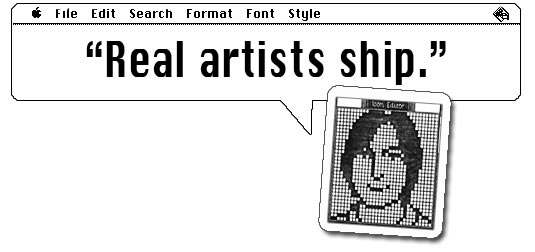
Steve Jobs and the Value of Deadlines: Real Artists Ship!

jobs-real-artists-ship

I recently listened to Walter Isaacson’s book Steve Jobs, in which the reader (or in my case the listener) is treated to a behind the scenes view of the rise of Apple, Inc. and the role played by its founder.  One of the most memorable moments in the book comes when only a week before the scheduled launch of the Macintosh a  small team of engineers and designers approaches Jobs to let him know they won’t be able to make the deadline.  In an effort to rally and cajole his team to meet the deadline, he exclaims, “Real Artists Ship!”

The concept was that it doesn’t matter if you’re the most creative person in the world if you can’t deliver on that creativity.  There are no shortages of accounts in Isaacon’s book that suggest Jobs was a lover of creative thinking and artistic design –some might say he held that in higher regard than anything else –but this particular instance indicates his clear understanding on the value of delivering the goods –on setting a deadline and sticking to it, no matter what.

All too often in life (with the exception of legal filing deadlines during my years as a litigator) I have been soft on deadlines.  Whether it’s with myself or with people who are reporting to me.  I adopt an “okay, we can push it back one more week,” mentality, believing, like Jobs’s engineers that one more read through of a contract or one more week spent practicing tennis before a big match is going to make a substantive difference.  Jobs’s point, however, was that it does not matter if you have written the perfect contract or crafted the perfect forehand volley if you can’t get out there and share it with the world.  The reason “real artists ship,” is that you only know about the artists that actually sat down and delivered their work –the others, well, they weren’t artists, they were just dreamers.   So set your deadlines for yourself and your team and stick to them!  Real Artists Ship!

If you’d like to read a firsthand account of what it was like trying to meet the Mac software deadline, you can do so here, where Andy Hertzfeld shares his perspective on running under the gun of Steve Jobs.


Lessons in Team Management from NASA and the movie Apollo 13

Time Magazine Cover, December 6, 1968


I’ve always been fascinated by the Space Race of the 1960s.  I am particularly amazed by the fact that in less than ten short years we went from considering space the realm of Hollywood and science-fiction to the kind of reality that you could watch live on the television in your living room.  How did they do it?  Computers? A bottomless budget? Sure, there were major advances in computer processing and increases in federal financing, but how did they go from being behind the Soviet Union to surpassing them en route to being the first nation to rendezvous, dock and land on the moon?  I believe it has a lot to do with the team management practices that were exercised by NASA’s space flight leadership team.  In former Flight Director Gene Kranz’s book Failure is not an Option he described how the NASA team was able to advance quickly through the Apollo program towards landing on the moon by saying, “Apollo succeeded at critical moments like this because the bosses had no hesitation about assigning critical tasks to one individual, trusting his judgment and then getting out of his way.”  The basis for this trust was largely due to the emphasis NASA leadership placed on communicating, mapping out systematic solutions to complex problems, and establishing clear responsibilities for solving those problems and executing their designed solutions.

What’s interesting is that this is exactly what we were taught to do in MP.  Upon reviewing the slides Professor Noonan presented during the Fall Semester, it is apparent that many of the lessons shared by our own “decision Jedi” were actually put to use by NASA in their effort to win the Space Race.  Two slides, in particular seem applicable, which I’ve paraphrased below:

Intro Deck, Slide #24:

MP learning objectives and topics include: (a) defining the central problem in a situation; (b) connecting that problem to effective teamwork; (c) developing and delivering valuable insights; and (d) connecting those insights to effective action.  “Excellence is an art won by training and habituation.” – Aristotle

Part 3 Deck, Slide #2:

How can we organize and manage team effort?  (A) Appropriate work stream: (i) Targeted analyses, (ii) Spanning the tree, (iii) Driven by issues, and (iv) Focused using hypotheses; (B) Productive: (i) Focused info, resource needs; (ii) Clear, specific deliverables and declines; and (C) Effective use of team: (i) Responsibility and (ii) Coordination.

During the Space Race, the engineers and test pilots at NASA trained religiously, and spent extensive time developing rules and procedures for their flights.  Since no one had ever flown in space before, each new mission provided an opportunity to literally “write the manual” on how certain objectives should be reached.  Because the lives of the colleagues and friends, as well as the future of the nation, depended upon their precision, these engineers would try to consider every step of every mission from all angles before lighting a single rocket.  In doing so, they were essentially asking themselves closing their eyes and asking themselves, “what do we need to do to achieve X?” and then building out mental “issue trees,” branches of which were then assigned to specific departments or team members to research, resolve and execute.

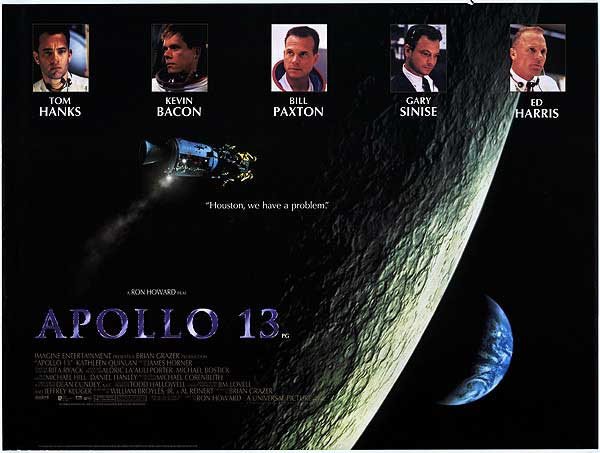
Apollo 13 (Theatrical Poster)

Although this kind of structured team management and leadership was a part of each stage of the Space Race, the most enduring display came in April of 1970, during the Apollo 13 mission.  One of the most detailed accounts of how the Apollo 13 problems were tackled can be found in Flight Director Gene Kranz’s account in Failure is not an Option.  Kranz describes how he broke the task down into key parts (e.g., power, trajectory, using the LM as a lifeboat for three men when it was designed for two, etc.) and then began in a structured and disciplined form of “brain storming” (or what some might call “brain steering”) during which every option was explored to ensure that the issue tree was mutually exclusive and collectively exhaustive.  Short of reading Kranz’s book yourself, you can get an idea of what happened during the Apollo 13 mission by viewing the 1995 film starring Tom Hanks.  Below are some key points in the film and links to YouTube clips that help provide a nice representation of this kind of team management:

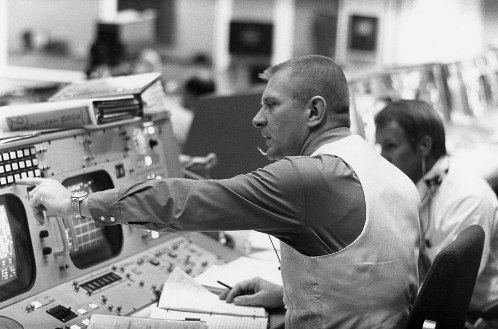
Flight Director, Gene Kranz - sporting his famous "white team" vest
Flight Director, Gene Kranz – sporting his famous “white team” vest

1)      Shortly after the explosion occurs on the Command Module, mission control begins to devolve into chaos over the news that the Apollo 13 spacecraft is mysteriously venting oxygen into outer space. Gene Kranz focuses the group by saying, “Let’s work the problem people, let’s not make things worse by guessing.” (NOTE, only the first 42 seconds of this clip are from the scene that I’m referring to here, you can ignore the rest).  Kranz’s statement reframes the crisis as a problem that can be solved, not a moment for mindless panic, and in so doing he returns his team to the tasks they’ve been trained to do: solve space flight problems in a systematic fashion.  Moreover, although it’s hard to appreciate from this short clip, you can get a sense for how direct the lines of communication are in mission control. Every person has a role to play and their area of expertise is distinct.  Gene Kranz sources information from each of them and provides specific instructions to each group.  He never says, “somebody go do that” it’s always clear communication directed at a specific individual or sub-team so everyone knows who is responsible for generating the answer to a specific question.


2)      After relocating the astronauts to the LM (a/k/a Lunar Module, LEM), Gene Kranz makes it clear that the old flight plan is being tossed out the window and he focuses the team’s brainstorm efforts on the key question, “How do we get our people home?”  When the sling-shot around the moon idea is presented a debate ensues, displaying how team members are wearing “different colored hats,” to essentially test the strength of the proposed solution.


3)      When faced with the challenge of managing the power supply, a man named “John” proposes that everything must be turned off otherwise the LM will run out of power in 16 hours, not 45 hours.  A cacophony of negative responses fills the room but Gene Kranz assesses the situation, makes the decision to power down the LM and moves on with the remaining team members to say they need to find a squeeze every amp out of the electronics in the spacecraft –“failure is not an option!”  This particular scene displays the trust Kranz placed in his team members and their expertise, and, again, the power of positioning each challenge as a problem that can be solved by specific team members or sub-groups of team members.


4)      As one team works on the electronic power issues, another is just discovering that the CO2 levels in the LEM are rising and that the filters from the Odyssey and the LEM are not compatible.  This leads to the famous “Square peg in a round hole” problem.  This might be the most incredible problem solved during the mission, and if you’d like to read more about it, you can do so here.  The work done by Ed Smylie’s “tiger team” unquestionably saved the lives of the three astronauts, but again it shows the value of breaking a big problem (“how do we get our guys home?”) into smaller questions and dividing the task of researching and resolving those problems up to be the responsibility of smaller groups or individuals.


Years later, the Apollo 13 the flight commander, Jim Lovell, during a separate interview, suggested the Apollo 13 mission and provides several key takeaways for business leaders:

  1. Identify the problem and figure out what you have to solve it;
  2. Communicate – you need to share information with your team members in order to solve the problem;
  3. Good leadership and good teamwork are marked by perseverance and initiative.

Thanks to this structured approach to problem solving and team management, NASA was able to bring the crew of Apollo 13 home and in the process they achieved what is largely regarded as the administration’s finest hour.  If you’re interested in learning how you too can achieve this level of success within your own organization, I would invite you to review the aforementioned slides and check out the movie Apollo 13 on iTunes or your preferred viewing platform.  Remember, “FAILURE IS NOT AN OPTION!”

Apollo 13,  James A. Lovell,  John L. "Jack" Swigert and Fred W. Haise, arriving at the USS Iwo Jema after landing in the South Pacific Ocean
Apollo 13 crew members Fred W. Haise, James A. Lovell, and John L. “Jack” Swigert, arriving at the USS Iwo Jema after safely landing in the South Pacific Ocean.

Exerting Influence Without Authority

In the business environment today the “I leader, you follower” mentality may not always be the most appropriate approach anymore.

With so many business structures relying on partnerships and working with teams inside and outside the company, the traditional leader tactic will not always work. Many managers and executives need to be able to adopt a more lateral style of leadership in order to coordinate, communicate, and complete work with these interwoven relationships.

The article explains lateral leadership as the ability to combine multiple essential skills. The article explains 4 essential capabilities to assist you with understanding how to use lateral leadership to your benefit.

1) Networking – “Cultivate a broad network of relationships with the people inside and outside your company whose support you need to carry out your initiatives.”

2) Constructive persuasion and negotiation – Look at persuasion and negotiation as a way to  heighten your influence not as way to manipulate.

3) Consultation – “Take time to visit the people whose buy-in you need. Ask their opinions about the initiative you’re championing. Get their ideas as well as their reactions to your ideas.”

4) Coalition building – “It’s a fact of human nature that several people who are collectively advocating an idea exert more influence than a lone proponent.”

A few more take aways:

  •  Lateral leadership can be challenging for managers to execute. It is difficult to master many of the capabilities that go into achieving lateral leadership. It may take time.
  • It is important to find the people in your company that have a lot of influence. Take the time to meet these people and get to know them before jumping into a project with them.
  •  A natural positive environment can help bring relationships together. A company should encourage opportunities for people to meet, but let the relationships form on their own and not be forced.

Exerting Influence Without Authority


Poor Managers Are More Costly Than You May Realize

In this HBR blog, Monique Valcour identifies some of the key success factors in top managers. To sum up her thoughts in one impactful statement, “If you’re not helping people develop, you’re not management material.”

So what does this mean? It means that because candidates value learning and development opportunities above any other aspect of a prospective job, a manager’s role is more critical than ever. Skilled managers attract top candidates, retain and challenge them, and drive performance. Poor managers do just the opposite. The firm not only misses out on potential talent, but it also costs them a lot of money due to employee turnover and subpar productivity.

As most of us have learned, the majority of learning and development (roughly 90%) happens on the job rather than in schooling (not to knock Goizueta!) or formal training programs. An effective manager can benefit you in many ways – from mentoring and challenging you to providing constructive feedback and helping facilitate conversations. In many ways, a mentor is someone you can look up to and model yourself after. Thus, your own management style will, in turn, help to shape the firm’s future leaders.

Below are some characteristics of effective managers:

-Invested in coaching

-Someone you can respect and learn from

-Takes interest in your career development

In conjunction, here are some tips to becoming an effective manager:

1) Be transparent

2) Share detailed information about firm’s ongoing operations

3) Support internal networking

4) Have frequent conversations about career goals and interests rather than just once a year during annual performance review (I have found this to be very helpful in my own relationship with my supervisor)

5) When planning the team’s work, ask employees how they can contribute and what they’d like to get out of the project (this gives them ownership and helps them buy into it more)

6) Establish open lines of communication and provide regular feedback

Having a poor manager/undesirable relationship with a direct supervisor tops the list as the number one reason employees quit their jobs. Therefore, continual teaching and development should be a non-negotiable in every manager’s repertoire.

http://blogs.hbr.org/2014/01/if-youre-not-helping-people-develop-youre-not-management-material/

Are you a Leader or a Manager?

I took a class in undergrad about “Servant Leadership” by Robert Greenleaf. I started questioning the difference between a manager and a leader, and have been intrigued by the concept ever since. As I was interviewing for my current position, I was questioned as to what type of leader I would be in the organization.

I pondered, and proceeded to explain the type of manager I would be and the skills that I would bring to the table. I described that I did not feel that someone could place me in the role of “leader”. It was a position that others saw me as based on how they felt about my abilities. They would make the decision to follow, I could not decide that for them.

I stumbled upon this article in the Wall Street Journal regarding this very topic. It discusses the importance of differentiating between a manager and a leader as the concept of the knowledge worker becomes more profound in our society.

“The leader originates, the leader challenges, the leader is an individual, the leader focuses on people.”

Take a look at the article and see how your natural characteristics fall into the spectrum. I believe that leadership is a way of life. It’s a characteristic that exudes from you, both in the professional world and your personal life. Leaders are the people that I select as mentors. The fact that I have placed them in that position in my life re-iterates how I feel about their ability to lead and challenge me.

My father is a mouthy, Italian businessman with salt and pepper hair. He has drowned me in the business world from a very young age. Along the way, I have gathered a few Tony-isms from him about this matter:

“You can promote people and make them managers, but you cannot make them leaders. That trait is who you are. When it comes out, people will know.”

“The person who knows how and why will always have a leg up on the person who only knows how or why.”

He’s a deep fellow.

Decide the type of position you want to hold in the lives of your co-workers, and work towards being looked at in that light. These abilities will alter the way you present, the way you communicate, and the way you analyze situations.

I leave you with one final Tony-ism: “Be cautious not to take too much advice.”

Christine

Contrasting Styles of Management

As an avid reader, an addicted audio book listener and a small business owner I have read countless business biographies. Richard Branson, John D. Rockefeller, Ted Turner, Warren Buffett, Steve Jobs and John Mackey highlight the list. I have also read several political biographies. These include Harry Truman, Abraham Lincoln, Winston Churchill and the last three American Presidents. The effectiveness of these leaders can be debated, but they were all leaders. I have tried to find parallels between these historical figures to enhance my own abilities, but there are not many consistencies. Some of these men were tactical and some bold. Some were taciturn and others charismatic. Some were geniuses and others not at all.  Some were ostentatious and others frugal. As it seems more appropriate, here are some of my insights about the business leaders.

Richard Branson never graduated from high school, but instead started Student Magazine to protest the Vietnam War quickly followed by a mail order record business which led to Virgin Records. Branson never followed the rules. While running Virgin Records he convinced his board to let Virgin venture into the Airline business – and it worked. This would contradict the wisdom of almost any business executive or business school academic, but he trusted his instincts.

John D. Rockefeller also dropped out of high school. His success in the oil business came from achieving monopoly status by beating his competitors on price through economies of scale. His vast wealth stemmed from retaining and expanding his shares in Standard Oil. He bought up competing refineries left and right offering either cash or stock to the owners. He consistently advised them to take the stock and never let it go. Although he was neither charismatic nor a genius (by academic standards), he stuck to his plan and fervently believed in the company he created.

Ted Turner might have been the one business executive of whom I am aware to possess genius level intelligence and elite charisma. He made it through high school, but dropped out of college at Brown. After his father passed, Turner was only in his early 20’s. He negotiated, pleaded and even threated the acquirer of his father’s billboard business and eventually got it back. Fearlessly, he expanded, got into radio then cable TV, bought the Braves and started the first 24 hour new station, CNN. When he bought the Braves they were losing about $1 Million per year. He paid $10 Million and almost immediately guaranteed that they would win the World Series in five years. I am doubtful that he had a plan to bounce from outdoor advertising to radio to cable television and along the way own two professional sports teams. But, there is no doubt that he recognized opportunity and was a visionary of sorts in several business.

Warren Buffett took a more conventional path. He graduated from high school with good grades and an entrepreneurial spirit. He went To UPenn, but transferred to Nebraska likely due to home sickness. He graduated from Nebraska and even went to graduate school at Columbia to learn under his idol, Ben Graham, the “father of value investing”. He was a stock broker, but quickly realized that he preferred to create partnerships for his investors. With huge returns early on he quickly became a rich man. Part of his knack for big returns lied in his bold strategies. If he believed in something he would invest heavily. Early on he bought a huge stake in Geico which gave him “float” and the ability to buy up more stocks. Singlehandedly, over 50 years, he served as the one clear example of the ability to beat the market. When the Efficient Market Hypothesis popularized among academics, he was the one inexplicable phenomenon. It is hard to say his secret, but investing heavily and spending very little along the way is a good formula.

Steve Jobs was perhaps the least conventional. He dropped out of college and created the first Apple Computers out of a garage with his friend Steve Wozniak. Jobs did not even know how to write code for computers, but guided “Woz” as the first Apple computer was created. This is hard for some computer experts to fathom, but Jobs who helped found the company and then turn it into the Apple that we know today, could not even create a computer. Gates jabbed at Jobs for this lacking this skillset so important the computer brethren of the 1980’s. Despite lacking the technical expertise, Jobs always ran the show often verbally attacking the designers until he liked what he saw. According to some testimonies, he was wildly inconsistent – one day claiming that something was terrible and the next not only proclaiming it great but taking credit for it. He was incredibly unpredictable and admittedly “mercurial”, but his focus was always the product. When asked why he chose not to use market research he replied that Alexander Graham Bell did not use market research when he invented to telephone. He was a visionary. He singlehandedly turned Apple into one of the most profitable companies in the world and made Pixar into a powerhouse, launched two of the greatest advertisement campaigns in history, and revolutionized the phone, tablet and music industries. He just seemed to know what people would want. A good example of his uniqueness is that he opted not to bathe for long periods as he swore that his vegetarian diet made showering superfluous. Jobs broke every mold for a CEO. He didn’t go to a fancy school, did not even truly understand the intricacies of his products, was extremely difficult to work for, and refused to adhere to societal norms. It is far easier to be confident when you possess all of the abilities consistent with the expectations for someone in your position, but far more difficult to lack all of those qualities. Simply put, Jobs’ confidence is unsurpassed in my opinion.

John Mackey built Whole Foods from the ground up. His style is more modern and outlook lends credence to both his company and capitalism in general. Mackey believes that companies successful in the modern age need to exemplify a “conscious” culture. He does not believe in gouging suppliers, beating up competitors or only meeting the minimum standards for ethics as required by law. He proclaims that modern companies must have a clear culture that emphasizes what he calls “Winning to the Sixth Power”. This means running a business so that you bolster company profits as well as suppliers, employees, the environment, the industry etc. Quite the contrarian, he believes in empowering employees through autonomy and rarely ever firing them, allowing good suppliers fair profit margins, listening to his critics and trying to rationalize their viewpoints, exceeding environmental and animal welfare standards. He even goes out of his way to compliment his competitors (i.e. Trader Joe’s) when he believes they are meeting these standards.

Judging from these business leaders, there are a lot of different ways to effectively manage a company. Branson was bold and charismatic. Rockefeller was obsessive and borderline tyrannical. Turner was brilliant and energetic, Buffett was purposeful and consistent, Jobs was obsessed with the product itself and Mackey emphatic about the culture. The only parallels I can ascertain are hard work and confidence. I know it would be far more helpful if it certain characteristics led to success in business, but like many things, it’s not that simple.


References

Chernow, R. (2007). Titan: the life of John D. Rockefeller, Sr. New York: Knopf Double Day Publishing Group.

Turner, T. (2009). Call Me Ted. New York: Hachette Audio.

Schroeder, A. (2008). The Snowball. Warren Buffett and the Business of Life. New York: Random House.

Issacson, W. (2011). Steve Jobs. New York: Simon and Schuster.

Sisodia, R., George, B., Mackey, J. (2014). Conscious Capitalism: liberating the heroic spirit of business. Boston: Harvard Business Review Press.

 

You Can’t Be a Great Manager If You’re Not a Good Coach

In a recent blog post on hbr.org, Professor Monique Valcour presents a powerful suggestion for managers to connect with and get the most out of employees. She argues that “if your job involves leading others, the implications are clear: the most important thing you can do each day is to help your team members experience progress at meaningful work.”

So how do you know what is meaningful to them? By developing a coaching relationship and having coaching conversations. These conversations will allow managers to understand what drives each person, help build connections between each person’s work and the organization’s mission and strategic objectives, provide timely feedback, and help each person learn and grow on an ongoing basis. The goal is to develop the employee, just as the goal of a pitching coach is to develop his pitchers.

To do so, she lays out 5 tactics for managers.

  1. Listen deeply. Listen with your full attention, and create a high-quality connection that invites your team member to open up and to think creatively.
  2. Ask, don’t tell. In a coaching conversation, it’s essential to restrain your impulse to provide the answers. Your path is not your employee’s path.   Similar to the Socratic method,  open-ended questions, not answers, are the tools of coaching.
  3. Create and sustain a developmental alliance.  Follow-up is critical to build trust and to make your coaching more effective. The more you follow through on supporting your employees’ developmental plans, the more productive your coaching becomes, the greater your employees’ trust in you, and the more engaged you all become. It’s a virtuous cycle.
  4. Focus on moving forward positively. Similar to Professor Smith’s recommendation to have a 5:1 positive to negative feedback ratio, the reverse is true here — when an employee focuses on the negatives during coaching conversations, it’s the job of the manager to end the venting session and steer the discussion into a positive, solution-based dialogue.  You might ask, “Which of the activities you mention offer the greatest potential for building your knowledge and adding value to the company?” “Could you schedule two hours of time for developmental activities each week as a recurring appointment?” “Are there skills or relationships that would increase your ability to meet your primary deliverables?” “How could we work more efficiently within the team to free up and protect time for development?”
  5. Build accountability.  In addition to making sure you follow through on any commitments you make to employees in coaching conversations, it’s also useful to build accountability for the employee’s side of formulating and implementing developmental plans. Accountability increases the positive impact of coaching conversations and solidifies their rightful place as keys to organizational effectiveness.

I wanted to share this article because viewing management through a coaching lens resonates with me. To this day, I deeply appreciate and have nothing but fond thoughts towards my high school athletic coaches — they took a genuine interest in developing me as an athlete and as a person. I’ve yet to have a manager take this same kind of interest my own development, but I imagine my response to that kind of attention would be to make my time at work more meaningful and encourage me to do more meaningful work.

Healthcare & Business Intelligence

I took a sociology class in undergrad that focused on the healthcare industry, specifically evaluating the efficiency and quality of delivering services. Most of what we focused on was from the patient perspective and how the system either did or didn’t support patient needs. This article focuses on applying business strategy and intelligence to the healthcare industry from the perspective of the supplier/organization.

With the mounting scrutiny on healthcare costs and quality, especially with the implementation of the ACA, it will become increasingly important for innovative leaders to bring business savvy to the industry. I think it’s the moral debate at the heart of healthcare and whether it’s a human right vs. a service rendered that makes the issue even more interesting. Leaders who effectively balance business acumen with responsible decision-making (keeping patient needs in mind) to turn hospitals profitable, or at least sustainable, are in short supply.

With the vacuum of innovative leadership, the industry is in drastic need of smart reform so it’s nice to see the skills we’ve already been practicing in class outlined in tangible ways within healthcare. I wonder, as places like Emory start to merge their business schools and schools of public health or medicine, if the right solutions will tend to arise more prominently out of public policy initiatives or business practices? Systems like the National Health Service in the UK arose out of necessity through public policy after WWII. Without a national crisis such as that, the transition of our system to predominately government-based organizations rather than private will be far more gradual. In that time, the application of the cited business intelligence will hopefully highlight the best parts of competition and business practices while embracing the benefits of greater access.

http://www.healthleadersmedia.com/content/TEC-90944/Applying-Business-Intelligence-to-the-Needs-of-Healthcare-Organizations.html##

Listen, Learn and then Lead

2) Planning the Work of a Team, 3) Managing a Project Team

http://www.ted.com/speakers/stanley_mcchrystal

So I openly admit bias on my inspirational and informative reference (but in fairness most of my other Military Officer vets have incredible admiration for the guy). The former commander of US and ISAF forces in Afghanistan, General Stanly McChrystal, gave an incredible lecture via TED that is applicable to anyone wishing to take on a leadership role in a not just challenging environment but seek to implement transformational changes to said organization. As with many of my peers, I too have been in (and will seek post-MBA) leadership positions that have entirely different duties and responsibilities than my previous roles. From the transition from a Platoon Leader as a Second Lieutenant in a Sapper Platoon (https://www.youtube.com/watch?v=Hp5LqGCtzYI ) to my other less interesting (and more plans-oriented) positions I realized that there are certain traits that make leaders excel in any field or organization that they are placed in.

One of the common themes at the US Army Officer Candidate School is leadership is leadership: irrespective of your specialty or organizational level responsibility. It has taken years for me to develop (and am still learning in the corporate world now) but the key traits I have observed and am now especially cognizant of are best summed up by General McChrystal:

Listen, Learn and then Lead.

Reflecting on all the skills one learns during his or her MBA experience I believe it to be equally important to understand how to implement your ideas to fully utilize lessons learned from classes such as Management Practice. In the course of leading often skeptical clients or coworkers (or Soldiers and civilians in the General’s case), McChrystal suggests to first listen. Listening is quite possibly the most difficult task leaders have, particularly as we are prone to defaulting to preconceived notions on how the role and responsibilities should play out before we even arrive; this is especially difficult when compounded with issues such as generational differences, prior experiences and job diversity. Throughout the learning phase (continuous) the main goal is to build trust and rapport; people tend to work harder and with more conviction when they believe someone has their best interest in mind; this is particularly true when it comes to leading higher risk maneuvers or actions where the natural tendency is risk-aversion to prevent failure / negative performance reviews. Finally there is learning when to fully lead. “When in charge be in charge” is one of the idioms always taught to military officers; when you have demonstrated the listening and learning traits to your group this becomes significantly easier to execute. I have found these leadership maxims to be of extreme value regardless of leading Soldiers in warzones or my peers when implementing a new sales strategy as a novice to seasoned sales representatives.

The “Listen, learn and lead” design is paramount to a leader’s success, particularly of importance when leading teams with informational and generational differences.