“You don’t drive races on paper” – Kimi Raikkonen.
I have been a Formula1 racing aficionado since a kid. I would watch live telecast of a race hosted in any time-zone and also attended the Grand Prix at Austin. Their planning, strategy, risk management and precision has always amazed me. For once I saw the race from the eyes of a Project Manager and not a race car aficionado. There is so much that I have learnt which helped me in handling my projects much efficiently.
If we compare, Formula1 season is like a project and each race is like a milestone. The season has a Scope, Timelines, Requirements, Resources, Budget, Strategy, WBS, Quality assurance, KPIs and so does each race. Engineers, designers, mechanics, PR all work for the driver to help him minimize risk and increase the opportunities to win the race.
A race car driver is faced with competition, risk of crash, financial loss if any damage to the car and more. With all these, it is only imperative that the team provide an early identification and assessment of risks. The point is to know and stick to a threshold. We need to go through the hardship of taking the risk to either be successful or learn the lesson and move on.
“ I accept every time I get into my car, that there is a 20% chance I could die, and I can live with that risk – but not 1% more” – Nikki Lauda
Project management shall lead to the team success. Project plan which is monitored and updated as necessary, maintaining communication with all the stakeholders, maintain all the project documentation including meetings notes, technical reports, Analytics, diagnostic reports, KPIs and develop contingency plan for all the risks. All the above apply equally the same to Formula1 or software development or construction of a building or any other project. Any slight error to capture or communicate information would have an impact on the productivity and performance. Thereby posing huge threat on the budget or deadlines.
The project manager should be wise to have the technical resources working only on the dedicated project without having any internal pressure to work on other projects. If resources have to be shared project manager should plan to have the phase prior to entering the core of project work as switching projects would interfere with engineer’s concentration. All communication should happen at the discretion of the project manager, who in turn should be capable of knowing what to speak, when and to whom.
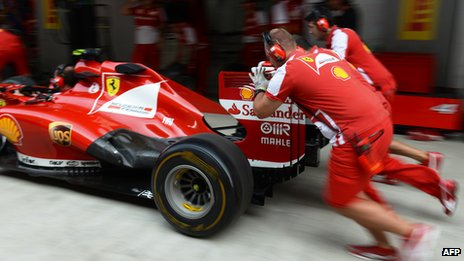
It is also very important to know who is responsible and who is accountable for what. During the race the Pit stop-team is responsible for changing the tires, cleaning driver’s helmet, replacing the damaged body parts, etc. It is the responsibility of one ‘lollypop man’ to control the car’s departure from the pit stop. The precise timing and millimeter perfect choreography plays an important role in the race. If a nut is loose, someone at the pit-stop is held accountable. If departure timing conflicts with another race car, the lollypop man is held accountable. In any projects RACSI (Responsible, Accountable, Consulted, Supported and Informed) plays a vital role to manage the roles and responsibilities of stakeholders and team members of a project.
I could writes pages and never give a closure to this article. There is a lot to be explored and learnt and every race gives me a new insight.