Tag Archives: intuition

How Effective Leaders Solve Problems

Effective leaders tend to find a strong balance between data analysis and intuition. Many times, the aspect of intuition comes from recognizing patterns or trends. A big part of problem solving is recognizing these trends and finding ways to minimize its reoccurrence. Additionally, it is important for leaders to understand the true essence of the problem rather than finding a temporary fix that will likely rise again in the near future. This gives leaders more time to focus on other areas of the business rather than continuing to fix the same problem over and over again.

Understanding the intricacies of every aspect of the business is one way to develop a strong sense of how your decisions can affect specific areas of the business. Effective leaders don’t look at problems as a nuisance; effective leaders see problems as an opportunity for ongoing improvements.

Forbes has come up with four characteristics that make an effective leader:

1) Transparent Communication: The main takeaway is that transparent communication allows for other people to be heard. It fosters an environment where people are willing to speak up if there is an issue.

2) Break Down Silos: The importance of this characteristic is to eliminate boundaries. It is important to solve problems that affect the overall business rather than one segment of the business.

3) Open-Minded People: Effective leaders are ones who are not discouraged to find innovative ways to solve a problem. They are individuals that do not avoid the problem; they are not afraid to face problems head-on.

4) A Solid Foundational Strategy: As we have learned in our Strategy course, a business without a strategy is dangerous. Effective leaders go beyond figuring out the problem; they find ways to implement a strategy to solve the problem. This includes resource allocation and budgeting.

Some final takeaways are:

  • Always step back and assess the situation; never take a blind guess when solving a problem.
  • Find ways to solve the cause of the problem to eliminate it from reoccurring.
  • Learn from your previous failures and use those lessons learned to solve future problems.
  • Don’t avoid problem solving; challenge yourself to solve the problem head-on.

To read more about becoming an effective leader, feel free to visit the article: http://www.forbes.com/sites/glennllopis/2013/11/04/the-4-most-effective-ways-leaders-solve-problems/.
A Methodical Approach to Problem Solving

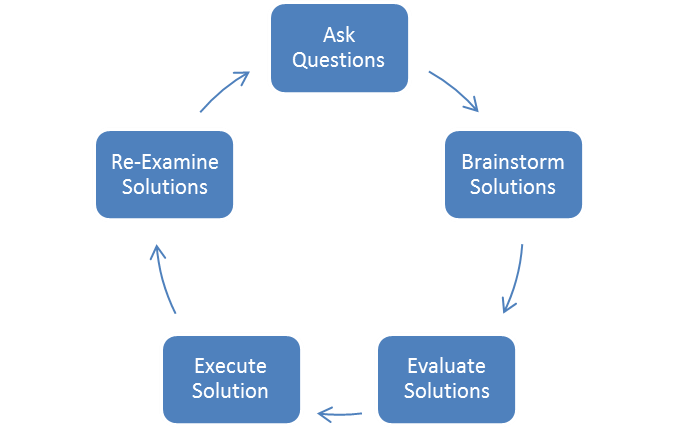
Oftentimes, we equate ‘problem solving’ with ‘critical thinking.’ However, in this case we’re referring to ‘problem solving’ as a method for finding solutions to short-term complications or setbacks. Although strong intuition is important for problem solving, you must also rely on the research and data that you encounter. What is most important is what you do with that combination of intuition and research. Here are the five steps to becoming a better problem solver:

problem-solving-process

  1. Ask a lot of questions to identify the underlying problem. Don’t jump to conclusions.
  2. Brainstorm all of the possible solutions to the problem that you identified.
  3. Evaluate the solutions that you came up with. Determine the feasibility of those ideas.
  4. Execute the most feasible idea. Good problem solvers are responsible for implementing a solution.
  5. Re-evaluate the project throughout its execution. Sometimes you will find out that you are either not solving the underlying problem or there are more problems that need to be solved.

For more information on the myths and facts of problem solving, feel free to visit the link below. This process can be applied in any business setting. By practicing these skills over-and-over, you can become a better problem solver.

http://www.entrepreneur.com/article/217516

Intuition + Data = Good Decisions and Compelling Storytelling

One of my reasons for attending business school is to improve my decision making skills. I typically apply the mantra “follow your gut,” when making decisions, but have quickly found that this doesn’t fly in the business world.  Colleagues want evidence based recommendations, which in my mind means I have to work with numbers (not my favorite).  Fortunately, incorporating both data and intuition can result in good decisions and compelling storytelling.

In this article by Andrew McAfee, we learn from specific examples that human judgment alone does not trump algorithms. So is the sum of our experiences and beliefs worthless? No! It’s all about using judgment or opinions as inputs to data models. Unfortunately, many people get this process turned around and disregard data that doesn’t align with their opinions.

From there, you can use data to tell compelling stories and build persuasive business cases. In this HBR blog, Walter Frick interviews Jim Takersly on how data and stories enhance each other. At one point, data is referred to as “medicine” and the story as something that helps you consume that medicine. I’d have to agree with that metaphor, but I also understand how data can give a story shock value or credibility. There are many different kinds of stories to tell with data. Here are ten.