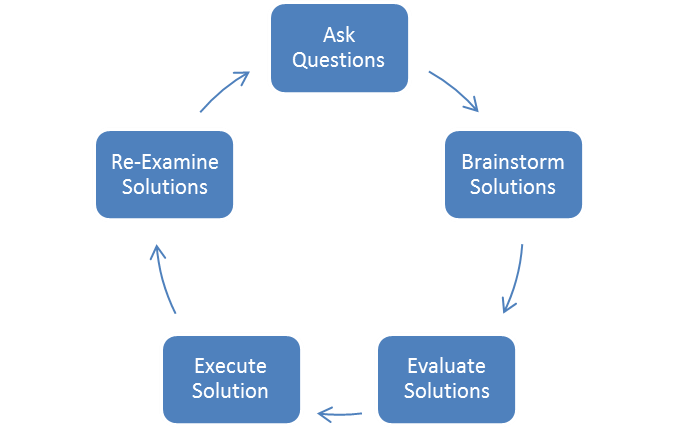
Oftentimes, we equate ‘problem solving’ with ‘critical thinking.’ However, in this case we’re referring to ‘problem solving’ as a method for finding solutions to short-term complications or setbacks. Although strong intuition is important for problem solving, you must also rely on the research and data that you encounter. What is most important is what you do with that combination of intuition and research. Here are the five steps to becoming a better problem solver:
- Ask a lot of questions to identify the underlying problem. Don’t jump to conclusions.
- Brainstorm all of the possible solutions to the problem that you identified.
- Evaluate the solutions that you came up with. Determine the feasibility of those ideas.
- Execute the most feasible idea. Good problem solvers are responsible for implementing a solution.
- Re-evaluate the project throughout its execution. Sometimes you will find out that you are either not solving the underlying problem or there are more problems that need to be solved.
For more information on the myths and facts of problem solving, feel free to visit the link below. This process can be applied in any business setting. By practicing these skills over-and-over, you can become a better problem solver.
http://www.entrepreneur.com/article/217516
In this article, which I found on Business Insider, the author discusses how to be a more effective critical thinker and problem solver. He speaks about how after obtaining a position as a strategy consultant after his MBA, he struggled to solve problems quickly and effectively for clients. A mentor then coached him to “START WITH THE ANSWERS.” This advice that was very foreign to the author at the time. He struggled with this concept but his mentor taught him how to start with the basic structure of a problem they were trying to solve and then develop some hypotheses around that problem based on any given knowledge or prior experience. Then they would put the hypotheses down into a structured diagram with answers that tie to the logic of the problem they were trying to solve. The mentor noted that once they knew the structure of the problem and the possible solutions, they could plan the data that proves or disproves their theories.
This immediately made me think of Issue Trees; a concept I struggled with when first presented to us by Professor Noonan in fall semester. I felt that I could not come up with possible solutions before knowing all of the facts or researching all of the relevant information I needed to try to find the solution. But the mentor in this article also makes a good point that the key to this top-down approach to critical thinking is to not be married to the original answer but by having an original hypothesis or hypotheses, one can begin to focus the data that one collects regarding the solution, as well as begin to socialize the “answers” to illicit feedback and reactions, which can help to hone in on a real and viable solution.
Read more: http://www.businessinsider.com/the-better-way-to-solve-problems-in-business-2010-7#ixzz37IYQ5WMo
MEMBA learning community, Fall 2016- Spring 2017