Tag Archives: Stories

Tricks to Giving Phone Presentations

conference-phone

Being a great presenter is a great skill to have in front of a live audience.  However, the reality of large national and international corporations is that creating a live in-person audience is often impractical and costly. Technology has been making speaking to a physically absent audience more realistic with teleconferencing, video conferencing, and the like. However, an effective presenter also needs to have a great presence over the phone and through video conferencing equipment. The skill set is obviously similar, but here are some tips for nailing that presentation on your next conference call or video conference (which I have filtered and summarized below).

  • Check in to solicit comments or verbal acknowledgement that the audience is still with you. You may have lost the audience 10 minutes ago, and you don’t even know it.
  • Master the silence. Silence can be okay as long as it is not too long. Over the phone, it can still be used for dramatic effect.
  • Go around the horn to check in on different audience members to see that they are still following along. For instance, call someone out who you know should be listening, i.e. “Are there any questions from the Atlanta office?”
  • Don’t over answer questions. It is possible that a large portion of the audience already knows the answer and has decided to tune you out because you spent 5 minutes answering the question from the new guy who needs individual attention later.
  • Send out visuals beforehand. The addendum to the call should be sent in advance of the call to all attendees. Don’t forget page numbers and reference them in your call so the audience knows where you are.
  • Don’t read off the slides. Unlike a live presentation, the audience already has your slide deck and has probably looked ahead because you were supposed to send them the slides and exhibits before the call. Add color. Make it lively. Add value to the listeners. Keep the audience awake with a funny anecdote or an example that they couldn’t find using Google.
  • Remember to practice. Depending on the format, you may be tempted to write down what you are going to say and read it on the call. The audience can tell when something is scripted. Instead of sounding polished, you sound like an actor reading over his lines in a read-through. This is not a dress rehearsal – this is the real thing!

BIG cell phone

Inspiration:

http://blog.teamthinklabs.com/index.php/2011/12/21/7-tips-for-presenting-over-the-phone/

http://www.threetraining.com/three-tricks-to-powerful-phone-presenting/

http://brainzooming.com/7-tips-to-improve-conference-call-presentations/952/

The story behind your presentation

Just a quick one…

The beginning of this HBR article, How to give a killer presentation, is intriguing to the relationship of what many of us just experienced in our final presentations of MP.  Even though this article is shortened to non-subscribers, the intriguing part to me is the basis of the article – a story about a boy who had a story to tell.  The 90+ of us just finished our presentations, and it was amazing to see what some of my peers had to say.  Learning from each other is one of the biggest facets of this program, yet at the same time this isn’t just to learn about each others’ business knowledge, but to learn about the more personal part of each others’ lives.

Many of us gave great presentations, and as this article began, you have to begin with a good background to your story.  I think the key to this article is not just another subset of bulletpoints of how to do a process (although that’s probably where the article heads), but to make you think about what the baseline of any presentation needs to be – a good story.  A lot of times we can get caught up in the details – get caught up in the data.  Presenting the data is so critical, that we forget what the baseline is, and how to bring the story completely together, full circle.  Without a clearly stated statement at the beginning of your presentation, there’s a good chance you’ve already lost a large part of the story you’re trying to tell.

http://hbr.org/2013/06/how-to-give-a-killer-presentation/ar/1

Importance of storytelling in business and effect of interactive media in this process

This article discusses the importance of storytelling in communications and its effect on creating strong bonds between people, consumers, and businesses. The article also talks about the effect of technology and interactive media on business and consumer interactions. http://adage.com/article/guest-columnists/storytelling-apple-google-chevy-led-success/229814/

Throughout ages storytelling has been used as a tool to convey our thoughts, educate ourselves and help others to shape their opinion about us. The article uses “journalists”, “teachers”, “athletic coaches” and even “moms and dads” and “little kids playing with dolls and fire engines” as examples of storytellers that each have their own tale to talk to others about.

Storytelling is also essential to the success of many businesses: how effective they interact with consumers and how well they build value with them. The article points out a creative method used by successful companies to build upon their stories; “creation myths: Jobs and Wozniak toiling away in a garage; Page and Brin penning plans for Google at Stanford; Coca-Cola’s secret formula locked in a vault”; these tales convey company cultures to consumers and help businesses to shape consumers view about the company and build value with them.

The importance of storytelling can specially be appreciated in the advertising industry as it plays a key role in creating bonds between consumers and the brands. The article uses Chevrolet and Pepsi as examples: “Chevrolet has been associated with “baseball,” “hot dogs,” “apple pie” and the American ethic for almost 100 years. Pepsi has been “the choice of a new generation” in one way, shape or form for more than half a century.”; I think diligent communication and well-crafted storytelling techniques helped these to companies to build special bonds with their consumers.

Thanks to today’s advanced technology, consumers and business are able to communicate more effectively via interactive media. Just like this very blog that we are using, consumers can leave their comments about a particular product and the feedback can then be expanded by other people’s comments. I think this type of storytelling benefits both sides as producers can improve their products based on the collective feedback ‘story’ received from consumers.

While interactive media provides a communication channel between businesses and consumers, it may have some shortcomings as well. Focusing only on boosting their efficiency, some advertising and distribution companies have missed on building ‘deep relationships’ with their consumers and instead focused on how many ‘likes’ or ‘clicks’ they are receiving; I believe that by using such techniques, not only the companies do not receive in-depth product feedbacks, but also they weaken their relationship with the users! This is a limiting factor for interactive media and needs to get improved over time.

Making Stories Soar

One area that I want to improve is my ability to tell good stories. I tend to rely heavily on my ability to connect with the audience by using numbers/figures but do not spend enough time preparing simple stories that effectively relate my points. Here are a couple pointers to improve your story-telling. Here are 2 simple rules that I found from the executive coaching sit: Essential Communications. Please see below for the link to the website. Stories soar when you follow two rules:

  1. Tell us details of what people did, said and felt. Don’t hover over the forest telling us about the landscape; bring us down onto the forest floor so we can enter the landscape. Give us the leaves and roots and dirt. Details of what people did, said and felt pull us into the story.
  2. Connect the details to other details. The details of what people did, said and felt must connect to and influence other details of what people did, said, and felt. The details you tell us need to feel important. In order words, the details you include must affect the outcome of the story.

Other Tips:

  • If the details don’t connect to other details, cut’em out.
  • Does everything in the story have to be true? The answer is no. But everything in the story has to feel true. The details what people did, said and felt have to create a truth that feels authentic.

http://www.essentialcomm.com/tips/execcoachtips/making-stories-soar-030311.html

Telling Stories to Persuade People

In the age of big data, we think data is persuasive.  If we can just visualize it,  harness it, and display it in a very detailed presentation, we can convince people with it.  All they need to do is see our numbers, facts and figures, and they will be convinced to follow our lead. Unfortunately, this is where the human mind comes to play – as  neuroscientists have discovered,  most decisions are informed by emotional responses rather than by cold and hard rational thinking.

In his Wall Street Journal article on the topic, “To Persuade People, Tell Them a Story”, Dennis Nishi tells a story of Paul Smith, associate director at P&G. For many days, Mr. Smith prepared to present to P&G CEO, A.G. Lafley. However, on the day of the presentation,  CEO entered the room,  greeted everyone and turned his back to the screen. As Mr. Smith tells his side of the story,

“I felt like maybe I hadn’t done a very good job because he wasn’t looking at my slides like everyone else.It didn’t occur to me until later that he did that because he was more interested in what I had to say than in what my slides looked like.”

To address this issue, presenters need to connect to their audiences on an emotional level.   The above mentioned Paul Smith, now a corporate trainer and an author, has a new book:  “Lead With a Story: A Guide to Crafting Business Narratives That Captivate, Convince, and Inspire”. In it,  he told a story of a mother’s plea to P&G executives about hardships and trade-offs she had to make for her children, and how that story convinced them to lower the price of shortening, underscoring the power of an emotional connection.

In another book mentioned in the article,  “Beyond Bullet Points” by Cliff Atkinson,  Mr. Atkinson tells us to move beyond facts in figures. He suggests  structuring our story in three acts – starting by establishing context,  following with a description of how the main character fights to resolve the conflicts, and finishing with a call to action.

Stories are important to human communication – they started long before PowerPoint presentations,  and we have strong emotional connections to them. So it is important that we do not start our story with an apology or ask a permission to tell it – we should be confident enough for it to stand on its own.

You may read the rest of  “To Persuade People, Tell Them a Story” at http://online.wsj.com/news/articles/SB10001424052702303482504579177651982683162.

Information Design For Dummies

This title is clearly tongue-in-cheek, but for me, “For Dummies” can be applied to several areas of mine that need improvement. I suppose those of us who aren’t fortunate enough to practice every viable business skillset regularly may feel the same. But hey, isn’t that why we’re in school? Isn’t that the nature of this project? I digress….

Presentations haven’t been a focus of career thus far, so even the term Information Design is something relatively new. In trying to gain expertise and understanding quickly, I always like to start at the beginning. Where did Information Design originate? What’s its purpose? How is it best used today? To quote professor Makadok, “I’m energized! I’m ready to learn!”

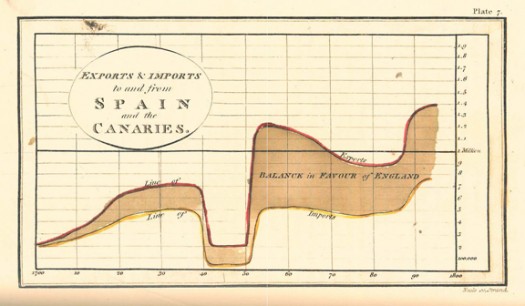
The term “information design” originated in the early 1990’s, however humans have been using visual aids to tell stories for a very long time (think cave paintings, hieroglyphics, etc.). Formal Information Design really hit its stride in the 18th century, with innovators like William Playfair creating some groundbreaking representations of data (http://www.humantific.com/making-sense-of-the-early-sensemakers). Playfair, a Scottish engineer and political economist, invented pie charts, line graphs, and bar charts. And you thought Scotch whisky was Scotland’s greatest invention! All kidding aside, Playfair’s charts were beautiful representations of imports and exports, giving life to previously abstract statistics.Playfair13-525x306

The evolution continued, and fast forward to 20th century: Harry Beck, an English technical draftsman creates the famous London Underground tube map in 1931 (http://britton.disted.camosun.bc.ca/beck_map.jpg).

beck_map

As a map lover, this is truly an iconic work, and set the standard of urban transit maps that we all know today. To me, Beck’s work truly achieves one of the key goals of information design: clearly visualizing something that is difficult to understand. Can you imagine the complexity of an actual map of the London Underground in its correct scale? It would likely look like an angry cluster of snakes. Beck’s map breaks down the complexity into something that even a novice traveller can visually digest over a cup of tea and a scone.

So with a little history under our belt, what are some tips for taking a modern approach to Information Design? Amy Balliett of Smashing Magazine wrote a fantastic article that gives some great examples of do’s and don’ts, that we can all use to approach our next presentation (http://www.smashingmagazine.com/2011/10/14/the-dos-and-donts-of-infographic-design/):

1) Show, don’t tell: Don’t miss an opportunity to visualize data. In other words, avoid putting into text what can better be conveyed with an image, chart, or graph.
2) If the client wanted an excel chart, they wouldn’t need you: This is clearly aimed at professional info designers, but you get the idea. Step your game up, and get creative! If possible, learning some design platform could really differentiate your skills from the rest of the pack.
3) Typography should not be a crutch: avoid leaning too heavily on fancy fonts that distract from the visualized data. I think this is great advice, and reflects back to “show, don’t tell.”

She goes on to make several other good points, but I’ll get right to the good stuff…

4) Tell a story: Funny how it always comes back to a good story. Great info graphics introduce a problem, back it up with data, and finish with a conclusion.

I highly recommend reading Ballet’s entire article, and hopefully it will provide some inspiration next time you attempt to convey a message visually. Now where did I put that Scotch?

What we can learn from the Declaration of Independence

What we can learn from The Declaration of Independence about the art and craft of structured problem solving.

This past weekend, as our nation celebrated the 4th of July, I took time to reread the Declaration of Independence. The document contains the most famous and precious words in American history, and arguably the finest articulation of the idea of natural rights ever written: “We hold these truths to be self-evident, that all men are created equal, that they are endowed by their Creator with certain inalienable Rights, that among these are Life, Liberty, and the pursuit of Happiness.”

I have long marveled at the beauty and power of the Declaration, and been fascinated by Thomas Jefferson, its principal author. This document provides a good example of 3 key management practice learning objectives: 1. Persuasive communication 2. Successful, real-world, problem solving and 3. An incitement to action.

1.  Making the Case Through Persuasive Communication

In the spring of 1776 Jefferson devoted much effort surveying the opinions of his countrymen to get their thoughts on American independence. He told one correspondent that he, “took great pains to enquire into the sentiments of the people on that head. In the upper counties I think I may safely say that nine out of ten are for it.” In terms of American political history, Jefferson was among the first to generate data from a survey of public opinion.

The ideas of freedom and liberty, which define the central themes of the emerging American republic, were commonplace in conversations, sermons, letters, and printed essays of the times. In drafting the declaration Thomas Jefferson said that his purpose was, “not aiming at originality of principle or sentiment.” Rather his intent was to, “place before mankind the common sense of the subject,” and to offer, “an expression of the American mind, and to give to that expression the proper tone and spirit called for by the occasion.”

Drawing upon the philosophers of the Scottish Enlightenment, Jefferson built his case on a contract between government and the governed that was founded on the consent of the people. Both poetic and practical, his arguments are grounded in the context of a story. The effect is a compelling narrative, even a romantic version of reality, which helped create an American identity.

Perhaps the most striking aspect of the document is the logical force and rational power of the arguments it presents, the most notable of which is the notion of self-evident Truths − Truths that are self evident by reason and definition and based upon assertions of reality. (The angles of a triangle equal 180 degrees)

Great writing commands respect. The Declaration is an excellent example of persuasive, evidenced based logic that shaped the course of history. Thomas Jefferson took the current American political ideas and put them into a form that the Colonists could read, appreciate, and understand. With the power of the pen, he articulated a new principle for the government of humanity: all men are created equal. He also ensured that from the beginning, the United States of America would be a nation based on the principles of rational thought.

2.  Creating Value through Real World Problem Solving

While Jefferson’s skill and abilities as a thinker and a writer were remarkable, he also possessed another important quality: the power to analyze a historical situation in depth, to propose a course of action, and shape the minds of the decision makers and legislative assemblies. The bulk of the declaration contains a list of charges condemning the actions of King George III, while creating sympathy for the American cause.

The main problems were subjecting the colonies to laws without representation and the increasing tyrannical abuses from the English system of monarchy. Jefferson provided a solution by focusing his structure on two important themes. The first was the concept of individual rights: ‘The God who gave us life, gave us liberty at the same time: the hand of force may destroy, but cannot enjoin them.’ Second, and equally important, was placing these rights within the context of popularly sovereignty, or the right of a nation to govern itself.

It was Jefferson’s ability to link the right to self government with liberty, both rooted in a Divine plan, and further legitimized by ancient practice and English tradition, which gave the colonists such a strong , clear, and compelling case for action. All of this led to a momentous decision. The struggle they faced was a daunting one.

3.  The Call to Effective Action

With forceful logic, evidence, and a sense of urgency, the declaration details the reasons the American colonists had to declare themselves independent, given their mistreatment at the hands of the British. Implementing these ideals would prove to be enormously challenging.  And, of course, England did not recognize or grant authority to the Declaration of Independence, and it would take a war of seven years to give validity and meaning to our founding document, but Jefferson’s efforts were essential for defining and legitimizing the new nation. With persuasive written communication, a logical framework for understanding the problem, and by proposing a  justifiable course of action, he won the hearts and the minds of the American people.

Great events in history are determined from all kinds of varied and complex factors, but the single most important one is always the quality of the people in charge. It all comes down to leadership. Two hundred and thirty-eight years ago our founding fathers made the sacrifices necessary to create the freedoms that we enjoy today. With the English language they gave voice to the unspoken hopes and aspirations of people everywhere. In the words of Benjamin Franklin, it was “the miracle of human affairs,” one that would result in “the greatest revolution the world ever saw.”

Full text of the document: http://avalon.law.yale.edu/18th_century/declare.asp


Sources that were used in the composition of this post:

Thomas Jefferson: The Art of Power by Jon Meacham 2012. Random House. New York

The Road To Monticello: The Life and Mind of Thomas Jefferson by Kevin J. Hayes. 2008. Oxford University Press.

American Sphinx: The Character of Thomas Jefferson by Joseph J. Ellis 1996. Random House. New York

A History of the American People by Paul Johnson 1997. Harper Perennial. New York

Benjamin Franklin: An American Life by Walter Issacson. Simon & Schuster. 2003. New York

Public Speaking Tips from Susan Cain

 Susan Cain is a writer and lecturer, her most recent book is called “Quiet” from 2012. The book is about “The Power of introverts in a World That Can’t Stop Talking”, she describes how all introverts need to realize the power of stepping outside of their safe zone to be an extrovert every now and again.

She is a well known presenter who is currently delivering speeches on this book. Her style of presenting is intriguing in that she has strong story telling abilities, uses props, humor, strong facial expressions and hand expressions.

She has the ability to remain animated and interesting, as she takes a personal approach and shares her views and funny stories about her life as an introvert.

Several keys to her successes as a speaker that she uses to present her material are below:

1)   Preparation is key- Practicing out loud, and video taping yourself are all helpful things as most people are uncomfortable with the idea of how you come across.

2)   Feed the audience what they want to hear. Is your audience looking to solve a problem or looking for any information in particular?

3)   Watch videos taken from different speakers vantage points. While you are watching take note of all the eyes on you and get used to it.

4)   Practice standing in the place you will be speaking at while looking over the room of empty seats.

5)   Get a hold of a great speakers written version of their speech and see how the speaker engages, inspires, and educates the audience.

6)   Utilize your strengths and weaknesses as a speaker. If you are funny, be funny; if you are great at telling stories, tell one.

7)   Create a persona of sorts. You are on stage and this is a performance, you need to keep the audience entertained and engaged.

8)   Smile at the audience, it will keep you relaxed as well as keep the audience connected.


Are there any introverts out there that struggle presenting that have any tips for pushing through a presentation? Please share!


Below is a link to her original article on tips for presenting:

http://www.readitforward.com/susan-cains-public-speaking-tips-for-introverts/


Below is a link to her speech on the book “Quiet”

11 Techniques Steve Jobs’s used to Present Apple’s

Steve Jobs was known for a slick product presentation with a seemingly casual delivery. His visionary products he pitched through his keynote presentations created hype and buzz in the industry that will be timeless. He was a fantastic presenter however not a natural, which gives hope to all of us that need improvement!

He used many different techniques to perfect his art of presenting and many articles can be found that explain his effective use of these techniques.

I have attached an article which describes 11 different techniques that Steve Jobs practiced. Teaser alert; my favorite recommendation is Practice & Have Fun.


1) Express your passion

2) Create a Twitter-friendly headline

3) Stick to the rule of three

4) Introduce a villain

5) Sell the benefit

6) Build simple, visual slides

7) Tell stories

8) Prepare and practice excessively

9) Avoid reading from notes

10) Have fun

11) Inspire your audience

If you have any good tips on presenting you utilize, please share!

Attached below is the original article:

http://www.forbes.com/sites/carminegallo/2012/10/04/11-presentation-lessons-you-can-still-learn-from-steve-jobs/

Continue reading 11 Techniques Steve Jobs’s used to Present Apple’s