Tag Archives: Ted Talks

10 tips on how to make slides that communicate your idea, from TED’s in-house expert

One of the skills that I chose to work on this semester was improving my presentation skills and slide design. In the past, I have been guilty of using the standard slide template, including too much text and underutilizing images. Over the course of the semester, I have been tasked with giving two presentations at work and have found ways to visually enhance my slides that have resulted in more effective presentations.

I recently came across an article on the TEDBlog that was written by Aaron Weyenberg, a UX Lead at Ted, and internally referred to as the master of slide decks. Below are 10 tips on how to make effective slides that he identified, however I have highlighted 2 tips that I found the most insightful and provided excerpts from the article.

  1. Think about your slides last. 
  2. Create a consistent look and feel. 
  3. Think about topic transitions. 
  4. With text, less is almost always more. 
  5. Use photos that enhance meaning.
  • I love using simple, punchy photos in presentations, because they help what you’re saying resonate in your audience’s mind without pulling their attention from your spoken words. Look for photos that (1) speak strongly to the concept you’re talking about and (2) aren’t compositionally complex. Your photo could be a metaphor or something more literal, but it should be clear why the audience is looking at it, and why it’s paired with what you’re saying. Below is an example of a photo I used in a deck to talk about the launch of the new TED.com. The point I was making was that a launch isn’t the end of a project—it’s the beginning of something new.

newbeginning-1

  • I found this tip to be eye-opening for me because I tend to be more literal in my presentations, so it was interesting to see how Aaron Weyenberg uses images to represent more tactical elements. For example, I am currently working on a deck outlining the new features of the upcoming relaunch of CNN.com, and instead of opening the presentation with an image from the new site, I’m planning on using a photo that represents the essence of the redesign and the impact it will have on the user.

6. Go easy on the effects and transitions.

7.  Use masking to direct attention in images.

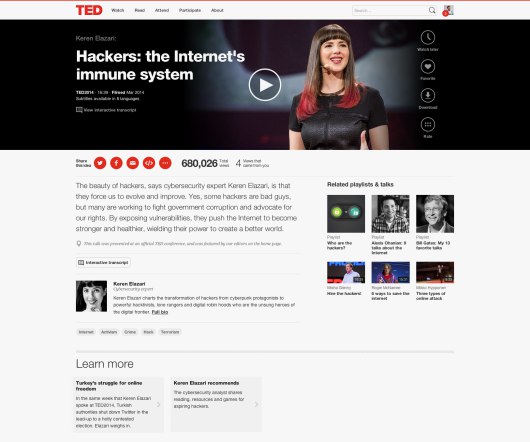
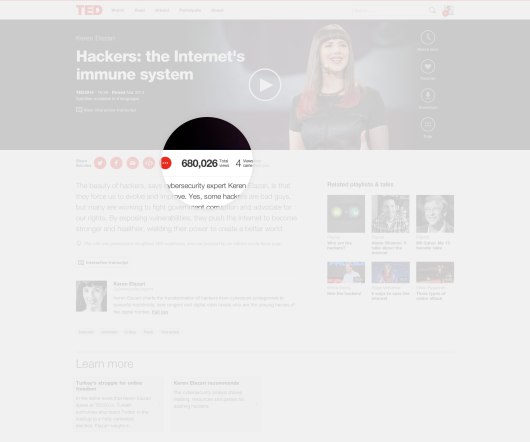
If you want to point something out in a photo, you could use a big arrow. Or you could do what I call a dupe-and-mask. I do this a lot when showing new page designs, particularly when I don’t want the audience to see the whole design until I’m finished talking about individual components of it. Here’s the original image:
mask-11

Here’s the process for masking it. (1) Set the image transparency to something less than 100. (2) Duplicate that image so there is one directly over the top of the other. (3) Set the dup’d image transparency back to 100. and (4) Follow the technique here to mask the dup’d image. You’ll end up with something that looks like this:
mask-31

  • I am often faced with this problem since my work is primarily focused on CNN.com, so many of my presentations include screenshots of our website. The tip above is a really great way to still show the site, but hone in on an area in a very interesting way.

8. Try panning large images.
9. For video, don’t use autoplay.
10. Reproduce simple charts and graphs.

Here’s the link to the full article where you can get the details on each tip.


Give a Killer Presentation, TED Style

How to Give a Killer Presentation

If a 12-year-old boy can successfully present an idea/invention to hundreds of adults, can you effectively present quarterly financials to your manager?  The answer is “probably,” and the TED Talks curator, Chris Anderson, has a couple of tips that will help you present like a 12-year-old kid!

We have an obvious affinity for the TED Talks videos and why not?!  The subjects are mesmerizing and the presenters are passionate.  Many of them are professional speakers and others are at TED presenting for the first time in their lives.  TED developed a process to help inexperienced presenters prepare, and it typically begins six to nine months before the event.  (How long have you been working on your MP presentation?)  Here are a couple of tips from Chris, and be sure to watch the first video about Richard Turere (twelve years old!) and how he’s saving Africa from lions.

Frame Your Story:  Conceptualizing and framing what you want to say is the most vital part of preparation

  • As a presenter, you are about to take your audience on an adventure.  Your biggest decision is selecting where to start and where to end.
  • Don’t assume your audience is prepared for the journey. Quickly introduce the topic and explain why the journey is going to be AWESOME, why you care about it, and why they should too.
  • Use specific examples to flesh out your ideas and avoid abstract language.
  • Some journeys are too long (like baseball season).  Limit the scope of your presentation and don’t try to over explain.  For example, if you only watch Major League Baseball during the months of April and October, you’ll still get the gist of the season.

Plan Your Delivery:  Memorizing a presentation is the best way to go

  • Do not read, EVER.
  • Keep it natural and connect with the audience.
  • Pay attention to your tone and sound conversational.  Talk to the audience, don’t talk at them.
  • During the journey, don’t annoy your companions by projecting ego.  No one likes a Conceited Cathy or Pompous Phil.

Develop Stage Presence:  Stage presence is coachable and takes practice

  • While presence is important, getting the words, story, and substance right are more important.
  • Making eye contact is the most important physical act on-stage.
  • Swaying side-to-side or shifting your weight around can be distracting to the audience.
  • Nervousness affects everyone. Here are a couple tricks to deal with it:

o   Stay out in the audience until the moment you go on; this keeps your mind engaged.

o   Spend time before you present striding around, standing tall, and extending your body; this will make you feel more powerful.

o   Breathe deeply before you go on-stage.

  • Nervousness can be a powerful way to connect with the audience by showing vulnerability and authenticity.

Plan the Multimedia:  The best TED speakers don’t use slides at all

  • There are tons of technology aids, so experiment!

Putting It Together:  Practice, Practice, Practice

  • Practice on your own and in front of an audience.
  • If you rehearse to an audience, choose people who are experienced presenters and will offer constructive feedback.

In sum, Anderson presented to a TED audience for the first time after curating for nine years.  Here are his parting comments on his experience:

Presentations rise or fall on the quality of the idea, the narrative, and passion of the speaker.  It’s about substance, not speaking style or multimedia pyrotechnics.”


http://hbr.org/2013/06/how-to-give-a-killer-presentation/ar/5


The Silent Story: Striking a Power Pose

Stories, sales pitches, and every other form of communication rely heavily on word selection, but there is another key ingredient in the recipe: body language.  Our subconscious relies on more than just a string of words to interpret the meaning and depth of a story.  We also use body language to determine the credibility of the speaker.  The interesting thing about body language is that it has a similar effect on both the speaker and the audience.  An article published by the Wall Street Journal says that striking a powerful pose actually changes a person’s hormones and behavior, giving the perception of real power.  The power pose can be practiced before a meeting to start elevating the hormones conducive to a better performance and more confidence.

Professor Amy Cuddy of Harvard University presented a TED talk  titled “Your Body Language Shapes Who You Are” in which she elaborated on her research regarding the impact of the power pose.   In one experiment that she conducted, individuals were asked to assume either a low power pose or a high power pose for 2 minutes.  The results showed that after just 2 minutes, there was a change in the hormones testosterone and cortisol, giving the high power posing individuals a higher tolerance for risk and the low power posing individuals a lower tolerance for risk.

So what exactly is a power pose?  According to Forbes magazine, a power pose can be as simple as standing with arms out, hands on hips, and legs spread open.  The victory arm-pumping in the air is another example.  Although very informal, sitting back in a chair with legs propped on a desk and arms folded behind the shoulders is a classic power pose.  Basically, the act of expanding the body can create a power pose that triggers the brain to think bigger too.

There is a proper time to strike a power pose, whether privately in a bathroom or publicly in front of an audience.  The mindset that is achieved through behavior is one of the most powerful tools that can be utilized in communication.  Your business pitch might just depend on that extra little bump in hormones.

9 Public-Speaking Lessons From The World’s Greatest TED Talks

When asked what my passions in life are, I often respond the same way – food and public speaking (in no particular order). While one is likely to help me further my career and the other is likely to help me further my waistline, they are both still passions of mine.

Public speaking didn’t come naturally to me at first; in fact, there was a time in life where it terrified me. But through practice, practice, and more practice, I came to not only achieve an acceptable level of competency in the skill, but I started to truly enjoy speaking to large groups.

I, like most, am constantly looking for ways to improve my public speaking skills. Like many, I often watch TED talks to gain ideas, inspiration, and witty one-liners to utilize in my presentations. Carmine Gallow’s article entitled, 9 Public-Speaking Lessons From The World’s Greatest TED Talks, is a great synopsis of how there is a style to TED talks, and how this same style can be incorporated into everyday presentations.

There are two ways to summarize this article. The first, and the conventional way, would be with the nine bullet points below. However, it is more exciting to view the most watched TED talk of all time via this link. This TED talk, like many others, illustrates eight of the nine points below (The presenter does not use any materials, so point #8 does not apply).

  1. Unleash the master within.
  2. Tell three stories.
  3. Practice relentlessly.
  4. Teach your audience something new.
  5. Deliver jaw-dropping moments.
  6. Use humor without telling a joke.
  7. Stick to the 18-minute rule.
  8. Favor pictures over text.
  9. Stay in your lane.

Aside from the list, I would like to add one more bullet point that I see as a theme through most of the great presentations that I have seen, the one you may have just watched included.

  1. Take chances.

I would like to point out one skill in particular that this article highlights and the TED talk illustrates – storytelling. This presenter is a phenomenal storyteller. He paints vivid images for the audience through the use of tales about his family, his friends, or moments in history that help bring his points to life. When this powerful imagery is combined with his vibrant scene of humor that both engages and captivates the audience, his message becomes memorable, and he gains instant credibility based on the audience liking him, not his actual subject knowledge.

The points raised in the article do not differ from the lessons learned in MP over the past year. Style, delivery, and content are at the heart of every presentation. The only way to improve these skills is to practice and learn from mistakes made along the way. For anyone with trepidation about public speaking, weather at school or at work, read this article and watch this TED Talk, you will be glad that you did.

Read more: 9 Public-Speaking Lessons From The World’s Greatest TED Talks

Watch the TED Talk: Ken Robinson: How schools kill creativity


Structure Storytelling into a Formal Presentation

I will admit that I am not the best at crafting formal presentations. However, I also would not consider myself the worst. I have a technical background and my slide craft and delivery tend to reflect that. Why do my presentations tend to lean towards the technical and away from creativity and storytelling? I think it may because of my misperception that developing a presentation around storytelling means sacrificing structure until the presentation becomes “fluff”.

Nancy Duarte, a self-described communications theorist and empathy architect, is the CEO of a firm that specializes in the application of storytelling and visual thinking to communications in business settings. Duarte has also authored several books on the topic of communications: Guide to Persuasive Presentations, Resonate, Slide:ology, and Slidedocs. Duarte gave a TED Talk (view here) that has changed my understanding of the structure involved in successfully integrating storytelling into a formal presentation.

Here are a few notes that I took away from Duarte’s talk:

1. Understanding Proper Role Assignment

The presenter is not the hero of the story, the audience is the hero. Duarte states that the presenter needs to play the role of a mentor, guiding the audience along from the current state forward to the presenter’s idea.

2. Three Part Structure

Every story has a beginning, middle, and end, right? Yes, but Duarte provides a little more substance. The story should start with a likeable hero who has a desire. This hero should then encounter a roadblock or obstacle. Ultimately, the hero emerges transformed. This is the kind of structure seen in most movies.

3.  Presentation Shape

Should there be a structure to a good presentation? Most novels have an arch shape, in which they start, build into a climax and then return as the story is resolved. Duarte studied several famous speeches and recognized a similar structure, a repeating step function. The beginning starts with “what is” and compares it to “what could be”. Here is how things currently are, but look at how they could be. The remainder of the presentation should be based on the amplification of the gap between these two. The middle of the presentation repeats the back and forth motion of what is, what could be, what is, what could be. The goal is to make the current status quo and normal condition look unappealing. Finally, the end should be a call to action. The presentation should end on a high with the audience imaging how the world could be with your idea.

Two of the presentations that Duarte analyzed that exhibited this structure were Steve Job’s 2007 presentation to introduce the iPhone and Dr. Martin Luther King Jr’s “I have a Dream” speech. For more information regarding Duarte’s work, check out her website.

Deconstructing a Ted Talk

Happy early 4th of July! Before I head out to the pool to enjoy this long weekend, I thought I would leave everyone with a few tangible tips on how to make a presentation great.

Everyone is familiar with Ted Talks, and for good reason—they contain powerful ideas that often change people’s attitudes, lives, and the world. I happened to find an article that deconstructs one of the most viewed Ted Talks of all time: “How Great Leaders Inspire Action.” I do encourage watching it when you get a chance, as it contains some intriguing and useful ideas. Whether you get to watch it or not, here are some takeaways that can be applied to future presentations.  Click Here for the Ted Talk and full deconstruction of the speech.

1. Get your audience in the proper mindset right away. Simon did this by getting the listeners “to question,” but you can be creative here with stories or astonishing facts.

2. Have an inflection point, and be sure to emphasize it.

3. Make your speech tangible by bringing in examples or research to support your ideas (duh!), but do not spend too much time or get into the nitty-gritty details. Otherwise, you risk losing your listeners.

4. Build suspense into your story. More direct eye contact helps you achieve this effect.

5. Consider using parallel structure. Think JFK’s famous line: “Ask not what your country can do for you. Ask what you can do for your country.” As for Simon, “We follow those who lead, not because we have to, but because we want to. We follow those who lead, not for them, but for ourselves.” Very impactful!

6. Pause for impact, but you need to be strategic with quantity and placement; keep them to a minimum and spaced out.

7. The most viewed Ted Talks do not use PowerPoint slides, so do you really need to?

8. This one is my favorite: fascination cannot be faked. Hopefully you have the privilege of being fascinated with what you present because this allows you to connect with your audience. And if you are not fascinated…well, good luck?!

I would like to add “smile” to the list as my own. When I was an intern, that was one of the most important pieces of advice that I received regarding public speaking: “Don’t forget to smile while presenting.” I was a little surprised with this advice since I thought it could take away from the seriousness of a formal presentation, but the more top-notch presentations I see, the more I notice the smiles throughout the speeches. This goes together with tip #8, but I thought it needed to be called out specifically. Hopefully I smiled during the Delta presentation…

Lastly, I came across an article titled, “How to Give a Killer Presentation,” which appeared in the Harvard Business Review last summer (you can get the full article through the Emory library system; click here for a portion of the article). It was inspired by the Ted Talk given by Richard Turere, which this one YOU MUST WATCH (Richard Turere: My invention that made peace with lions)! Richard was an unlikely candidate to give a Ted Talk: terribly shy, spoke poor English, and had difficulty producing coherent sentences. But, his idea was so inspirational that the folks at Ted worked with him to frame his story and give a powerful speech. Boy, did he nail it!

The lesson here is that you do not need to be the best speaker to be engaging and inspiring. There are tools and tips you can follow to improve presentations (i.e. the list from above, this HBR article, all the other posts on this blog…), and if you let your pure passion and unique personality shine through honestly, people will hear you. And how about Richard’s smile? My heart melted.

Three Public Speaking Secrets

TED Talks certainly holds a library of great presentations given by  some great presenters. Drake Baer share with us in this Business Insider article, “3 Public Speaking Secrets from the Most Successful TED Talks”, what he finds as the 3 public speaking secrets from TED Talks presenters.

We’ve been taught various tactics for how to deliver a great presentation, and you’ve heard all of this before.  And although it’s best for presenters to incorporate everything we’ve already learned in MP and throughout our career and education, for a novice presenter like myself, this article really highlights to me the three most important things to focus on when developing my presentation skills, from a public speaking perspective.

1. Tell them a story

This article states that you connect with people on an emotional level when you tell them a story- it helps to build a connection when your audience is able to relate to what you’re saying.  Gallo believes that the most successful TED Talks are 65% story, 25% data, and 10% building credibility.

2. Create “emotionally charged events”

An “emotionally charged event” is described in the article “as an incident where you experience shock, surprise, or fear”. This creates a trigger in your brain that remembers this experience.  We learned a similar technique called creating urgency in our presentations. Do we all remember the trailer from “An Inconvenient Truth” about global warming to create that urgency?  The article recommends that in every presentation, you create a way to present the information in a way that is new, novel, and unexpected.

3. Use the rule of three

This rule has probably been engrained in us for a while. This will help structure the presentation as well as help people remember it, since it is easier to remember information given at 3-4 chunks at a time.

Even from a presenter perspective, I believe that these three “secrets” will be very helpful when preparing as well as presenting the presentation.  Stories help connect with the audience, but it help better organize and build on or relate back to the story throughout the presentation.  Creating urgency or “an emotionally charged event” will allow you to remember why you’re am presenting in the first place, as well as help with transitions when structuring the presentation. Using the rule of three will also help with the organization and flow of the presentation.  It will also help me to be sure to touch on three key points for every topic I have.  One of my goals is to rely less on my rehearsed and memorized presentation, and not get caught up in missing a word that I should have used. Instead, I want to be able to focus on preparing the  delivery of my three key points.  I think focusing on these when first preparing my presentation, as well as developing my presentation/ public speaking skills, will be very helpful.
Do you agree with these three secrets to successful presentations? If you could add one more “secret” to public speaking, what would it be?

Link to full article: http://www.businessinsider.com/public-speaking-secrets-from-successful-ted-talks-2014-3