
A Pilot’s Lesson in Planning

DZ N684CD 12-17-2006
The author, after returning from a cross-country flight to Kitty Hawk, NC.

One the most exciting and challenging days in the life of a student pilot is the day he or she sets out on their long solo cross-country flight (“Cross-Country”).  Although the name suggests a flight across the United States of America, in this context the term Cross-Country refers to a journey that is at least 150 nautical miles, involves full stops at three different airports, and a leg of at least 50 nautical miles between two of the stops.  Although it is only one of the final steps before a pilot’s license can be awarded, it is largely viewed as the true test of a student’s ability to responsibly map out and execute a flight plan.  It requires a demonstration of skill, discipline and focus, and for this reason it is considered a rite of passage that separates real “pilots” from mere “flyers.”  Reflecting upon my own my Cross-Country experience, I can see now that the principles applied in preparing for that flight can also be applied to planning a business project.    If you search, “how to plan a Cross-Country flight” on Google, you’ll receive a number of hits, ranging from brief overviews to detailed instructor guides, but my personal favorite guide is Rod Machodo’s Private Pilot Handbook.  Below, I’ve selected the most relevant points from all of these sources, and a quote from Mr. Machodo’s chapter 14 titled “Flight Planning: Getting there from here,” and I then explain how these practices can be applied as a framework for planning out a business project:

CrossCountry2
A sectional chart


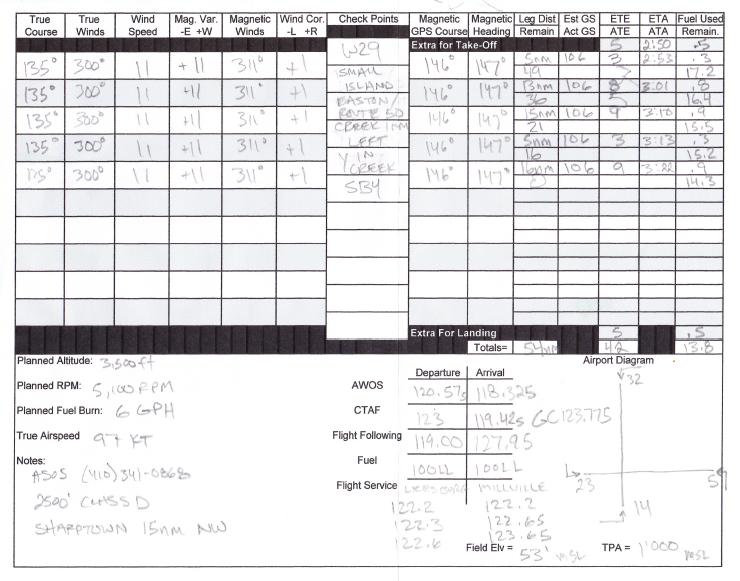
A flight plan with way-points, course headings, and estimated time marks.

Flight planning is information management.  Your job is to assemble, interpret, and put to use all the information needed to safely make a flight from Point A to Point B.”  ­- Rod Machado

Identify your destination.  All general aviation Cross-Countries begin with the choice of a destination.  While you might get into your car just to go “drive around town,” with the peace of mind that if you need to get fuel or food, you will be able to find it along the way, you would never do the same with an airplane.  As a pilot, you always need to know where you’re going –even if “there” is just doing touch-and-go’s in the traffic pattern of your home base airport.  The reason you need to know where you’re going when you take-off is that the destination will govern important details such as how much fuel you will need to store, which sectional map to examine to identify waypoints, what radio frequencies you will use to communicate with other airplanes and controllers on the ground, what weather you will need to look out for en route, and what kind of provisions you should pack in the event of an emergency (e.g., are you flying over water, a desert, snow-capped mountains? Survival in each environment requires different provisions).

Planning out a project in business is no different.  As discussed during the Fall Semester, there’s a tendency to just want to dive-in and start smashing the watermelon, but just as a pilot’s choice of destination will affect such basic decisions as how much fuel he needs to load into his tanks and what map he’ll need to examine for way-point identification, the selection of a business project’s objective or “destination” is equally important.  Without knowing the objective, it’s impossible to plan out how to achieve it.

Selecting a Route.  Once a destination is selected, it’s time to choose a route.  This process begins by selecting the correct aviation map, known as a sectional chart.  Within the U.S., there are over 50 sectional charts to choose from, each focusing on a different part of the country, so again, identifying the destination is a prerequisite to choosing the right chart.  Examining the chart is an essential step because of how much information a pilot can obtain from a careful reading.  In addition to showing the location of airports, these charts also provide information on geographic formations that are visible from the air, obstructions (e.g., cell towers) that should be avoided, radio frequencies used by ground based operations and other aircraft in the region, private airstrips, airspace classification (which connotes different rules and procedures that need to be applied), and much more.

Although there is tendency to want to take the shortest route by drawing a straight line between two points on the chart, the truth is that the shortest route is not always the best.  I distinctly recall when I was planning my flight from an airport south of Washington, DC to Ocean City, MD and then down to the mouth of the Chesapeake Bay, that the most direct path would take me through restricted airspace, controlled by the U.S. Navy.  Moreover, the most direct path would not bring me within eyesight of significant landmarks that would be distinguishable from the air.  As the flight involved a significant amount of flying over-water, it was essential that I select a route along which I could double-check my heading, and measure my actual progress against my predicted time-marks by looking out the window.  Accordingly, I selected a less direct route that would bring me in close range of several distinguishable landmarks to make sure I remained on course and on-time .

In business, once the objective has been identified, there’s a similar tendency to want to select the fastest route towards achieving that objective; however, the fastest route is not necessarily the best one for you or your resources.  The fastest route may be the most costly, it might involve exposure to unacceptable risk, or it might not be feasible with the resources that are available.   Moreover, like a flight plan, a project plan must include distinguishable way-points (a more colloquial term might be “mile markers”) against which the team can measure its performance and ensure it remains on course, and just like the use of time-marks the plan should layout realistic deadlines for when those way-points will be reached.  Simply telling someone “go solve this problem and come back when its done,” is not as effective as saying, “go solve this problem by completing these 10 specific steps and as you complete each step check back with me so we know we’re on point.”  Laying out a plan that allows you to break the project up into these measurable tasks and metrics will enhance your ability to track your team’s progress and report on that progress to the stakeholders,  just like a pilot tracks his progress and reports it to the controllers on the ground.

Plan for Uncertainty.  The “if” in If everything goes according to plan,” is something no pilot can afford to ignore.  Rarely does everything go exactly according to plan.  Something as mundane as the direction of the wind could change and in so doing it would alter your airspeed, heading, and even the runway you had planned to take-off or land-on, and of course there are no shortage of more major “if’s” that could alter your plans.  With this in mind, a good pilot needs to plan for contingencies (e.g., identifying alternative/emergency landing spots along his route), manage his own and his passengers’ expectations about timing and variability of conditions, and always make sure reserve fuel is left in the tank. It also means a pilot needs to consider what kind of provisions (e.g., survival gear, communication devices, food, water, temporary shelter, etc.) he might need to survive in the event he is forced to put the plane down along his route.

While some business projects are couched as “do or die,” “bet the company,” or even “get it done, no matter the cost,” projects, every plan needs to consider what resources are required to achieve the objective, whether these resources are available, and what contingencies should be put into effect if certain scenarios arise.  While all business environments may not be as unpredictable as the weather, relying on a blind belief that “everything will go as planned” in your industry is no small folly.  Accordingly, a good plan must at least acknowledge the points that are uncertain or that could be variable, and consider what should happen if those variables change.

Executing.  Executing a flight plan properly requires skill, discipline, and flexibility.  A pilot needs to be (a) skilled at maintaining his desired heading, speed, altitude, and communications while also on the lookout for incoming traffic and obstructions; (b) disciplined at checking his progress along his route, clocking in at regular intervals to measure changes in both the internal performance of his plane (e.g., engine RPMs) and the effect of outside forces (e.g., head or tail winds) on his progress; and (c) flexible in his ability to deviate from the plan as new information comes to him (e.g., materialization of a summer thunderstorm directly in his flight path).  This last point on flexibility is particularly essential because one of the biggest causes of general aviation accidents is a disease known as “get-home-itis,” wherein the pilot becomes so focused on the idea of getting home that he may compromise his normal risk tolerances and decide to try to fly through bad weather or mechanical failures in an effort to “just get home” rather than divert to another airport or delay his departure.  Get-home-itis is characterized by a loss of sight of the big picture, which is to stay alive and well.

In business, the proper execution of a plan also requires this combination of skill, discipline, and flexibility.  The skill of coordinating of team members  and the discipline to follow-up with each of them to make sure a project is meeting its way-points on-time and on-budget are essential, but again, flexibility is particularly important.  There are countless examples of companies that became so consumed with a project and the sunk costs associated with it that they were unwilling to cut their losses before it was too late.  The formulation of a plan is essential to achieving an objective, but sometimes the plan needs to be changed, and sometimes the individual objective may even need to be modified, so that it remains consistent with the company’s overall goal.  No matter how good your plan executed, it will never be viewed as a success if it undermines the big picture objective of your company.

Conclusion.  All too often, people are inclined to think of planning as a static, stagnant, and un-dynamic process.  The prevalence of phrases like “analysis paralysis” in the business suggest a lack of respect for putting in the time and energy necessary to develop a proper plan from the start; many people -desperate to start “taking action” – prefer to smash the watermelon first and ask questions later.  This demonstrates a fundamental misunderstanding for what planning is and how it should be done.  Mr. Machado’s assertion that when you plan, “your job is to assemble, interpret, and put to use all the information needed” to achieve your objective, beautifully explains that planning is an active process.  It’s not static or stagnant and it’s not something you do at the beginning and then never revisit –if it is you’re doing it wrong.  It’s about actively examining the goals and the steps needed to achieve them, and just as a flight plan can evolve mid-flight, business project planners should also be prepared to evolve their plans mid-project, as new information comes to them.  So the next time you get tasked with a new project, I encourage you to think of yourself as a pilot.  Identify your destination, break out your map, and begin selecting the right route for you and your resources.  When the time comes to execute, be disciplined in trying to reach the way-points and in measuring whether your reaching them on-time and on-budget, and if not, don’t be afraid to re-calibrate your plan the way a pilot might adjust his heading to account for changes in wind direction.  Above all else, avoid your own form of “get-home-itis.”  Put the objective of your project in context with the overall goal of your company.  If everything goes according to plan, you’ll be soaring above the competition, but since everything rarely goes according to plan, at least you’ll be prepared for whatever comes your way.

Solo Flight
Shaking hands with my CFI after my first solo flight. Summer 2006.


A Recap on the Strategic Problem-Solving Model

Oftentimes, we can be inundated with information from work, school, and other obligations. We have covered a lot of this information in our MP course, but it is good information to look at and keep in mind when faced with trying to solve a problem in your business. McKinsey has developed a strategic problem-solving model that is specifically set in place to help MBA students build knowledge and skillsets in strategy.

Here is McKinsey’s strategic problem-solving model:

We must first start with defining the problem and determining what information is required to expand your research on that problem. This is where you “frame the problem” and then develop a hypothesis based on that problem. At this step, we develop an issue tree to break down our ideas into smaller components.

Once you develop an issue tree, you need to sort out the information into what you know and what you don’t know. Then you seek out more information on those topics that you don’t know by using fact-finding and interviewing techniques to gather information.

Here are a few tips to keep in mind when following this problem-solving model:

  • Be sure to follow facts, not intuition
  • Figure out the underlying issue before diving into the project
  • Don’t reinvent the wheel; follow the frameworks given to you
  • Look to other resources to help guide you with your research
  • Garbage in = garbage out
  • First, look at the annual report, then outliers in data as well as best practices in the industry

For more information on this strategic problem-solving model, be sure to visit http://www.webpages.uidaho.edu/~mbolin/donaldson.html.

Iron Maiden and Data Analysis: How one Heavy-metal band used data to profit from a revenue-stealing platform

Applying data analysis definitely isn’t always the most exciting field- certainly not as fun as seeing a heavy metal band say Iron Maiden live for instance. With the constant shrinking revenues from traditional album recordings many bands are increasingly reliant on live shows- especially older bands who’s catalog of albums can be easily downloaded in a matter of minutes at no profit to the band or label. This leads them down a road of never ending farewell tours in the same reliable but boring locations.

Enter Iron Maiden: The international super group undoubtedly has fans all over the world but has struggled with their selection of where to tour, despite being one of the most iconic acts in industry. In an innovative use of data analytics for the music industry the band now weighs illegal downloads by location to help determine demand. This has paid off huge in their recent South American tours whereas prior data say that it would have been a disaster and complete opportunity loss. Their most recent tour gained them the distinction of “One of six groups that outperformed the industry” including live documentary sales and one concert alone in Sao Palo that grossed them over $2.5 million. South American attendance and revenue also trumped their previous averages in NA and the EU too.

Hail the Iron Maiden data wonks!

http://www.rollingstone.com/music/news/iron-maiden-using-bittorrent-analytics-to-plot-tours-20131226

Exerting Influence Without Authority

In the business environment today the “I leader, you follower” mentality may not always be the most appropriate approach anymore.

With so many business structures relying on partnerships and working with teams inside and outside the company, the traditional leader tactic will not always work. Many managers and executives need to be able to adopt a more lateral style of leadership in order to coordinate, communicate, and complete work with these interwoven relationships.

The article explains lateral leadership as the ability to combine multiple essential skills. The article explains 4 essential capabilities to assist you with understanding how to use lateral leadership to your benefit.

1) Networking – “Cultivate a broad network of relationships with the people inside and outside your company whose support you need to carry out your initiatives.”

2) Constructive persuasion and negotiation – Look at persuasion and negotiation as a way to  heighten your influence not as way to manipulate.

3) Consultation – “Take time to visit the people whose buy-in you need. Ask their opinions about the initiative you’re championing. Get their ideas as well as their reactions to your ideas.”

4) Coalition building – “It’s a fact of human nature that several people who are collectively advocating an idea exert more influence than a lone proponent.”

A few more take aways:

  •  Lateral leadership can be challenging for managers to execute. It is difficult to master many of the capabilities that go into achieving lateral leadership. It may take time.
  • It is important to find the people in your company that have a lot of influence. Take the time to meet these people and get to know them before jumping into a project with them.
  •  A natural positive environment can help bring relationships together. A company should encourage opportunities for people to meet, but let the relationships form on their own and not be forced.

Exerting Influence Without Authority


Career Rocket Fuel in Three Stages

http://www.fastcocreate.com/3027499/career-rocket-fuel-whether-youre-a-millennial-or-eyeing-retirement-heres-what-you-really-nee?utm_source=facebook

Recently, my boss shared this thoughtful article on career planning. Despite the unwieldy title, “Career Rocket Fuel: Whether You’re A Millennial Or Eyeing Retirement, Here’s What You Really Need To Get Right About Work,” it opened my eyes to a longer view of what constitutes a career.

The key takeaway for me is the thought of pacing. Author Brian Fetherstonhaugh suggests thinking of a career as a three stage process, with each stage spanning roughly 15 years. These days, people don’t stay with one company for their entire career. The article points out that it isn’t necessary to remain in one place if you have the structure to build toward something.

Stage One is a time to acquire valuable skills and experiences that are transportable to all types of work. These are the skills we are working on this summer—problem solving, communication, working with teams, reasoned decision making—not purely technical skills. Another goal in this stage is to build enduring relationships with people on all sides of us. Stage One is a time to figure out what you find interesting and what you could devote future years pursuing.

Stage Two is a time to focus in on the interests and hone the skills discovered in Stage One. It’s a time to elevate those skills to a level that differentiates you from the rest of the field. This is the time to take the skills with which have the most proficiency and become most proficient in your department, company, industry, etc.

Stage Three was the most revolutionary part of this article for me. This is a time to mentor the next generation and pass along the wisdom (hopefully) earned over a nearly full career. Thinking of coworkers in this stage made me realize how much value there is to gain by listening to people near the end of a successful career.

This article concludes with an interesting breakdown of how you might invest your time in each career stage if you wanted to optimize your return in each segment.

Unlocking Your Strengths

I recently had the opportunity to attend a half day training seminar and I found the topic extremely relevant to each of us as we transition from execution to management within our companies. I think everyone knows how passionate I am about personal growth and development, and I stand firmly behind the idea of strength-based feedback. This post is going to focus more on how to give feedback rather than receiving it yourself, but the framework can be applied in either direction.

Strength-based development is the practice of deeply knowing and documenting an individuals’ distinguishing capabilities and linking their strengths to priority development areas in order to accelerate learning and growth.

Strength-based feedback is comprised of three steps. Step 1 calls for an inventory of strengths. Step two pushes you to link the strengths to development goals, and then in the third step you apply the strengths and development goals to an action plan.

A strength inventory is a comprehensive list of the skills, characteristics and value an individual brings to your organization. They are individual and specific and supplemented with examples on how the strength manifests in behavior and actions. By creating this inventory, you provide explicit recognition of the strengths, which fosters self-confidence.

The next step is to link the strengths to development goals. It’s important to remember that we can only focus on a small number of development goals at a time, so as you’re providing feedback, focus on what’s most important. For example, if someone on your team really struggles to speak up in meetings, but they can create very polished presentation slides, your feedback should focus on helping them pivot their strength in slide creation to polishing their presentation skills in the same manor.

The final step is to create an action plan together with your employee. Agree to tactical goals that the individual can refer back to, and do so regularly. An example might include “…improve first impressions and body language and avoid coming off as more junior. Leverage your natural confidence and credibility and extend it from beginning to end of an interaction.” Each subsequent meeting you have should include an update on the action plan and a focus on what the individual has done to address each of the goals you agreed to. The action plan encourages collaboration and fosters a shared responsibility between you and your employee to monitor their personal growth and development together.

How have you helped foster development on your own teams at work, either as a colleague or manager?

Storytelling Tips for Success

  • Don’t be afraid to show your vulnerable side.

Tell about your struggles or (mild) embarrassments. The audience will identify with a speaker who isn’t afraid to be self-deprecating. The audience will think you are more credible if they can relate to your failures. Ronald Reagan (see below) has told stories of walking down the street in a foreign country to explain to the audience what the people there are like. No one is perfect and the audience knows you aren’t either. As I stated in my previous post, the audience is rooting for you to succeed. If you portray yourself as an underdog, it will be even easier for them to like you because everyone likes rooting for an underdog.

Reagan’s Storytelling at its Finest

  • Make the audience feel like they were there.

Most importantly, it is better if you are telling a story that is actually true or that is nearly true. The purpose of the story is to set the stage for what the experience was like. Before television and movies, humans told other humans what happened in their lives by describing it to each other as if the other person was there. Use a lot of descriptive words. Set the mood. What was going through your mind as the events unfolded? As social media and other forms of instant, abbreviated content fills our minds and worlds (think texting, BuzzFeed articles, Instagram, snapchats, etc.), it will become increasingly important to be able to tell another person or group of people about an experience in a genuine human way.

  • Start with the end in mind.

The point of the story is not to entertain the audience. The purpose is for the audience to remember what you are trying to tell them. The medium of a story is easier for people to remember. It is ingrained in us from our prehistoric ancestors. They convinced people to do things based on stories and emotion, not with powerpoint slideshows or colorful charts and graphs. Make sure you the story brings you to the point and helps you drive it home. The story will make the audience much more likely to remember the presentation, and a good overall goal would have an audience member be able to convey it to someone who wasn’t even there by telling your story and relating it to the overall message. Of course practice is important. Professionals at the Advanced Publix Speaking Institute recommend practicing 30 times. TED presenter Dr. Jill Bolte-Taylor says she rehearsed her presentation 200 times before delivering it. What should I do if I don’t have time to practice it that many times? You should do the best you can and practice it as many times as you think you need to be successful. However, at some point you can sound over-rehearsed and you should just “do it live” for more authenticity.

Do it Live

Inspiration: http://www.gingerpublicspeaking.com/storytelling-public-speaking http://www.public-speaking.org/public-speaking-storydo-article.htm

Discovering Your Authentic Leadership

This Harvard Business Review  article outlines how to be an authentic leader and explains that you do not have to be born with a specific set of characteristics that labels you a leader. Rather authentic leadership develops from a multiple of facets that make up ones life. Their study shows that you do not have to be in a high position at your organization or wait for that tap on the shoulder to be recognized or portray authentic leadership.

The authors and their research team surveyed over a 125 leaders at multiple levels. This proved to be one of the most extensive study on leadership development.  The team wanted to know how these leaders developed their leadership skills. They found that after “Analyzing 3,000 pages of transcripts, our team was startled to see you do not have to be born with specific characteristics or traits of a leader. Leadership emerges from your life story”.

One of their interviewees was Ann Fudge, Chairman and CEO for Young & Rubicam. She stated, “All of us have the spark of leadership in us, whether it is in business, in government, or as a nonprofit volunteer. The challenge is to understand ourselves well enough to discover where we can use our leadership gifts to serve others”.

There are 7 areas in which the authors express make up authentic leaders. Please read below for a brief description of these 7 areas.

1) Learning from Your Life Story – Many leaders use life experiences and happenings to help motivate their leadership. They use these experiences to give meaning to their lives and find the inspiration to lead.

2) Knowing Your Authentic Self -This article expresses that one of the most important capabilities of a leader to possess, is to have self awareness. As time goes on many leaders who may find benefits from the outside world such as money, fame, and power will eventually feel like something is missing. These leaders have left no time for them to understand and develop the inside part of their leadership.

3) Practicing Your Values and Principles – The article explains “leadership principles are values translated into action. Having a solid base of values and testing them under fire enables you to develop the principles you will use in leading”.

4) Balancing Your Extrinsic and Intrinsic Motivations – It is easy to get caught up in the external motivators such as promotions or financial rewards, but in the end of the day intrinsic motivators work closer with your values and will be more fulfilling then extrinsic motivations.

5) Building Your Support Team – Authentic leaders maintain strong relationships in multiple forms. These relationships help them continue their forward movement. These relationships can include family, mentors, colleagues, and close friends.

6) Integrating Your Life by Staying Grounded – This can be very challenging for many leaders. It is important to integrate a balance between work, family, friends, health, and even spiritual practices. This allows leaders to maintain an authenticity.

7) Empowering People to Lead – An authentic leader recognizes that leadership is not defined by their success but rather the success of an organization by empowering leaders at all levels. Authentic leaders will motivate and encourage people to lead.

I found that this HBR article offered a great perspective of what we can focus on to develop our abilities as authentic leaders. We do not have to wait to start becoming the leaders we want to be, the best time to start is now using our life stories and experiences to lead the way.

I want to end with my favorite quote from the article.

“Authentic leaders demonstrate a passion for their purpose, practice their values consistently, and lead with their hearts as well as their heads. They establish long-term, meaningful relationships and have the self-discipline to get results. They know who they are.”

Here is pdf version of the article

Discovering Your Authentic Leadership 

Crap Circles

It’s Time to Retire ‘Crap Circles’” by Gardiner Morse, may be my favorite HBR article that I have read this semester. Morse makes the point that people often add graphics to PowerPoint presentations without considering if the graphic actually supports their model or idea. Obviously, graphics can be an effective tool for connecting to an audience, more so than a slide deck packed full of text, however, before including a “crap circle” make sure the idea that you are attempting to portray is circular in nature and not linear.

Here are a two bad examples from Morse’s article:

An accounting firm graphic for company services (in a circular graphic): 1) Conception/Start-up Phase, 2) Survival Phase, 3) Growth Phase, 4) Take-off Phase, and 5) Maturity Phase. There is an arrow between each phase pointing to the next. So the question is, how does the fifth phase of Maturity Phase progress into the first phase of Conception/Start-up? It doesn’t.

A solar energy advocacy group use a circular graphic in an attempt to display the relationship between supply and demand for solar power. “Supply Goes Up” as economies of scale are improved, feeds into “Demand Goes Up” as more people and cities begin producing their own power. As “Demand Goes Up” this feeds back into “Supply Goes Up”. Their graphic creates an endless loop of awesomeness for their product and company.

Bottom line, don’t just add random graphics to presentations because they are better than text, be sure to ask yourself if the graphic accurately and effectively portrays the model or idea.

Jumpstarting post-grad job searches

As has been mentioned in multiple posts already, it’s never too early to begin thinking about job searches for those of us that plan on changing companies, roles, or industry’s post graduation.  Here’s a short article that offers some tips and strategies that could help the process.  There’s nothing earth shattering or likely anything you haven’t heard in the past but a good reminder nonetheless.  Also, if you haven’t subscribed to Vault, it’s a great resource for career intelligence and has helped me in the past. 

Highlights include leveraging Emory’s career center, leveraging school contacts, casting a broad net because referrals are key, staying organized, and customizing resume’s and cover letters for each opportunity. 

http://www.vault.com/blog/job-search/how-to-jumpstart-your-post-grad-job-search?utm_source=WCU_Letter&utm_medium=Newsletter&utm_campaign=7_31_2014&referer_ID=7778&utm_source=&utm_medium=email&utm_campaign=86670

MEMBA learning community, Fall 2016- Spring 2017