In pursuit of “Strengths and Weaknesses”

Reading the article “Managing Oneself”, reminded me of Joe Song’s question during our summer MP launch – Should one build from a position of strength or work on a weakness ? , crossed my mind.

Peter Drucker posits the following-“Companies today aren’t managing their employees’ careers; knowledge workers must, effectively, be their own chief executive officers. It’s up to you to carve out your place, to know when to change course, and to keep yourself engaged and productive during a work life that may span some 50 years. To do those things well, you’ll need to cultivate a deep understanding of yourself—not only what your strengths and weaknesses are but also how you learn, how you work with others, what your values are, and where you can make the greatest contribution. Because only when you operate from strengths can you achieve true excellence.”

Do we really know our true strengths and weaknesses ?  Our classmate Patrick Daly strongly opined that the millennial generation thinks it has very few weaknesses.  This is what Mr. Drucker says – “Most people think they know what they are good at. They are usually wrong. More often, people know what they are not good at—and even then more people are wrong than right.”

So how do we recognize our true strengths and weaknesses ? Again, during class we had multiple suggestions from the class as well as from Prof. Noonan.  Mr. Drucker recommends the following in answering that elusive question.

The only way to discover your strengths is through feedback analysis. Whenever you make a key decision or take a key action, write down what you expect will happen. Nine or 12 months later, compare the actual results with your expectations.”

“Practiced consistently, this simple method will show you within a fairly short period of time, maybe two or three years, where your strengths lie—and this is the most important thing to know. The method will show you what you are doing or failing to do that deprives you of the full benefits of your strengths. It will show you where you are not particularly competent.”

By far, this is the one of the best objective method that I have come across that answers the questions raised in class during our MP launch. I plan to implement this in the coming months and hope what I think my strengths are will match my real strengths.

http://hbr.org/2005/01/managing-oneself/ar/1
Increasing Influence through Self Monitoring

The definition of charisma is “compelling attractiveness or charm that can inspire devotion in others.”  The ability to formulate a speech or deliver a pitch is very valuable, but the ability to attain followers in the process requires introspection and skill.  There is a yin and yang in the achievement of influence.  Speakers want to feel confidence in front of an audience or a group and listeners want to feel a connection with the speaker and his/her content.  A previous blog post on Power Poses discusses the impact of striking a power pose for the benefit of the speaker.  The confidence that the speaker emulates will most likely also have an effect on the audience, but there is another approach called self monitoring which influences the listener as well.

Professor Mark Snyder of the University of Minnesota published a paper titled “Self Monitoring of Expressive Behavior” in the Journal of Personality and Social Psychology in 1974 describing his research on self monitoring and its impact.  In the paper, he describes self monitoring as “self-observation and self control guided by situational cues to social appropriateness.”  Snyder notes that politicians and actors are more easily able to achieve a high degree of self monitoring, while individuals who are not as attuned to his/her environment exhibit more low self monitoring characteristics.

Much research regarding self monitoring has since been conducted since Dr. Mark Snyder’s initial research.  An interesting Stanford ECorner lecture given by Ori Brafman titled “How to Build Instant Connections” describes research defining high and low self monitors and their attributes.   This lecture was inspired by Brafman’s book titled Click: The Magic of Instant Connections.

The question that Brafman answers is: how do certain people form natural, instant connections?  Brafman found that high self monitors naturally meet the people around them where they are through a mirroring technique. When people mirror us, we naturally like them better.  Brafman reported that a Stanford team researched a group of college graduates and found that high self monitors changed jobs more frequently and were promoted more rapidly than their peers.  This accelerated promotion track was largely attributed to the fact that high self monitors were often found in the center of networks due to their ability to self monitor.  Another interesting observation that Brafman notes is that the average person takes 18 years to be in the center of a network while it only takes an average of 13 months for a high self monitor to elevate to the center of a network.

In the published articles, lectures, and book reviews the theme traits of high self monitors include the ability to read people and make them feel comfortable, the characteristic of “mirroring,” and the ability to be fluid in group situations.  It may take practice to become a natural high self monitor, but the increased influence that it affords makes the rewards worth the effort.  To take Dr. Mark Snyder’s self monitoring assessment test, click here.

What makes great boards great

This article from HBR applies to almost everything we’ve been doing in MP from a group standpoint, and yet at one of the highest levels of business responsibility.

In today’s corporate society, it seems that Boards of Directors are sometimes viewed or regarded as just “guys sitting around a table”.  But this article deals specifically with the fact of how boards need to work, because there were lots of “smart people” in some of the most successful companies, while at the same time some of the most disastrous and unethical ones.

This article closely reminds me of the colored hat activity we had in class.  Who’s a black hat, causing all the trouble… It reminds me of a couple of conversations we had in our fall and spring MP groups, since in the first meetings we had, we all discussed who was strong in certain areas, who was the black hat, etc, and what other hats we purposely wanted to try on.  Instead of being complacent individuals to go with the flow and not challenge major initiatives, board members need to be engaged, involved, and asking the questions, the real ones, not just agreeing or disagreeing to a topic.

The article also noted that even though fierce discussion and disagreement is necessary and just, once the group decision has been made, the most successful boards also put up a united front on the action.  There is no “I told you so”, or private dissention if a decision was good or bad.  The board unanimously backs the forward motion of the decisions of the company.

http://archive.excellencegateway.org.uk/media/FE%20Governance/What_makes_great_boards_great.pdf

How Intelligent is Business Intelligence?

The article below focuses on the gaps between the potential for business intelligence and its current usage. Much of the gap can be explained my management’s reluctance to change- something that we have discussed thoroughly during our first year at Emory.

According to a survey they conducted among executives only 13% utilized advanced BI techniques such as predictive analytics and alerts, and about half of the respondents fill reporting needs through manual extraction of information into spreadsheets and PDFs.

There is still a significant resilience to change among executives who believe that “if it ain’t broke, don’t fix it” so companies still use analytical tools like Tableau and Microstrategy that do the job but come with a large price tag in time and manpower.

In most cases, companies don’t need real-time information, but getting daily reports (P&L, for example), can make a significant difference in your forecasting and variance analysis capabilities.

It seems that using BI is far from being a standard across industries and that early adopters are still enjoying the first-mover benefits.

http://www.forbes.com/sites/tomgroenfeldt/2014/07/30/business-intelligence-bi-isnt-very-intelligent-yet/

How to spot a horrible boss

As part of a MBA program, most of us are either going to be looking for a new boss soon or will be a boss to some new employees. To that point, I came across an article by Alex Malley that is helpful on how to spot (and avoid) a horrible boss. This helps us not only while we are contemplating on a new position but also the pitfalls to avoid so that we don’t become one of “them”.

Alex basically talks about 5 signs to watch out for during a job interview. They are:

1) Keep an ear to the ground: Right from your first conversation, pay attention if the interviewer is actually listening to what you have to say. If they don’t in an interview, it is likely in the job they won’t too.

2) Honest eyes: The eyes often tell a different story to the voice. When in doubt, trust the eyes. See if the eyes and what they are telling is consistent.

3) If it is “I” before “we”, reconsider working with them: A natural leader will comfortably use the word “we” when discussing the workplace. Sure they may slip in occasionally, but be cautious if it is always “I” before “we”.

4) The dominator: Look for the dominant interviewer, and observe the other staff around. Do they agree to everything they say? Are they too intimidated to bring something up? If yes, then ask yourself, is this the environment you want to work in?

5) Throw in culture question: Closely follow the response to the question and assess if it is genuine. If it is genuine you should see a positive change in the body language of the responder. This will give you a real feel on how the culture of that department is.

Developing complete certainty about any job/boss is almost impossible, but following the above tips will give us a better chance of success as well as if you are the boss, avoiding these tips will not make us “that bad boss”.

http://www.thenakedceo.com/job-seeking/how-to-spot-and-avoid-a-horrible-boss/


Traditional and Crowd Sourced Business Intelligence

Going into grad school, one of my main goals was to change jobs and change industries.  Needless to say, I knew that I had a lot to learn, both in and out of the classroom.  In retrospect, I took a three-pronged approach to acquire the business intelligence that helped move me from me from point A to point B:

1) Talk to anyone and everyone who worked in the space.  I mean everyone. Through networking opportunities, I was able to land some informational interviews with industry leaders that were happy to share their experiences.  There is no substitute for the value of their insights that both informed me and reinforced my desire to be a part of the industry.  Even more valuable – and directly responsible for my eventual success – was the help of classmates that had significant experience working for food and beverage companies (you know who you are!).  Their willingness to help was undoubtedly the turning point for me, and the shared knowledge of industry dynamics and lingo was instrumental.  I truly believe gaining direct knowledge from peers and mentors is the best way to gain business intelligence.

2) Industry publications: Being familiar with the current landscape of an industry is critical in making a big transition.  So many resources are available to help deepen understanding and industry knowledge, and not just the usual suspects.  I was able to stay on top of emerging food and beverage trends by following leaders on Twitter and other social media platforms.  This awareness was integral during the interview process.  However, as Ann Cullen, on of our business librarians, was quick to point out: consider the source.  Industry publications can be motivated by all sorts of outside forces, so this must be considered.

3) The old fashioned way: research.  In my meeting with Ann, we walked through so many examples of deep resources available to us.  It’s truly amazing how much data there is out there, and it’s up to us to refine our skills on how to find it.  Luckily, our business librarians are there every step of the way to support.  In addition, she showed me several great methods to make the search easier.  My favorite trick is to narrow a google search by using “inurl,” which can search for any keyword within a specific website.  Another great tip is using the tilday symbol (~), which searches for any synonym of a key word.  Using tips like these have helped me become more efficient in my research, and the mountain of information out there seems a little less daunting.

What research tips can you share?  Do you agree with my three-pronged approach mentioned above?  Have I forgotten any good source?

Five Easy Presentation Tricks

I am sure  many of you have stumbled upon articles and lists of presentation tips. I have found the following list during my preparation for a recent client presentation. I always search for articles like this right before I present  in hopes that at least one thing will stick.

This Forbes articles mentions the following simple tips:

1. Ask for interaction– simply tell your audience that you want their participation and questions during your presentation (if it’s appropriate, of course).

2. Ask a great question early to get people talking– “if you suffer the silence for a couple of seconds- someone will answer you”.

3. Ask for your audience opinion– it can be a specific/random person if you’re presenting to a small group or just a general answer from the audience if the group is large. This will help you tailor the tone of your presentation.

4. Build in audience discussion and reporting– ask your audience to divide into small group and share their conclusion on a question. Mostly relevant to large-audience presentations.

5. Get moving– don’t be afraid to walk around and use hand gestures, it’s the easiest way to captivate your audience.

All of these tips involve some sort of interaction with your audience and I think that this is the biggest point. Make your audience believe like you care about the presentation and about their opinions and you will win their attention.

http://www.forbes.com/sites/work-in-progress/2014/01/28/five-easy-tricks-to-make-your-presentation-interactive/

A Methodical Approach to Problem Solving

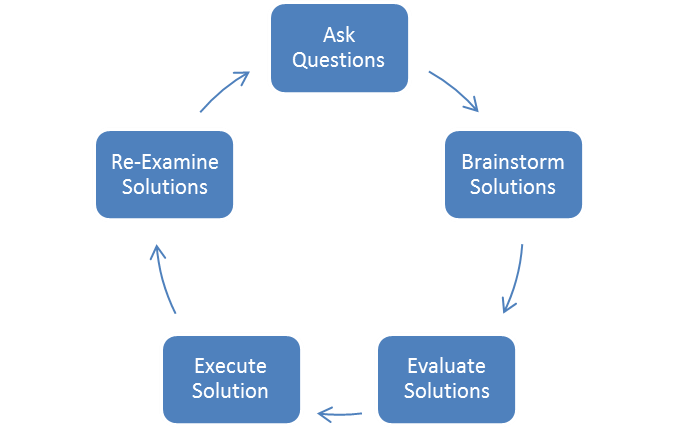
Oftentimes, we equate ‘problem solving’ with ‘critical thinking.’ However, in this case we’re referring to ‘problem solving’ as a method for finding solutions to short-term complications or setbacks. Although strong intuition is important for problem solving, you must also rely on the research and data that you encounter. What is most important is what you do with that combination of intuition and research. Here are the five steps to becoming a better problem solver:

problem-solving-process

  1. Ask a lot of questions to identify the underlying problem. Don’t jump to conclusions.
  2. Brainstorm all of the possible solutions to the problem that you identified.
  3. Evaluate the solutions that you came up with. Determine the feasibility of those ideas.
  4. Execute the most feasible idea. Good problem solvers are responsible for implementing a solution.
  5. Re-evaluate the project throughout its execution. Sometimes you will find out that you are either not solving the underlying problem or there are more problems that need to be solved.

For more information on the myths and facts of problem solving, feel free to visit the link below. This process can be applied in any business setting. By practicing these skills over-and-over, you can become a better problem solver.

http://www.entrepreneur.com/article/217516

How to Motivate Employees

There have been quite a few blog posts regarding effective management styles and how to be a good leader. In addition to these tips, one thing I find very relevant is how to motivate your direct reports and ensure your team is engaged every day. We’ve probably all been rewarded at some point or another with trophies, bonuses, etc. While those are all nice to receive, do they really keep us motivated and energized to deliver great work on a daily basis?

In a recent Inc. article, the author highlights some of the most effective things you can do as a manager to motivate your team:

1) Interesting Work

2) Information

3) Involvement

4) Independence

5) Increased Visibility

I wholeheartedly agree with the tips of being transparent and supporting employees with independence. I think one of the most demotivating characteristics a manager can have is to micromanage his or her employees. In my experience, having a manager who empowers you to make decisions on your own is by far more motivating than anything else. As we all advance in our careers, I think these are great tips to ground ourselves in how to keep our employees engaged and delivering great work.


Bridging the Gaps for Future Mobile BI Users

Most of us utilize Business Intelligence software mainly on our laptops, but the world has started to drift towards the mobile trends. Many workers travel and rely on tablets or phones for presentation aides yet there are still gaps between the corporate data and these mobile devices. Below are some examples;

Culture Gaps

  • Fast Data vs. BI Reporting
  • Friendly Users
  • Post PC Diversity

Technology Gaps

  • Cloud Platforms
  • Social Interaction
  • All Encompassing Ecosystem

The 2 articles in the embedded links below, focus on the current gaps that we see today between the mobile world and business intelligence in terms of culture and technology. Hopefully in the near future we can bridge the gaps and truly rely on the cloud and other internet services to tailor to our business needs.

MEMBA learning community, Fall 2016- Spring 2017