Category Archives: 07c-Telling stories

Creating a compelling vision, engaging an audience, stimulating creative thinking *beyond* the logic and evidence of problem/solution/recommendation type of communication

Telling Stories to Persuade People

In the age of big data, we think data is persuasive.  If we can just visualize it,  harness it, and display it in a very detailed presentation, we can convince people with it.  All they need to do is see our numbers, facts and figures, and they will be convinced to follow our lead. Unfortunately, this is where the human mind comes to play – as  neuroscientists have discovered,  most decisions are informed by emotional responses rather than by cold and hard rational thinking.

In his Wall Street Journal article on the topic, “To Persuade People, Tell Them a Story”, Dennis Nishi tells a story of Paul Smith, associate director at P&G. For many days, Mr. Smith prepared to present to P&G CEO, A.G. Lafley. However, on the day of the presentation,  CEO entered the room,  greeted everyone and turned his back to the screen. As Mr. Smith tells his side of the story,

“I felt like maybe I hadn’t done a very good job because he wasn’t looking at my slides like everyone else.It didn’t occur to me until later that he did that because he was more interested in what I had to say than in what my slides looked like.”

To address this issue, presenters need to connect to their audiences on an emotional level.   The above mentioned Paul Smith, now a corporate trainer and an author, has a new book:  “Lead With a Story: A Guide to Crafting Business Narratives That Captivate, Convince, and Inspire”. In it,  he told a story of a mother’s plea to P&G executives about hardships and trade-offs she had to make for her children, and how that story convinced them to lower the price of shortening, underscoring the power of an emotional connection.

In another book mentioned in the article,  “Beyond Bullet Points” by Cliff Atkinson,  Mr. Atkinson tells us to move beyond facts in figures. He suggests  structuring our story in three acts – starting by establishing context,  following with a description of how the main character fights to resolve the conflicts, and finishing with a call to action.

Stories are important to human communication – they started long before PowerPoint presentations,  and we have strong emotional connections to them. So it is important that we do not start our story with an apology or ask a permission to tell it – we should be confident enough for it to stand on its own.

You may read the rest of  “To Persuade People, Tell Them a Story” at http://online.wsj.com/news/articles/SB10001424052702303482504579177651982683162.

Information Design For Dummies

This title is clearly tongue-in-cheek, but for me, “For Dummies” can be applied to several areas of mine that need improvement. I suppose those of us who aren’t fortunate enough to practice every viable business skillset regularly may feel the same. But hey, isn’t that why we’re in school? Isn’t that the nature of this project? I digress….

Presentations haven’t been a focus of career thus far, so even the term Information Design is something relatively new. In trying to gain expertise and understanding quickly, I always like to start at the beginning. Where did Information Design originate? What’s its purpose? How is it best used today? To quote professor Makadok, “I’m energized! I’m ready to learn!”

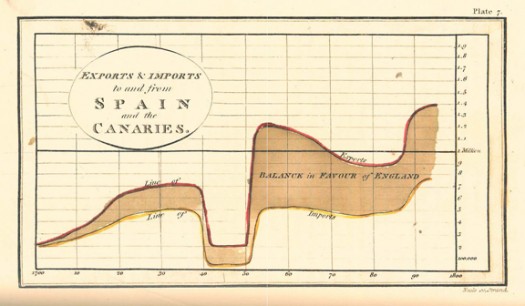
The term “information design” originated in the early 1990’s, however humans have been using visual aids to tell stories for a very long time (think cave paintings, hieroglyphics, etc.). Formal Information Design really hit its stride in the 18th century, with innovators like William Playfair creating some groundbreaking representations of data (http://www.humantific.com/making-sense-of-the-early-sensemakers). Playfair, a Scottish engineer and political economist, invented pie charts, line graphs, and bar charts. And you thought Scotch whisky was Scotland’s greatest invention! All kidding aside, Playfair’s charts were beautiful representations of imports and exports, giving life to previously abstract statistics.Playfair13-525x306

The evolution continued, and fast forward to 20th century: Harry Beck, an English technical draftsman creates the famous London Underground tube map in 1931 (http://britton.disted.camosun.bc.ca/beck_map.jpg).

beck_map

As a map lover, this is truly an iconic work, and set the standard of urban transit maps that we all know today. To me, Beck’s work truly achieves one of the key goals of information design: clearly visualizing something that is difficult to understand. Can you imagine the complexity of an actual map of the London Underground in its correct scale? It would likely look like an angry cluster of snakes. Beck’s map breaks down the complexity into something that even a novice traveller can visually digest over a cup of tea and a scone.

So with a little history under our belt, what are some tips for taking a modern approach to Information Design? Amy Balliett of Smashing Magazine wrote a fantastic article that gives some great examples of do’s and don’ts, that we can all use to approach our next presentation (http://www.smashingmagazine.com/2011/10/14/the-dos-and-donts-of-infographic-design/):

1) Show, don’t tell: Don’t miss an opportunity to visualize data. In other words, avoid putting into text what can better be conveyed with an image, chart, or graph.
2) If the client wanted an excel chart, they wouldn’t need you: This is clearly aimed at professional info designers, but you get the idea. Step your game up, and get creative! If possible, learning some design platform could really differentiate your skills from the rest of the pack.
3) Typography should not be a crutch: avoid leaning too heavily on fancy fonts that distract from the visualized data. I think this is great advice, and reflects back to “show, don’t tell.”

She goes on to make several other good points, but I’ll get right to the good stuff…

4) Tell a story: Funny how it always comes back to a good story. Great info graphics introduce a problem, back it up with data, and finish with a conclusion.

I highly recommend reading Ballet’s entire article, and hopefully it will provide some inspiration next time you attempt to convey a message visually. Now where did I put that Scotch?

Elements of a Story

Stories are the fiber of what holds everything together. Stories can be personal or they can be professional. The elements that make a story great remain consistent, but the emphasis on different elements of a story may shift. When you go home at Thanksgiving, your grandfather wants to hear all of the details of your new job, but when you face an executive review board at work, you need to keep your words to their most effective minimum. This is the difference of when emphasis shifts. Knowing the give and take of a good story is where the art exists. And that is where practice makes perfect.

1.     The Audience: Knowing your audience is one of the biggest keys to a good story. By knowing the expectations and world view of your audience, everyone is on the same team. When your story resonates with the audience’s belief system, this is when stories are spread. (Remember, you are resonating with an existing world view, not trying to bully pulpit the audience to think the way that you do.)

2.     Clarity: Details are important, but not at the expense of your main point. Make sure that the main point of what you are saying is not lost in all of your attention to the telling of the story. The reason you are telling the story is to evoke a response—inspire, motivate, create urgency, give warning. Make that happen by always returning to the main point.

3.     Credibility: This goes back to the audience element. If you cannot evoke trust, you aren’t just telling a story, you are telling a lie (which ironically some people call a story). Be authentic and maintain the trust of the audience. Don’t contradict the belief system that your story appears to espouse. Be authentic and win friends.

4.    Brevity: A simple story is more successful than a complicated one. Understatement carries a big impact. Maintain a cadence and progression in the story.

5.     Add Context: Appeal to the senses, not to logic: descriptive language makes you feel like you are there and relates to the audience. A Forbes article published in 2013 states that 80% of what we hear is gone within 24 hours, and a story makes information sharing more memorable.

6.     Create tension: Any time that you want to connect with an audience, you have to create some form of interaction. Ask a probing question to make them think (bonus: require that someone in the audience responds). Tension makes the audience wrestle. Make the audience feel invested.

7.     It never hurts to add humor: As Mark Twain says, “The humorous story is strictly a work of art—high and delicate art—and only an artist can tell it; but no art is necessary in telling the comic and the witty story; anybody can do it. The art of telling a humorous story—understand, I mean by word of mouth, not print—was created in America, and has remained at home.”

The final element of a good story is practice. As much as we would like to think that storytelling off the cuff will come easy, the best story tellers will attest that practice makes perfect. Given the value of a story, mastering this art is worth it.

Have you heard the one about the . . .

What do a joke, a fable, a poem, a lecture, and a commercial all have in common? They tell a story. Like a book you can’t put down (hopefully), these pleasures in life should be looked at as the textbook for how to create compelling stories in business.

Ad agencies learned this long ago. The formula to a great ad  is to tell a great story. Advertising is a vehicle for marketing communication used to encourage, persuade, or manipulate targets to make a move – whether to change behavior or motivate behavior it is meant to drive consumers. In business, when we present either internally or externally within our companies, why don’t we treat the circumstance the same way? Obviously we don’t want to manipulate others, but we want to drive behavior towards a desired outcome.

In an Adage article discussing 2014 superbowl ads, the analysts noted that, “The winners had one thing in common: a strong narrative . . .”.  At work, is this not the same? Those who dominate their pitches or sell in their ideas to top level management create robust narratives that string you along and bring you to a conclusion. We should all use this as best practice.  We should look at how comedians develop their content, or philanthropists, or ad executive. We need to get inspired, develop the content, and revise until we can tell the best story we can.

Humans are natural storytellers. In the HBR article, The Irrestible Power of Storytelling, blogger Harrison Monarth, hits the nail on the head by stating, “People are attracted to stories . . . because we’re social creatures and we relate to other people.” Business is about building relationships – with consumers, with customers, with coworkers. Storytelling is a natural outlet to connect and get others to relate to what you are talking about.

Whether you are in finance, marketing, supply chain, or any other function, the next time you are asked to present, try thinking of your presentation as building a story.  

Get inspired. Develop the content. Revise

Check out another classmate’s post on storytelling here.

Easy on the Slides, Heavy on the Story

I currently work for a large energy management company, specifically on a team that develops new software applications that promote internal efficiencies of business processes. Every few months I find myself in front of groups of engineers, project managers, and business managers presenting information regarding the latest set of features released in our software applications. The presentation material is always technical, the demonstrations are always technical, and the questions and answers exchanged with the audience are always technical. My purpose is to equip the audience with the technical knowledge to enable them to turn-around and use the software applications to their fullest.

Needless to say, I don’t often weave storytelling into my technical presentations. I’m not particularly looking to close a sale or win over a new investor with my presentations. However, with aspirations to venture into entrepreneurship post-MBA, I have been considering the art of storytelling as a skill that may be extremely beneficial in my near future. An Inc.com article by Riley Gibson highlights three reasons why mastering the art of storytelling can help entrepreneurs and start-ups succeed (Article Link).

1. Stories are Memorable.

No matter how great your idea is or how much data you have to prove its greatness, if your audience isn’t connected to what you are saying, they won’t care or remember after you finish. Gibson points out Dollar Shave Club and their over-the-top hilarious commercials. No PowerPoint slides or bar charts, just a witty and entertaining delivery that won’t quickly be forgotten by viewers, or more importantly investors.

2. Stories Travel Further.

Gibson suggests that memorable stories are much easier to recall in the future than detailed specifications or statistics. The accuracy to which your business idea or venture is retold by others after your initial presentation is very important. In essence, a memorable story will travel more accurately and further than other techniques.

3. Stories Inspire Action.

Finally, Gibson points out that entrepreneurs often need to inspire action, which may be among investors, employees, or even customers. Spilling out data or specifications isn’t likely to motivate the majority of audiences. Rather, a compelling story can reveal the what, why, and how that is behind the action and in-turn can help to inspire the action that is desired.

With a technical background, it will be a challenge for me to punt the PowerPoint slides filled with technical jargon and transition to the development of a story that is 1) memorable, 2) can be accurately recounted, and 3) inspire action. However, I fully agree with Gibson, with a high level of competition in the marketplace for investors and customers, it is of the upmost importance to be able to set your company or idea apart from the rest.


Article Link: http://www.inc.com/riley-gibson/3-reasons-every-start-up-should-tell-more-stories.html

What we can learn from the Declaration of Independence

What we can learn from The Declaration of Independence about the art and craft of structured problem solving.

This past weekend, as our nation celebrated the 4th of July, I took time to reread the Declaration of Independence. The document contains the most famous and precious words in American history, and arguably the finest articulation of the idea of natural rights ever written: “We hold these truths to be self-evident, that all men are created equal, that they are endowed by their Creator with certain inalienable Rights, that among these are Life, Liberty, and the pursuit of Happiness.”

I have long marveled at the beauty and power of the Declaration, and been fascinated by Thomas Jefferson, its principal author. This document provides a good example of 3 key management practice learning objectives: 1. Persuasive communication 2. Successful, real-world, problem solving and 3. An incitement to action.

1.  Making the Case Through Persuasive Communication

In the spring of 1776 Jefferson devoted much effort surveying the opinions of his countrymen to get their thoughts on American independence. He told one correspondent that he, “took great pains to enquire into the sentiments of the people on that head. In the upper counties I think I may safely say that nine out of ten are for it.” In terms of American political history, Jefferson was among the first to generate data from a survey of public opinion.

The ideas of freedom and liberty, which define the central themes of the emerging American republic, were commonplace in conversations, sermons, letters, and printed essays of the times. In drafting the declaration Thomas Jefferson said that his purpose was, “not aiming at originality of principle or sentiment.” Rather his intent was to, “place before mankind the common sense of the subject,” and to offer, “an expression of the American mind, and to give to that expression the proper tone and spirit called for by the occasion.”

Drawing upon the philosophers of the Scottish Enlightenment, Jefferson built his case on a contract between government and the governed that was founded on the consent of the people. Both poetic and practical, his arguments are grounded in the context of a story. The effect is a compelling narrative, even a romantic version of reality, which helped create an American identity.

Perhaps the most striking aspect of the document is the logical force and rational power of the arguments it presents, the most notable of which is the notion of self-evident Truths − Truths that are self evident by reason and definition and based upon assertions of reality. (The angles of a triangle equal 180 degrees)

Great writing commands respect. The Declaration is an excellent example of persuasive, evidenced based logic that shaped the course of history. Thomas Jefferson took the current American political ideas and put them into a form that the Colonists could read, appreciate, and understand. With the power of the pen, he articulated a new principle for the government of humanity: all men are created equal. He also ensured that from the beginning, the United States of America would be a nation based on the principles of rational thought.

2.  Creating Value through Real World Problem Solving

While Jefferson’s skill and abilities as a thinker and a writer were remarkable, he also possessed another important quality: the power to analyze a historical situation in depth, to propose a course of action, and shape the minds of the decision makers and legislative assemblies. The bulk of the declaration contains a list of charges condemning the actions of King George III, while creating sympathy for the American cause.

The main problems were subjecting the colonies to laws without representation and the increasing tyrannical abuses from the English system of monarchy. Jefferson provided a solution by focusing his structure on two important themes. The first was the concept of individual rights: ‘The God who gave us life, gave us liberty at the same time: the hand of force may destroy, but cannot enjoin them.’ Second, and equally important, was placing these rights within the context of popularly sovereignty, or the right of a nation to govern itself.

It was Jefferson’s ability to link the right to self government with liberty, both rooted in a Divine plan, and further legitimized by ancient practice and English tradition, which gave the colonists such a strong , clear, and compelling case for action. All of this led to a momentous decision. The struggle they faced was a daunting one.

3.  The Call to Effective Action

With forceful logic, evidence, and a sense of urgency, the declaration details the reasons the American colonists had to declare themselves independent, given their mistreatment at the hands of the British. Implementing these ideals would prove to be enormously challenging.  And, of course, England did not recognize or grant authority to the Declaration of Independence, and it would take a war of seven years to give validity and meaning to our founding document, but Jefferson’s efforts were essential for defining and legitimizing the new nation. With persuasive written communication, a logical framework for understanding the problem, and by proposing a  justifiable course of action, he won the hearts and the minds of the American people.

Great events in history are determined from all kinds of varied and complex factors, but the single most important one is always the quality of the people in charge. It all comes down to leadership. Two hundred and thirty-eight years ago our founding fathers made the sacrifices necessary to create the freedoms that we enjoy today. With the English language they gave voice to the unspoken hopes and aspirations of people everywhere. In the words of Benjamin Franklin, it was “the miracle of human affairs,” one that would result in “the greatest revolution the world ever saw.”

Full text of the document: http://avalon.law.yale.edu/18th_century/declare.asp


Sources that were used in the composition of this post:

Thomas Jefferson: The Art of Power by Jon Meacham 2012. Random House. New York

The Road To Monticello: The Life and Mind of Thomas Jefferson by Kevin J. Hayes. 2008. Oxford University Press.

American Sphinx: The Character of Thomas Jefferson by Joseph J. Ellis 1996. Random House. New York

A History of the American People by Paul Johnson 1997. Harper Perennial. New York

Benjamin Franklin: An American Life by Walter Issacson. Simon & Schuster. 2003. New York
Title Watch

Interesting titles are paramount for speeches for just as good housekeeping. Starting off on a good foot is paramount and titles are your first contact with your audience.

Avoid Cliches like well.. pretty much every other posts I have made for example. Look for originality and something fresh that will get people curious. Use titles that are active like “A Walk with Giants” or “Jumping into Equities”.   Try something original with humor. For example take a title like “Cars should yield to Joggers” and rename it something like “Don’t Stop for me”. Look for inspirations from recent books movies or even to topics in recent news articles.

Alexandra Watkins, ALB, a member of San Francisco Toastmasters, is founder and chief innovation officer of the naming and branding company Eat My Words. She says, “You have to catch someone’s interest with something unexpected, irresistible, fun or colorful — or with a clever twist on a familiar word or phrase.” She gives two examples on the subject of photography: “How to Shoot People” and “Confessions of a Sharp Shooter.”


http://magazines.toastmasters.org/display_article.php?id=1140173

Masters of Storytelling

Master Storytellers are known to utilize the three I’s of Storytelling: Invitation, Imagination and Impact

Invite people to think outside of the box. Make them curious by asking them a question like “Do you want to make a change ____?”.

Use people’s imagination to paint a picture of a better tomorrow. Guide them to thinking about how this improved future will impact them more specifically.

People desire for impact. Everyone wants to see that their work has a meaning. Every so often during your presentation take a slight pause to see how your presentation is affecting the group.


Some more exact pointers for storytelling using the three I’s of storytelling include:

–       Don’t dump facts and numbers on your audience, be investigative of sorts and ask your audience

–       Do not jump from point to point without making sure your audience is absorbing your content

–       Practice timing, do not rush through your presentation

–       Think of certain images for your audience, say things like: “Imagine this…” or “Picture that…” People respond well to imagery.

–       Do not forget to keep a pulse on the people in the room to see how you are effecting them.


Anyone out there a good storyteller? Is there anything you consistently do that heightens your ability to tell a story?

The inspiration for this blog post:

http://magazines.toastmasters.org/display_article.php?id=1140160

An Introduction into Neuro-Linguistic Programming (NLP)

Neuro-Linguistic Programming (NLP) was created in the 1970s by Richard Bandler whom is a computer scientist and Gestalt therapist as well as Dr. John Grinder whom is a linguist and therapist. NLP is a concept utilized to help with communication and is beneficial in many ways however is particularly useful if used for self development. Largely what NLP does is enable a heightened awareness and control of oneself, it improves a persons ability to appreciate another persons feelings and behaviors which results in more empathy and better cooperation.

Neuro-Linguistic Programming is a very in depth concept and can not be simply explained in a blog as there have been many books as well as training courses that teach the concept. Below are some of the Operational Basics of how the Programming works, I believe they can be utilized in not only presentations but also in how to be persuasive.

1)   Know what outcome you want to achieve

2)   Have a clear understanding of if you are pushing forward or away from your desired outcome

3)   Practice being flexible with your behavior to get your desired outcome

4)   Take action now

Largely the idea is you need to have a detailed understanding of exactly what you are looking to achieve and having the emotional intelligence to know if you are moving forward or not and changing your behaviors to try a different approach.

There are distinct presumptions you must understand the concept which is a backdrop or of what NLP is based on. Some of the most important as I see it are below:

1)   The meaning of communication is the response you get

2)   Language is a secondary representation of experience

3)   The mind and body are parts of the same cybernetic system and affect each other

4)   Behavior is geared towards adaptation

5)   Present behavior represents the very best choice currently available to a person

6)   “Possibility in the World” or “’Possible for me” is only a matter of how

7)   There is no such thing as failure; only feedback

If you are further interested in the concept read the original article attached for some additional introduction into the subject.

http://www.businessballs.com/nlpneuro-linguisticprogramming.htm

Has anyone out there ever used Neuro-Linguistic Programming in their life? Please share if you have had either positive or negative results from utilizing the concept!

What not to do while Presenting

We have all attended presentations where glaring errors have been made and we are just irking to exit the room, out of either pain or embarrassment. Surprisingly they are quite easy to make and with a little practice, easy to avoid.


1)   Failing to engage emotionally.

Explicitly speaking about facts will lose your audience. Incorporate an intriguing storyline that makes the presentation more meaningful. Ask yourself “Why is this important?” and speak to how the effects will hopefully help a process or employees.

2) Asking too much of your slides.

Keep your slides succinct. Nobody wants to be constantly reading and digesting your slides. Try to keep expansive bullet points to a minimum. Additionally keep your teleprompter text hidden from the audience’s view.

3) Trotting out Tired Visuals

Think of visuals you can present that are original. People can almost always predict what visuals you are going to present, so include some that are a bit different. Avoid Cliché visuals.

4) Speaking in Jargon

All businesses and departments have their own jargon, however you really need to avoid this highly technical or industry specific jargon. If people can’t follow your train of thought they aren’t going to be following your ideas any time soon.

5) Going over your allotted time.

One of my biggest pet peeves; nobody appreciates presentations going over the planned amount of time. You will start losing your audience to shuffling and IPhone use and realistically they will not absorb the information you are presenting.. People in general have the attention span for presentations of 30-40 minutes; if you can try to keep no more than that you will stand a chance of holding your audience’s attention.


View the original article below:

http://blogs.hbr.org/2012/12/avoid-these-five-mistakes-in-y/