Category Archives: 07a-Crafting an effective formal presentation

Designing and building a professional slide deck, using best principles of persuasion and slide-craft, using PowerPoint features efficiently and effectively

Have you heard the one about the . . .

What do a joke, a fable, a poem, a lecture, and a commercial all have in common? They tell a story. Like a book you can’t put down (hopefully), these pleasures in life should be looked at as the textbook for how to create compelling stories in business.

Ad agencies learned this long ago. The formula to a great ad  is to tell a great story. Advertising is a vehicle for marketing communication used to encourage, persuade, or manipulate targets to make a move – whether to change behavior or motivate behavior it is meant to drive consumers. In business, when we present either internally or externally within our companies, why don’t we treat the circumstance the same way? Obviously we don’t want to manipulate others, but we want to drive behavior towards a desired outcome.

In an Adage article discussing 2014 superbowl ads, the analysts noted that, “The winners had one thing in common: a strong narrative . . .”.  At work, is this not the same? Those who dominate their pitches or sell in their ideas to top level management create robust narratives that string you along and bring you to a conclusion. We should all use this as best practice.  We should look at how comedians develop their content, or philanthropists, or ad executive. We need to get inspired, develop the content, and revise until we can tell the best story we can.

Humans are natural storytellers. In the HBR article, The Irrestible Power of Storytelling, blogger Harrison Monarth, hits the nail on the head by stating, “People are attracted to stories . . . because we’re social creatures and we relate to other people.” Business is about building relationships – with consumers, with customers, with coworkers. Storytelling is a natural outlet to connect and get others to relate to what you are talking about.

Whether you are in finance, marketing, supply chain, or any other function, the next time you are asked to present, try thinking of your presentation as building a story.  

Get inspired. Develop the content. Revise

Check out another classmate’s post on storytelling here.

Less is More, Right?

In the article titled “My Seven-Step Method for Creating a Presentation When the Stakes are High” by Carmine Gallo  http://www.forbes.com/sites/carminegallo/2013/12/18/my-seven-step-method-for-creating-a-presentation-when-the-stakes-are-high/, Gallo accentuates one of the great points of creating a slide deck – less information and more pictures increases retention of the material. Specifically, Gallo identifies that only 10% of information conveyed verbally is retained by the audience, but this increases to 65% if the verbal concept is coupled with a relatable graphic or picture. This article also addresses a number of techniques for preparing to give the presentation, many of which have been covered in posts elsewhere.

I believe this concept extends far beyond the basics of slidecraft. We have seen other posts this semester about dealing with distracted audiences, so let’s evaluate this concept in that scope. Imagine that you are watching a presentation where the presenter is exploring a complex issue in detail. Suppose the slide looks something like this:

(from Gallo article)

How distracted will you be, specifically if the verbal presentation does not align with the visual? In my case, I would likely be even more confused if the presenter attempted to step through each part of this obviously overrun slide. By simplifying the presentation of the slide, the audience is allowed to focus on the information. I liken this idea to introducing the audience to the information in lieu of confronting them with it. The presentation and presenter will be far better received with a consumable amount of information on each slide and slide design that does not distract or alienate. If I can develop my skillset to always fall within the boundaries of this concept, I believe most of my battle is won. However, this is a difficult transition for me, as I am always most interested in the underlying data and information behind a presentation and always am yearning to dive deeper into what I have been presented with and what I am presenting. Therein lies my challenge: balancing the desire for information with the desire to be understood. Tricky for sure!

I think that we have seen fantastic examples in the first two semesters of MP of how to do this correctly, so we obviously have some classmates very strong in the area of slidecraft. Personally, I have had little previous need to develop me skills with Powerpoint or similar software, but I was fortunate to work with a great team in last fall’s semester of MP, from which I was able to begin to sharpen my skills. Again, thankfully, I was paired with a team during the spring that had excellent technical slide creators from whom I gained an even more detailed look into the mechanics of creating the slides. This is where I intend to focus the balance of my semester: the technical details of actually creating the slide deck and I look forward to seeing the resources that everyone is able to uncover.


Title Watch

Interesting titles are paramount for speeches for just as good housekeeping. Starting off on a good foot is paramount and titles are your first contact with your audience.

Avoid Cliches like well.. pretty much every other posts I have made for example. Look for originality and something fresh that will get people curious. Use titles that are active like “A Walk with Giants” or “Jumping into Equities”.   Try something original with humor. For example take a title like “Cars should yield to Joggers” and rename it something like “Don’t Stop for me”. Look for inspirations from recent books movies or even to topics in recent news articles.

Alexandra Watkins, ALB, a member of San Francisco Toastmasters, is founder and chief innovation officer of the naming and branding company Eat My Words. She says, “You have to catch someone’s interest with something unexpected, irresistible, fun or colorful — or with a clever twist on a familiar word or phrase.” She gives two examples on the subject of photography: “How to Shoot People” and “Confessions of a Sharp Shooter.”


http://magazines.toastmasters.org/display_article.php?id=1140173

Masters of Storytelling

Master Storytellers are known to utilize the three I’s of Storytelling: Invitation, Imagination and Impact

Invite people to think outside of the box. Make them curious by asking them a question like “Do you want to make a change ____?”.

Use people’s imagination to paint a picture of a better tomorrow. Guide them to thinking about how this improved future will impact them more specifically.

People desire for impact. Everyone wants to see that their work has a meaning. Every so often during your presentation take a slight pause to see how your presentation is affecting the group.


Some more exact pointers for storytelling using the three I’s of storytelling include:

–       Don’t dump facts and numbers on your audience, be investigative of sorts and ask your audience

–       Do not jump from point to point without making sure your audience is absorbing your content

–       Practice timing, do not rush through your presentation

–       Think of certain images for your audience, say things like: “Imagine this…” or “Picture that…” People respond well to imagery.

–       Do not forget to keep a pulse on the people in the room to see how you are effecting them.


Anyone out there a good storyteller? Is there anything you consistently do that heightens your ability to tell a story?

The inspiration for this blog post:

http://magazines.toastmasters.org/display_article.php?id=1140160

Dealing with a Distracted Audience

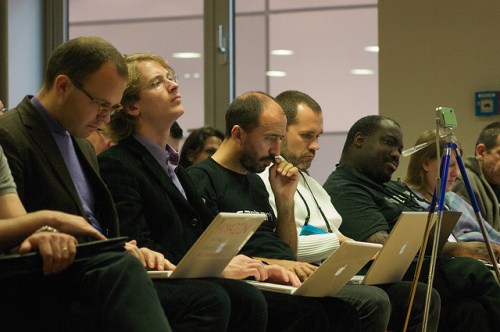
Whether it be a cell phone, laptop, tablet or phablet, people are finding themselves more and more self consumed with technology than ever before.  Do not be alarmed or offended when this happens, as it happens to everyone. You want to have a casual atmosphere when presenting and you don’t want to start the presentation banning technology use, who knows someone may be posting something positive on social media about your presentation and your voice could be reaching an even larger audience than you think.

Presenters should not judge their audience based on their attention and body language as you have to earn their attention by developing a connection with people. Here is a novel idea on attaining their attention, force it. Force your audience to participate. Instead of being more concerned with being the sole speaker be the guide of the presentation. Just like when we have our MBA classes, students are encouraged to bring the group through a conversational journey to an ultimate goal of learning certain topics. Student engagement is vital to keep our attention after a long day at work, at 9:00 at night.

Ask your audience questions throughout your presentation. By doing this you force people to be on their toes and concentrate less on being distracted and more on the topic at hand. You might even toy with the idea of asking your audience to have a 2 minute conversation with their neighbor about their experiences on an idea you are speaking about. This discussion encourages engagement that would otherwise potentially not be there.


For a more in depth read on keeping your audience’s attention check out the original articles I learned these concepts from.

http://www.inc.com/guides/how-to-improve-your-presentation-skills.html

http://magazines.toastmasters.org/display_article.php?id=1108437

What not to do while Presenting

We have all attended presentations where glaring errors have been made and we are just irking to exit the room, out of either pain or embarrassment. Surprisingly they are quite easy to make and with a little practice, easy to avoid.


1)   Failing to engage emotionally.

Explicitly speaking about facts will lose your audience. Incorporate an intriguing storyline that makes the presentation more meaningful. Ask yourself “Why is this important?” and speak to how the effects will hopefully help a process or employees.

2) Asking too much of your slides.

Keep your slides succinct. Nobody wants to be constantly reading and digesting your slides. Try to keep expansive bullet points to a minimum. Additionally keep your teleprompter text hidden from the audience’s view.

3) Trotting out Tired Visuals

Think of visuals you can present that are original. People can almost always predict what visuals you are going to present, so include some that are a bit different. Avoid Cliché visuals.

4) Speaking in Jargon

All businesses and departments have their own jargon, however you really need to avoid this highly technical or industry specific jargon. If people can’t follow your train of thought they aren’t going to be following your ideas any time soon.

5) Going over your allotted time.

One of my biggest pet peeves; nobody appreciates presentations going over the planned amount of time. You will start losing your audience to shuffling and IPhone use and realistically they will not absorb the information you are presenting.. People in general have the attention span for presentations of 30-40 minutes; if you can try to keep no more than that you will stand a chance of holding your audience’s attention.


View the original article below:

http://blogs.hbr.org/2012/12/avoid-these-five-mistakes-in-y/

Deconstructing a Ted Talk

Happy early 4th of July! Before I head out to the pool to enjoy this long weekend, I thought I would leave everyone with a few tangible tips on how to make a presentation great.

Everyone is familiar with Ted Talks, and for good reason—they contain powerful ideas that often change people’s attitudes, lives, and the world. I happened to find an article that deconstructs one of the most viewed Ted Talks of all time: “How Great Leaders Inspire Action.” I do encourage watching it when you get a chance, as it contains some intriguing and useful ideas. Whether you get to watch it or not, here are some takeaways that can be applied to future presentations.  Click Here for the Ted Talk and full deconstruction of the speech.

1. Get your audience in the proper mindset right away. Simon did this by getting the listeners “to question,” but you can be creative here with stories or astonishing facts.

2. Have an inflection point, and be sure to emphasize it.

3. Make your speech tangible by bringing in examples or research to support your ideas (duh!), but do not spend too much time or get into the nitty-gritty details. Otherwise, you risk losing your listeners.

4. Build suspense into your story. More direct eye contact helps you achieve this effect.

5. Consider using parallel structure. Think JFK’s famous line: “Ask not what your country can do for you. Ask what you can do for your country.” As for Simon, “We follow those who lead, not because we have to, but because we want to. We follow those who lead, not for them, but for ourselves.” Very impactful!

6. Pause for impact, but you need to be strategic with quantity and placement; keep them to a minimum and spaced out.

7. The most viewed Ted Talks do not use PowerPoint slides, so do you really need to?

8. This one is my favorite: fascination cannot be faked. Hopefully you have the privilege of being fascinated with what you present because this allows you to connect with your audience. And if you are not fascinated…well, good luck?!

I would like to add “smile” to the list as my own. When I was an intern, that was one of the most important pieces of advice that I received regarding public speaking: “Don’t forget to smile while presenting.” I was a little surprised with this advice since I thought it could take away from the seriousness of a formal presentation, but the more top-notch presentations I see, the more I notice the smiles throughout the speeches. This goes together with tip #8, but I thought it needed to be called out specifically. Hopefully I smiled during the Delta presentation…

Lastly, I came across an article titled, “How to Give a Killer Presentation,” which appeared in the Harvard Business Review last summer (you can get the full article through the Emory library system; click here for a portion of the article). It was inspired by the Ted Talk given by Richard Turere, which this one YOU MUST WATCH (Richard Turere: My invention that made peace with lions)! Richard was an unlikely candidate to give a Ted Talk: terribly shy, spoke poor English, and had difficulty producing coherent sentences. But, his idea was so inspirational that the folks at Ted worked with him to frame his story and give a powerful speech. Boy, did he nail it!

The lesson here is that you do not need to be the best speaker to be engaging and inspiring. There are tools and tips you can follow to improve presentations (i.e. the list from above, this HBR article, all the other posts on this blog…), and if you let your pure passion and unique personality shine through honestly, people will hear you. And how about Richard’s smile? My heart melted.

11 Techniques Steve Jobs’s used to Present Apple’s

Steve Jobs was known for a slick product presentation with a seemingly casual delivery. His visionary products he pitched through his keynote presentations created hype and buzz in the industry that will be timeless. He was a fantastic presenter however not a natural, which gives hope to all of us that need improvement!

He used many different techniques to perfect his art of presenting and many articles can be found that explain his effective use of these techniques.

I have attached an article which describes 11 different techniques that Steve Jobs practiced. Teaser alert; my favorite recommendation is Practice & Have Fun.


1) Express your passion

2) Create a Twitter-friendly headline

3) Stick to the rule of three

4) Introduce a villain

5) Sell the benefit

6) Build simple, visual slides

7) Tell stories

8) Prepare and practice excessively

9) Avoid reading from notes

10) Have fun

11) Inspire your audience

If you have any good tips on presenting you utilize, please share!

Attached below is the original article:

http://www.forbes.com/sites/carminegallo/2012/10/04/11-presentation-lessons-you-can-still-learn-from-steve-jobs/

Continue reading 11 Techniques Steve Jobs’s used to Present Apple’s

Deliver a Presentation like Steve Jobs

Steve Jobs was always famous for his style of presentations. His keynote presentations were a vital part of Apple’s  marketing plan to bring in sales.He informed, inspired, and always kept his audience entertained and had them at the edge of their seats with his famous one liner that he always used to conclude his presentation.”Oh and there is one more thing”.  A phrase he had famously used in making announcements of products towards the end of many of his presentations, which would amaze the audience and make them exit on a high. So what made him unique ? why was he so different ? Was it the product ? Was it his delivery style.

Carmine Gallo , communication skills coach in his recent article about steve jobs on business week talks about 10 presentation traits that steve jobs used  to inspire his audience and keep them engaged.
There are three key presentation skills that he references which stand out particularly.

Setting the theme

Jobs crafted the art of setting the theme Every presentation would start on a theme which he would reinforce several times throughout his presentation. 2008: There is something in the air today

Sell the benefit

Jobs would sell the benefits over the products; which I personally think is the reason why apple products are so successful. We all didn’t need the iPhone; before it was introduced. It was also one of the most expensive phones at that time; still many stood in line for as many as 3 days to get their hands on the phone. The benefits of listening to music, watching movies, access to multiple applications on a single device made the benefits outweigh the costs.

Trying for an unforgettable moment.

Every presentation of Steve jobs had one instance or one event which made the whole experience unique to its audience. There was always something new which was never experienced or seen to take away. In 2007, it was the iPhone. In 2009 it was the mobile me and in his last keynote address it was iCloud.

Has anyone else had any similar observations that they may have witnessed about Steve jobs or any other speakers which they admire the most. Do they all share similar presentation skills ? I invite you to share your experiences

Link to the article:  Deliver a presentation like Steve jobs


Storytelling for the number cruncher

As someone who works in Excel everyday and prides myself on an ability to crunch any numbers or run any analysis, creating a “story” and selling that to an audience doesn’t come naturally. For me, I’d rather use a line graph or bar chart and let that do the convincing. But if Brandon Smith taught me anything, it’s that using a story works for persuasion.

So I came across an article written a few months ago in HBR by Harrison Monarth (author of The Confident Speaker and Breakthrough Communication) where he writes about the power of storytelling as a strategic business tool. An example he uses to illustrate the power of storytelling is from the latest Super Bowl commercials for Budweiser. In one advertising study looking at the effectiveness of ads based on content or structure, a researcher at Johns Hopkins noted “regardless of the content of the ad, the structure of that content predicted its success.” So I’m thinking: it’s not what you say, but how you say it? Monarth concludes by writing “A story can go where quantitative analysis is denied admission: our hearts. Data can persuade people, but it doesn’t inspire them to act; to do that, you need to wrap your vision in a story that fires the imagination and stirs the soul.”

Working in the healthcare industry, I found it particularly interesting when Monarth notes an example of how patients change their behavior for the better based on stories their physicians tell them, rather than presenting the data.

Does anyone have specific examples of storytelling in a presentation to actually change behavior or implement a proposal? I’d love to use these tactics, but am still a little skeptical my company’s executives could be moved to action by a story vs. data. What works in your industry?