Category Archives: 07d-Delivering a presentation

Developing high-quality “stand, speak, explain and/or sell” skills, clearly communicating to a group using a PowerPoint presentation, adroitly handling Q&A, projecting confidence and competence

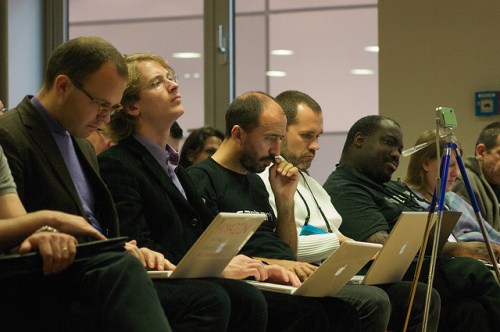
Dealing with a Distracted Audience

Whether it be a cell phone, laptop, tablet or phablet, people are finding themselves more and more self consumed with technology than ever before.  Do not be alarmed or offended when this happens, as it happens to everyone. You want to have a casual atmosphere when presenting and you don’t want to start the presentation banning technology use, who knows someone may be posting something positive on social media about your presentation and your voice could be reaching an even larger audience than you think.

Presenters should not judge their audience based on their attention and body language as you have to earn their attention by developing a connection with people. Here is a novel idea on attaining their attention, force it. Force your audience to participate. Instead of being more concerned with being the sole speaker be the guide of the presentation. Just like when we have our MBA classes, students are encouraged to bring the group through a conversational journey to an ultimate goal of learning certain topics. Student engagement is vital to keep our attention after a long day at work, at 9:00 at night.

Ask your audience questions throughout your presentation. By doing this you force people to be on their toes and concentrate less on being distracted and more on the topic at hand. You might even toy with the idea of asking your audience to have a 2 minute conversation with their neighbor about their experiences on an idea you are speaking about. This discussion encourages engagement that would otherwise potentially not be there.


For a more in depth read on keeping your audience’s attention check out the original articles I learned these concepts from.

http://www.inc.com/guides/how-to-improve-your-presentation-skills.html

http://magazines.toastmasters.org/display_article.php?id=1108437

An Introduction into Neuro-Linguistic Programming (NLP)

Neuro-Linguistic Programming (NLP) was created in the 1970s by Richard Bandler whom is a computer scientist and Gestalt therapist as well as Dr. John Grinder whom is a linguist and therapist. NLP is a concept utilized to help with communication and is beneficial in many ways however is particularly useful if used for self development. Largely what NLP does is enable a heightened awareness and control of oneself, it improves a persons ability to appreciate another persons feelings and behaviors which results in more empathy and better cooperation.

Neuro-Linguistic Programming is a very in depth concept and can not be simply explained in a blog as there have been many books as well as training courses that teach the concept. Below are some of the Operational Basics of how the Programming works, I believe they can be utilized in not only presentations but also in how to be persuasive.

1)   Know what outcome you want to achieve

2)   Have a clear understanding of if you are pushing forward or away from your desired outcome

3)   Practice being flexible with your behavior to get your desired outcome

4)   Take action now

Largely the idea is you need to have a detailed understanding of exactly what you are looking to achieve and having the emotional intelligence to know if you are moving forward or not and changing your behaviors to try a different approach.

There are distinct presumptions you must understand the concept which is a backdrop or of what NLP is based on. Some of the most important as I see it are below:

1)   The meaning of communication is the response you get

2)   Language is a secondary representation of experience

3)   The mind and body are parts of the same cybernetic system and affect each other

4)   Behavior is geared towards adaptation

5)   Present behavior represents the very best choice currently available to a person

6)   “Possibility in the World” or “’Possible for me” is only a matter of how

7)   There is no such thing as failure; only feedback

If you are further interested in the concept read the original article attached for some additional introduction into the subject.

http://www.businessballs.com/nlpneuro-linguisticprogramming.htm

Has anyone out there ever used Neuro-Linguistic Programming in their life? Please share if you have had either positive or negative results from utilizing the concept!

What not to do while Presenting

We have all attended presentations where glaring errors have been made and we are just irking to exit the room, out of either pain or embarrassment. Surprisingly they are quite easy to make and with a little practice, easy to avoid.


1)   Failing to engage emotionally.

Explicitly speaking about facts will lose your audience. Incorporate an intriguing storyline that makes the presentation more meaningful. Ask yourself “Why is this important?” and speak to how the effects will hopefully help a process or employees.

2) Asking too much of your slides.

Keep your slides succinct. Nobody wants to be constantly reading and digesting your slides. Try to keep expansive bullet points to a minimum. Additionally keep your teleprompter text hidden from the audience’s view.

3) Trotting out Tired Visuals

Think of visuals you can present that are original. People can almost always predict what visuals you are going to present, so include some that are a bit different. Avoid Cliché visuals.

4) Speaking in Jargon

All businesses and departments have their own jargon, however you really need to avoid this highly technical or industry specific jargon. If people can’t follow your train of thought they aren’t going to be following your ideas any time soon.

5) Going over your allotted time.

One of my biggest pet peeves; nobody appreciates presentations going over the planned amount of time. You will start losing your audience to shuffling and IPhone use and realistically they will not absorb the information you are presenting.. People in general have the attention span for presentations of 30-40 minutes; if you can try to keep no more than that you will stand a chance of holding your audience’s attention.


View the original article below:

http://blogs.hbr.org/2012/12/avoid-these-five-mistakes-in-y/

Deconstructing a Ted Talk

Happy early 4th of July! Before I head out to the pool to enjoy this long weekend, I thought I would leave everyone with a few tangible tips on how to make a presentation great.

Everyone is familiar with Ted Talks, and for good reason—they contain powerful ideas that often change people’s attitudes, lives, and the world. I happened to find an article that deconstructs one of the most viewed Ted Talks of all time: “How Great Leaders Inspire Action.” I do encourage watching it when you get a chance, as it contains some intriguing and useful ideas. Whether you get to watch it or not, here are some takeaways that can be applied to future presentations.  Click Here for the Ted Talk and full deconstruction of the speech.

1. Get your audience in the proper mindset right away. Simon did this by getting the listeners “to question,” but you can be creative here with stories or astonishing facts.

2. Have an inflection point, and be sure to emphasize it.

3. Make your speech tangible by bringing in examples or research to support your ideas (duh!), but do not spend too much time or get into the nitty-gritty details. Otherwise, you risk losing your listeners.

4. Build suspense into your story. More direct eye contact helps you achieve this effect.

5. Consider using parallel structure. Think JFK’s famous line: “Ask not what your country can do for you. Ask what you can do for your country.” As for Simon, “We follow those who lead, not because we have to, but because we want to. We follow those who lead, not for them, but for ourselves.” Very impactful!

6. Pause for impact, but you need to be strategic with quantity and placement; keep them to a minimum and spaced out.

7. The most viewed Ted Talks do not use PowerPoint slides, so do you really need to?

8. This one is my favorite: fascination cannot be faked. Hopefully you have the privilege of being fascinated with what you present because this allows you to connect with your audience. And if you are not fascinated…well, good luck?!

I would like to add “smile” to the list as my own. When I was an intern, that was one of the most important pieces of advice that I received regarding public speaking: “Don’t forget to smile while presenting.” I was a little surprised with this advice since I thought it could take away from the seriousness of a formal presentation, but the more top-notch presentations I see, the more I notice the smiles throughout the speeches. This goes together with tip #8, but I thought it needed to be called out specifically. Hopefully I smiled during the Delta presentation…

Lastly, I came across an article titled, “How to Give a Killer Presentation,” which appeared in the Harvard Business Review last summer (you can get the full article through the Emory library system; click here for a portion of the article). It was inspired by the Ted Talk given by Richard Turere, which this one YOU MUST WATCH (Richard Turere: My invention that made peace with lions)! Richard was an unlikely candidate to give a Ted Talk: terribly shy, spoke poor English, and had difficulty producing coherent sentences. But, his idea was so inspirational that the folks at Ted worked with him to frame his story and give a powerful speech. Boy, did he nail it!

The lesson here is that you do not need to be the best speaker to be engaging and inspiring. There are tools and tips you can follow to improve presentations (i.e. the list from above, this HBR article, all the other posts on this blog…), and if you let your pure passion and unique personality shine through honestly, people will hear you. And how about Richard’s smile? My heart melted.

Public Speaking Tips from Susan Cain

 Susan Cain is a writer and lecturer, her most recent book is called “Quiet” from 2012. The book is about “The Power of introverts in a World That Can’t Stop Talking”, she describes how all introverts need to realize the power of stepping outside of their safe zone to be an extrovert every now and again.

She is a well known presenter who is currently delivering speeches on this book. Her style of presenting is intriguing in that she has strong story telling abilities, uses props, humor, strong facial expressions and hand expressions.

She has the ability to remain animated and interesting, as she takes a personal approach and shares her views and funny stories about her life as an introvert.

Several keys to her successes as a speaker that she uses to present her material are below:

1)   Preparation is key- Practicing out loud, and video taping yourself are all helpful things as most people are uncomfortable with the idea of how you come across.

2)   Feed the audience what they want to hear. Is your audience looking to solve a problem or looking for any information in particular?

3)   Watch videos taken from different speakers vantage points. While you are watching take note of all the eyes on you and get used to it.

4)   Practice standing in the place you will be speaking at while looking over the room of empty seats.

5)   Get a hold of a great speakers written version of their speech and see how the speaker engages, inspires, and educates the audience.

6)   Utilize your strengths and weaknesses as a speaker. If you are funny, be funny; if you are great at telling stories, tell one.

7)   Create a persona of sorts. You are on stage and this is a performance, you need to keep the audience entertained and engaged.

8)   Smile at the audience, it will keep you relaxed as well as keep the audience connected.


Are there any introverts out there that struggle presenting that have any tips for pushing through a presentation? Please share!


Below is a link to her original article on tips for presenting:

http://www.readitforward.com/susan-cains-public-speaking-tips-for-introverts/


Below is a link to her speech on the book “Quiet”

Pre-Speech Rituals from Speaker Camp ATL

I was asked to serve as a mentor at a workshop this weekend called Speaker Camp ATL. The workshop is designed to prepare attendees for conference submission season. Attendees came prepared with presentation ideas and with the help of mentors they worked through the bios and abstracts they’ll use when they apply at various conferences in the fall. Then, at the end of the workshop, they presented for 5 minutes in front of a video camera (sound familiar anyone?). Following each speech the mentors offered encouragement and feedback to help them continue getting ready for a conference speaking position. For me, helping other people is a really great way for me to learn things myself, so I was super excited to participate.

There was a ton of great information during the workshop including things like setting realistic expectations on prep time for presentations (they suggested that a 45 minute presentation requires around 40 hours of prep and practice), and paying attention to details like arriving early to ‘case the joint’ so you feel comfortable in the space where you’ll speak etc.  The ideas behind the workshop come from a soon-to-be-published book of the same name.

My favorite discussion from the workshop actually centered around pre-speech rituals. I loved hearing what other experienced speakers do to get ready for a keynote presentation. I’d always thought that my pre-speech rituals were signs of inexperience and I was happy to hear that in fact these rituals frequently become more developed and specific as speakers gain more experience.

One ritual that several people shared was something they call “Power Posing.” Power posing essentially involves spending several minutes in a body posture that conveys power, such as standing up straight, feet hip-width apart with shoulders back and hands on your hips. The speakers in today’s workshop assert that they always do this for 2-5 minutes before they go on stage and that the results are transformative for them. They feel calm, confident and ready to share their knowledge and information with the audience. And much to my surprise, there’s some good research that backs this up. Specifically the CNN article above includes the quote,

“[power posers]… experienced significant increases in testosterone — a hormone linked to assertiveness — and significant decreases in cortisol — a hormone linked to stress. In other words — two minutes of preparatory power posing optimizes the brain to function well in high-stakes challenges.”

I’m so interested to try this out. Have you guys every heard of this or done this? Does it work for you? What other pre-speech rituals are helpful for you guys?

My ritual involves writing down my worst fears about what might happen during my presentation until I can’t think of anything else bad that might happen and then tearing up the paper and throwing it away. It seems to help clear all those irrational fears out of my head so I can focus on the speech itself.

11 Techniques Steve Jobs’s used to Present Apple’s

Steve Jobs was known for a slick product presentation with a seemingly casual delivery. His visionary products he pitched through his keynote presentations created hype and buzz in the industry that will be timeless. He was a fantastic presenter however not a natural, which gives hope to all of us that need improvement!

He used many different techniques to perfect his art of presenting and many articles can be found that explain his effective use of these techniques.

I have attached an article which describes 11 different techniques that Steve Jobs practiced. Teaser alert; my favorite recommendation is Practice & Have Fun.


1) Express your passion

2) Create a Twitter-friendly headline

3) Stick to the rule of three

4) Introduce a villain

5) Sell the benefit

6) Build simple, visual slides

7) Tell stories

8) Prepare and practice excessively

9) Avoid reading from notes

10) Have fun

11) Inspire your audience

If you have any good tips on presenting you utilize, please share!

Attached below is the original article:

http://www.forbes.com/sites/carminegallo/2012/10/04/11-presentation-lessons-you-can-still-learn-from-steve-jobs/

Continue reading 11 Techniques Steve Jobs’s used to Present Apple’s

Deliver a Presentation like Steve Jobs

Steve Jobs was always famous for his style of presentations. His keynote presentations were a vital part of Apple’s  marketing plan to bring in sales.He informed, inspired, and always kept his audience entertained and had them at the edge of their seats with his famous one liner that he always used to conclude his presentation.”Oh and there is one more thing”.  A phrase he had famously used in making announcements of products towards the end of many of his presentations, which would amaze the audience and make them exit on a high. So what made him unique ? why was he so different ? Was it the product ? Was it his delivery style.

Carmine Gallo , communication skills coach in his recent article about steve jobs on business week talks about 10 presentation traits that steve jobs used  to inspire his audience and keep them engaged.
There are three key presentation skills that he references which stand out particularly.

Setting the theme

Jobs crafted the art of setting the theme Every presentation would start on a theme which he would reinforce several times throughout his presentation. 2008: There is something in the air today

Sell the benefit

Jobs would sell the benefits over the products; which I personally think is the reason why apple products are so successful. We all didn’t need the iPhone; before it was introduced. It was also one of the most expensive phones at that time; still many stood in line for as many as 3 days to get their hands on the phone. The benefits of listening to music, watching movies, access to multiple applications on a single device made the benefits outweigh the costs.

Trying for an unforgettable moment.

Every presentation of Steve jobs had one instance or one event which made the whole experience unique to its audience. There was always something new which was never experienced or seen to take away. In 2007, it was the iPhone. In 2009 it was the mobile me and in his last keynote address it was iCloud.

Has anyone else had any similar observations that they may have witnessed about Steve jobs or any other speakers which they admire the most. Do they all share similar presentation skills ? I invite you to share your experiences

Link to the article:  Deliver a presentation like Steve jobs


11 Tips for Calming Nerves Before a Presentation

I know that many of us are working on improving our “delivery,” and I think the tips provided in a recent Business Insider article are interesting. I’ve heard most of the suggestions before (i.e. being comfortable with the material you’re presenting and exerting confidence), but some of them were new to me. I really like the three audience truths:

  • One: They believe you’re the expert, so don’t tell them otherwise.
  • Two: They want you to succeed, so they’re on your side.
  • Three: They won’t know when you make a mistake, so don’t announce it.

We have some really good presenters in our class, so I’m curious if anyone has any personal tips to share?

Three Public Speaking Secrets

TED Talks certainly holds a library of great presentations given by  some great presenters. Drake Baer share with us in this Business Insider article, “3 Public Speaking Secrets from the Most Successful TED Talks”, what he finds as the 3 public speaking secrets from TED Talks presenters.

We’ve been taught various tactics for how to deliver a great presentation, and you’ve heard all of this before.  And although it’s best for presenters to incorporate everything we’ve already learned in MP and throughout our career and education, for a novice presenter like myself, this article really highlights to me the three most important things to focus on when developing my presentation skills, from a public speaking perspective.

1. Tell them a story

This article states that you connect with people on an emotional level when you tell them a story- it helps to build a connection when your audience is able to relate to what you’re saying.  Gallo believes that the most successful TED Talks are 65% story, 25% data, and 10% building credibility.

2. Create “emotionally charged events”

An “emotionally charged event” is described in the article “as an incident where you experience shock, surprise, or fear”. This creates a trigger in your brain that remembers this experience.  We learned a similar technique called creating urgency in our presentations. Do we all remember the trailer from “An Inconvenient Truth” about global warming to create that urgency?  The article recommends that in every presentation, you create a way to present the information in a way that is new, novel, and unexpected.

3. Use the rule of three

This rule has probably been engrained in us for a while. This will help structure the presentation as well as help people remember it, since it is easier to remember information given at 3-4 chunks at a time.

Even from a presenter perspective, I believe that these three “secrets” will be very helpful when preparing as well as presenting the presentation.  Stories help connect with the audience, but it help better organize and build on or relate back to the story throughout the presentation.  Creating urgency or “an emotionally charged event” will allow you to remember why you’re am presenting in the first place, as well as help with transitions when structuring the presentation. Using the rule of three will also help with the organization and flow of the presentation.  It will also help me to be sure to touch on three key points for every topic I have.  One of my goals is to rely less on my rehearsed and memorized presentation, and not get caught up in missing a word that I should have used. Instead, I want to be able to focus on preparing the  delivery of my three key points.  I think focusing on these when first preparing my presentation, as well as developing my presentation/ public speaking skills, will be very helpful.
Do you agree with these three secrets to successful presentations? If you could add one more “secret” to public speaking, what would it be?

Link to full article: http://www.businessinsider.com/public-speaking-secrets-from-successful-ted-talks-2014-3