Often it is easier to go somewhere or achieve something if there is a plan in place to direct us, a map toward the goal.  Many frameworks have been developed to assist people in solving problems creatively. These models lead to the same goal, an implementation of a solution.
In the 2009 article “Towards a More Realistic Creative Problem Solving Approach”, Jan Buijs, Frido Smulders, and Han van der Meer summarize creative problem solving frameworks from the 1960s and then introduce their own variation.
“Creative Problem Solving” (CPS) was first established in 1967 by S.J. Parnes based on the 1953 work by Alex Osborn. Osborn also developed and promoted the concept of ‘brainstorming’ as a tool to solving problems.
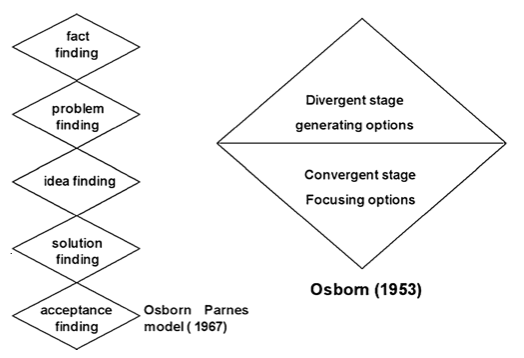
As Buijs writes, further analysis of the Osborn Parnes model brought up questions such as: is CPS truly a linear model? Does the model focus on American culture and isn’t representative of CPS in other cultures? Is the model too content oriented?
A subsequent model was created in 1993 by Isaksen and Dorval. This model moved away from the linear logic to more circular logic that leaves room for steps to be revisited.
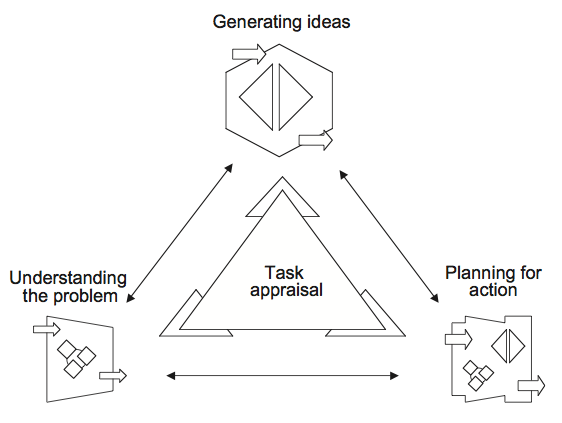
In Isakesen’s 2004 iteration of his CPS model the steps remained interdependent but the steps do not have to occur in a specific order. Isakesen also included subprocesses for each of the original steps.
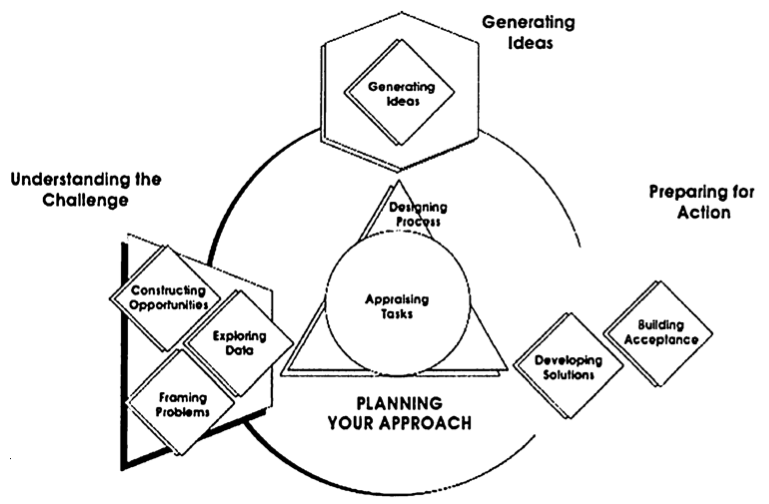
Based on their research, Buijs and team believes the Parnes Osborn CPS model does not offer a complete framework for effective problem solving. In their article, the team introduces a new Creative Problem Solving model. This model is a four-element approach described as “three parallel sub-processes: Content finding, Acceptance finding and Information finding, plus one overarching fourth process: Project management.”
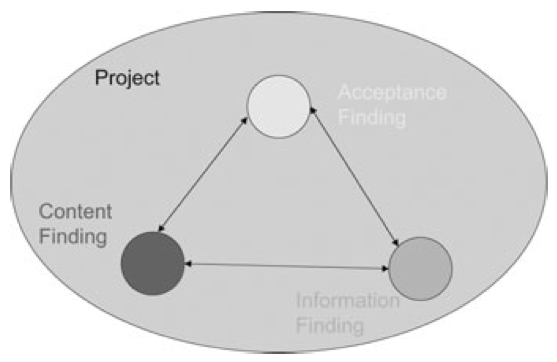
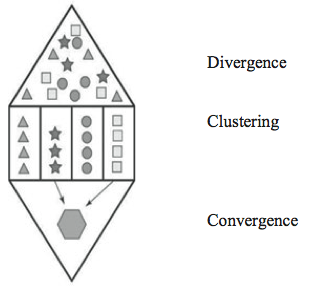
As Buijs explains, “the three parallel processes of Content finding, Acceptance finding and Information finding not only influence each other, they are also mutually dependent.” Together the results of the processes are under the umbrella of the Project Management process which acts “as an overall task appraisal for the total CPS and innovation project, as well as managing all activities in this project.” Each of the three sub-processes “start with their own specific task appraisal, followed by the divergence, clustering and convergence steps and end with a reflection on what has been achieved.” The images below illustrate the flow that occurs in each of the three processes.
 |
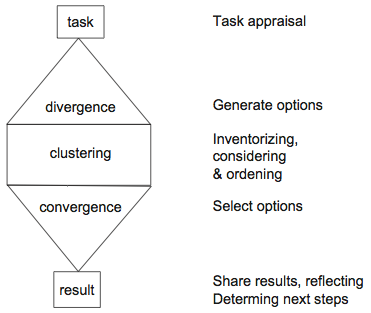 |
| The Diverging – Clustering – Converging Module |
Buijs claims this model will make CPS more realistic because “in executing one (sub)- process the need for starting one of the other processes is embedded,” they are completely interdependent, not linear.
While it seems odd to create a process for promoting creativity and innovation (something that seems spontaneous and unwilling to conform to processes), this model supports the identification of an innovative solution but also encourages the implementation of the project so the great solutions found during the process are actually implemented.
I believe this is a framework that I can use to start solving my business problems. A project management tool with methods for creative problem solving. In the next week I will use this framework for CPS and see if it meets my everyday needs for finding creative solutions.
———-
Problem Solving In Practice Update: Last week I stated that when an issue was presented to me, I would take the time to understand the issue prior to developing solutions. The beginning of the week was rocky. Twice I thought too quickly and misunderstood questions asked of me. Both times the team members restated themselves and corrected the assumptions I had made by responding without fully listening to their scenarios.
Later in the week, a complicated client request was made of me, a delicate issue regarding one of the people I manage. I was careful to take time to fully understand the situation. I called the client, asked them contextual questions to know the extent of the issue and asked for their preferred solution. After the call, I took time to think of a couple solutions, discussed them with a fellow manager and decided on a solution. I felt more prepared and satisfied with the solution when I shared the response to the client because I had taken the time to fully scope the situation prior to thinking of solutions to their request. Progress!
Sources:
Buijs, J. (2007) Innovation Leaders should be Controlled Schizophrenics. Creativity and Innovation Management, 16, 203–10.
Buijs, J., Frido Smulders, and Han van der Meer (2009) Towards a More Realistic Creative Problem Solving Approach. Creativity and Innovation Management, 18, 286–98.
Isaksen, S.G. and Dorval, K.B. (1993) Expanding Views of CPS: A Synergy Methodology. In Geschka, H., Moger, S. and Rickards, T. (eds.), Creativity and Innovation, The Power of Synergy, Darmstadt, Proceedings of the 4th European Conference on Creativity and Innovation.
Isaksen, S.G. and Treffinger, D.J. (2004) Celebrating 50 years of Reflective Practice: Versions of Creative Problem Solving. Journal of Creative Behavior, 38, 75–101.
Parnes, S.J. (1967) Creative Behavior Guidebook.
Scribner, New York.